The labour market has fared better in Canada than in many other rich countries, it has fared better than it has in past recessions, but it has not fared as well as it could.
This is the major message from a recently released report by the Parliamentary Budget Office, which offers a valuable description of the Canadian jobs market because it puts developments in context: comparing them to underlying trends, comparing them to previous recessions, and comparing them to developments in other countries.
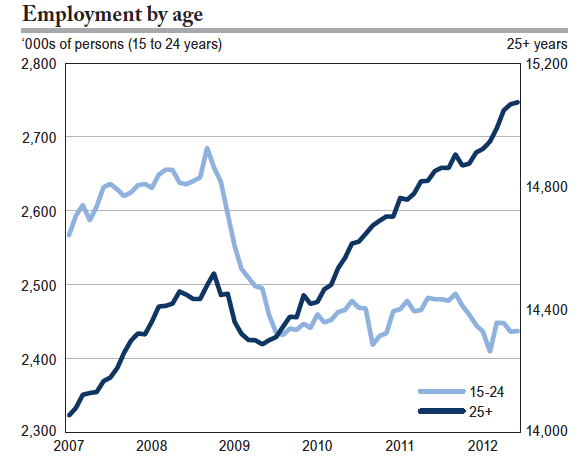
There has been virtually no growth in employment among young Canadians over the course of the last three years. Employment plummeted in late 2008 for those younger than 25, and has gone nowhere but sideways since . This is in sharp contrast for older groups: their employment levels recapturing all the recessionary losses by 2010.
Read the employment levels for 15 to 24 year olds in thousands off of the left scale, and that for those 25 and older off of the right scale. Between September 2008 and August 2009 employment among the young fell by a quarter of a million, and has been virtually stagnant since.
Inequality has increased in the majority of rich countries, but the share of income and earnings going to the top has increased most in the anglophone countries. McMaster University economist Mike Veall says Canada has not escaped this trend, and argues that a public policy response is needed.
The underlying causes of, in his words, “the surge” in the shares of the top 1%, one-tenth of 1% and even the top one-hundredth of 1% in Canada remain elusive. Even so these changes should motivate at least three policy responses that could be supported across the political spectrum.
Professor Veall was the 2012 president of the Canadian Economics Association, the professional association of economists based in Canada, and presented his presidential address at the annual meetings of the Association held last June at the University of Calgary.


 Economics for public policy