Young children whose families immigrate to Australia, Canada, the United Kingdom and the United States are as prepared and capable of starting school as their native-born counterparts, with one exception: vocabulary and language development.
But the resulting disadvantages in reading skills are overcome to a much greater degree as they progress through school in Australia and Canada than they are in the United Kingdom and the United States.
If there is a thread running through the books I read this summer I suppose it is inequality: its causes and consequences; the real life and not so real life—but no less true—experiences of living these causes and experiencing the consequences; and what can—or for that matter can’t—be done about it.
The original ad in the Princeton University newspaper announcing the publication of F. Scott Fitzgerald’s novel. Fitzgerald had been a student at the university. Source: The Daily Princetonian, April 18 1925 .
Inequality in earnings and incomes has been a very hot topic in labour economics for the last two decades, but the relevance of this research and its use in public policy discussion has now become strikingly clear.
My last academic year was dominated by the rise of inequality on the public and public policy radar screen, and I have been so tied up in these discussions that I was carried, as if on a train leaving the station, right along throughout the entire summer.
I re-read a speech President Obama made on the topic. Last December he spoke about a type of inequality that “hurts us all”, and made a link between equality of outcomes and equality of opportunities.
The Obama administration has offered a temporary reprieve from deportation for up to 1 and 3/4 million immigrants who came to the United States as children.
Whatever the immediate merits of the Deferred Action for Childhood Arrivals, it signals a much broader principle all immigrant receiving countries should recognize: children experience migration differently than adults, and public policy can create both great opportunity and great risks for their long-run capacity to become independent and successful adults.
The Survey of Labour and Income Dynamics died this morning.
The notice was given quietly by Statistics Canada: “This is the last release of longitudinal data from the Survey of Labour and Income Dynamics. Effective with next year’s release of 2011 data, only cross-sectional estimates will be available.”
A short, simple, and slightly obtuse, statement of a profound change for the user community and Canadians in general.
When I recently described the loss of a similar survey to a co-author over the telephone, she paused and said with sadness, “Ahhh…,” as if a friend had died.
There is no doubt that Statistics Canada also recognizes the value of this survey, and others like it. But there are important challenges in managing the information derived from so-called “longitudinal surveys”, and Canadians might be wondering whether or not they are being sold short.
Inequality has been increasing in most countries, in part because top 1% are capturing a higher fraction of all earnings but also for other reasons. I made a presentation to the Occupied Ottawa conference “Take Back Democracy!” on June 2nd, 2012. The presentation explores three issues in search of intelligent conversation, and in order to accomplish something constructive: description, explanation, and prescription.
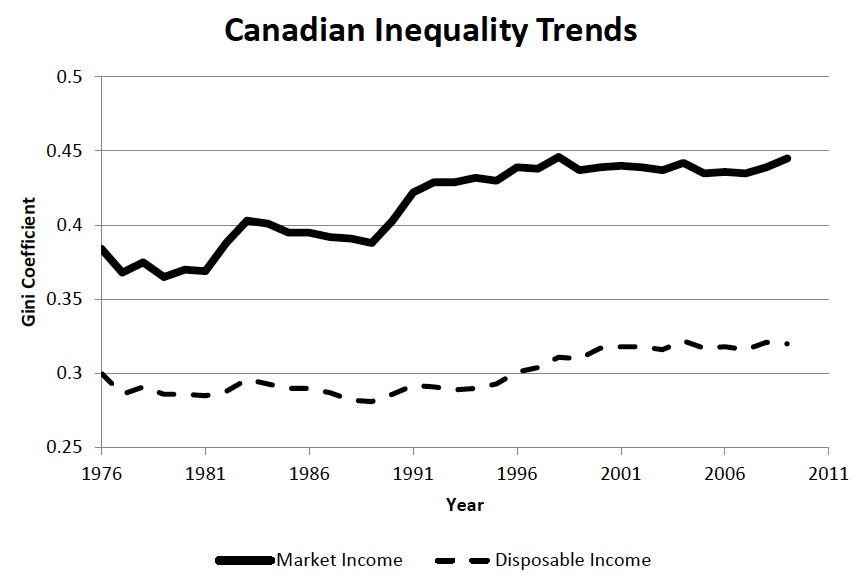
While inequality in Canada has increased over the course of the last three decades, the tax and transfer system can significantly reduce disparities in market incomes. But the political will to use the tax system may be limited, and public policy needs to address underlying labour market developments if it is to pursue an agenda of greater equality.
This is one of the major themes arising from a recently released discussion paper by a group of labour economists from the University of British Columbia: Nicole Fortin, David Green, Thomas Lemieux, Kevin Milligan, and Craig Riddell.





 Economics for public policy