“After Piketty”, 12 policy proposes to reduce inequality of outcomes

“The media storm surrounding the publication of Thomas Piketty’s remarkable Capital in the Twenty-First Century (2014) has ensured that inequality is now in the forefront of public debate. But what next?”
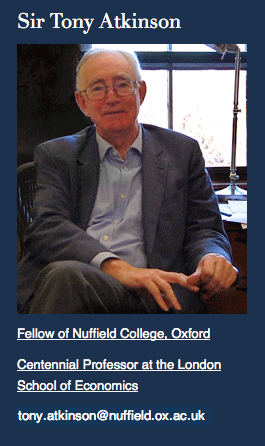
Sir Tony Atkinson

Thus begins an essay in The British Journal of Sociology by the dean of inequality studies, A. B. Atkinson of Oxford University. This is a must read for anyone interested in public policy addressed to the growing inequality in the rich countries.

Professor Atkinson’s focus is on the United Kingdom, but his far-reaching set of policy prescriptions address many aspects of public policy (not just tax and transfer policy), and have relevance well beyond the European context.

Tony Atkinson is an economist of the highest order who has been studying and contributing to the economics of inequality since the 1960s. In this paper he offers 12 proposals that, he says, “could bring about a genuine shift in the distribution of income towards less inequality.”

Continue reading ““After Piketty”, 12 policy proposes to reduce inequality of outcomes”

“Inequality, Life Chances, and Public Policy,” watch the presentation I made at Millersville university

I was very pleased to speak at the 2014 International Policy Conference on the theme “Inequality: Defining our Time?” held at Millersville University on November 6th and 7th, 2014. I spoke on the very kind invitation of Professor Ken Smith and the Department of Economics at Millersville University.

My talk was called “Inequality, Life Chances, and Public Policy: How to Slide Down the Great Gatsby Curve,” and you can watch it here if you have an interest.

These are the associated slides: Inequality Life Chances and Public Policy how to Slide Down the Great Gatsby Curve for Millersville University International Policy Conference

The source for this presentation is an article I published in the Journal of Economic Perspectives called “Income Inequality, Equality of Opportunity, and Intergenerational Mobility

The discussant, who begins speaking at about 47 minutes into the talk, is Professor Antonio Callari of Franklin and Marshall College. He offered some interesting remarks about how the theme of the talk relates to developments in Lancaster PA, where the conference was held.

[ One silly grammatical error that I wish I could take back occurs when I say “the more statistically significant among you,” when my intention was “the more statistically savvy among you.” ]

“Inequality and its discontents”: Introduction

[On September 22nd I had the honour of giving the 2014 Mabel Timlin Lecture—“Inequality and its Discontents”—at the University of Saskatchewan. This post is the introduction, and the full lecture will be published in the near future.]

Continue reading ““Inequality and its discontents”: Introduction”

Your summer reading list on inequality and opportunity

Before you finish packing for your vacation to the cottage, the beach, the backyard or the balcony, I thought you would appreciate some suggestions for your summer reading. (If you live in Australia, New Zealand, India, or anywhere else south of the equator, I hope you will read for the sheer pleasure, at work if you must!)

The first book on your holiday reading list is, without doubt, …


Continue reading “Your summer reading list on inequality and opportunity”

Joseph Fishkin’s book, “Bottlenecks,” explains why inequality lowers social mobility

Bottlenecks

[ The Brookings Institution has been having an online discussion of Bottlenecks: A New Theory of Equal Opportunity, a book by Joseph Fishkin. This post is a re-blog of my contribution, “Money: a Bottleneck with Bite.” ]

Continue reading “Joseph Fishkin’s book, “Bottlenecks,” explains why inequality lowers social mobility”

The two (irreconcilable?) states of the Union

sotu_slide_audience

When President Obama approaches the podium to deliver his State of the Union address he will have two past presidents looking over his shoulders.

Lyndon B. Johnson who in 1964 declared a “War on Poverty”, and Ronald Reagan who in 1986 surrendered victory with the claim that “… poverty won the war. Poverty won in part because instead of helping the poor, government programs ruptured the bonds holding poor families together.”

President Obama will surely celebrate Johnson for initiating the War on Poverty fifty years ago this month, but to advance his agenda he will also stress that government programs are a force for the good.

Continue reading “The two (irreconcilable?) states of the Union”