An American idea about the Canadian middle class

The suggestion that the middle class is stagnating, the linchpin of Justin Trudeau’s economic platform—to the extent it exists—is an idea shamelessly borrowed from the United States.

Shameless it may be, but it is, nonetheless, true.

Clearly there are some ways in which we are all better off not withstanding what President Obama tells the American public, and notwithstanding how closely Canadian political leaders listen to him.

In 1980, a cell phone was something carried in a brief case; and a Sony Walkman—you surely recall the portable cassette player the size of a thick paperback that strapped “conveniently” to your belt?—was the cutting edge musical accessory.

But shops filled with more variety, and more quality, make us and our kids better off only to a degree, and not only because the power to blow your ear drums out has increased exponentially.

In 1980 middle-income Canadian families reported a total of $57,000 on their tax returns, and 30 years later, … well exactly $57,000.

Continue reading “An American idea about the Canadian middle class”

Why should we care about inequality? Tim Harford nails it in this Financial Times column

Tim Harford nails it in an article called “How the wealthy keep themselves on top.

I set out two reasons why we might care about inequality: an unfair process or a harmful outcome. But what really should concern us is that the two reasons are not actually distinct after all. The harmful outcome and the unfair process feed each other. The more unequal a society becomes, the greater the incentive for the rich to pull up the ladder behind them.

The noted Financial Times columnist, and author of The Undercover Economist, does a great service to readers by pulling a major theme from the series of articles on inequality and the top 1% published in the summer 2013 issue of the Journal of Economic Perspectives.

First, he states that while the “idea that the fat cats simply stole everyone else’s cream is emotionally powerful; it is not entirely convincing.” Then he goes on to note that:

In a well-functioning market, people only earn high incomes if they create enough economic value to justify those incomes. But even if we could be convinced that this was true, we do not have to let the matter drop.

This is partly because the sums involved are immense.

We should care about inequality because of the outcomes. But also because outcomes influence process.

At the very top of the scale, plutocrats can shape the conversation by buying up newspapers and television channels or funding political campaigns. The merely prosperous scramble desperately to get their children into the right neighbourhood, nursery, school, university and internship – we know how big the gap has grown between winners and also-rans.

This is what sticks in the throat about the rise in inequality: the knowledge that the more unequal our societies become, the more we all become prisoners of that inequality. The well-off feel that they must strain to prevent their children from slipping down the income ladder. The poor see the best schools, colleges, even art clubs and ballet classes, disappearing behind a wall of fees or unaffordable housing.

This is exactly what I hoped would be the main message of my article “Income Inequality, Equality of Opportunity, and Intergenerational Mobility” in the Journal of Economic Perspectives symposium, and it is very satisfying to witness a talented journalist articulate these and related ideas with such clarity and precision!

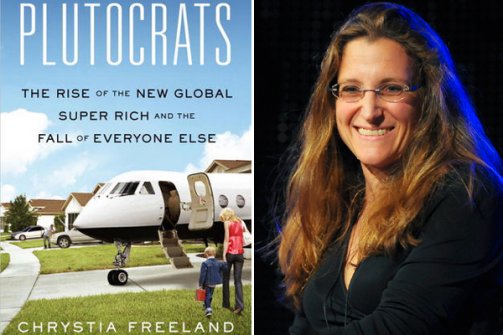
The simple economics of the declining middle class — and the not so simple politics

ChristieFreelandPlutocrats

The middle class is declining, or is it?

The question has taken on increased resonance in Canada since two respected and informed journalists—Chrystia Freeland and Linda McQuaig—have decided to enter politics.

Ms. Freeland is the author of Plutocrats: The Rise of the New Global Super Rich and the Fall of Everyone Else, and Ms. McQuaig a co-author of The Trouble with Billionaires.

Income inequality is what they know, and presumably what they feel should be a matter of public policy.

If the middle class is not shrinking then the policy program these individuals have to offer, and by reflection some of the policies of the political parties they hope to represent—the traditionally centrist Liberal Party in Ms. Freeland’s case, and the social democratic New Democratic Party in the case of Ms. McQuaig—are brought into question.

linda_mcquaig.jpg.size.xxlarge.letterbox

And that is what a number of observers have already done, arguing that the facts show the Canadian middle class is not under threat, and that those who argue otherwise—like Ms. Freeland and Ms. McQuaig—are spending too much time looking at American trends.

So this is an economic fact with some political impact.

My look at the numbers focuses on both incomes (the total amount of money a family brings home) and on wage rates (the hourly rate of an individual’s pay).

The trend in incomes is disturbing, but all the more so when viewed in light of a polarizing pattern in wage rates. These trends should be a real concern for public policy, and in my view a focus on other countries, particularly the United States, is one important way to constructively inform that concern.

Continue reading “The simple economics of the declining middle class — and the not so simple politics”

Who’s Your Daddy? Some feedback from the top 1% on my New York Times article

Among the readers of an opinion piece I wrote in the New York Times on July 21st, Who’s Your Daddy? Job Opportunities for the children of the top 1 percent,  are two top 1 percenters who kindly took the time to email me their thoughts.

One of the goofiest most nonsensical things I have ever seen filled with
contradictions as you twist opposite conclusions to fit your thesis of
inequality. Just bizarre.

Sent from my iPad

My article was based on a soon to be published paper, Income Inequality, Equality of Opportunity, and Intergenerational Mobility , so I would hope that it has some logic to it.

The following comments are from another top 1 percenter who offers a more nuanced view on my logic, such as it is. Continue reading “Who’s Your Daddy? Some feedback from the top 1% on my New York Times article”

Income Inequality, Equality of Opportunity, and Intergenerational Mobility

The summer issue of the Journal of Economic Perspectives will feature a collection of articles on inequality and the top 1%, some of which are now being circulated by the authors.

The paper by Tony Atkinson and his coauthors, “The top 1 percent in international and historical perspective,” is available in this post, and “The Pay of Corporate Executives and Financial Professionals as Evidence of Rents in Top 1 Percent Incomes,” by Josh Bivens and Lawerence Mishel, is available on the Economic Policy Institute website.

Greg Mankiw has also posted a copy of his paper, “Defending the One Percent“, on his blog.

My contribution to the collection is based on the notion that the inequality literature has paid little attention to the intergenerational consequences of increasing top income shares, and it can be read as a counterpoint to Mankiw’s piece, or at least to his claim that inequality of opportunity is not a reason to worry about the top 1%.

Here is the final draft: Income Inequality, Equality of Opportunity, and Intergenerational Mobility. But if you just want a quick read, an excerpt from the conclusion follows. Either way, feedback is—as always—welcomed.

[NOTE added December 10, 2013: the published version of this paper is available from the American Economics Association website for the Summer 2013 issue of the Journal of Economic Perspectives, as is the table of contents for the entire issue.]

Continue reading “Income Inequality, Equality of Opportunity, and Intergenerational Mobility”

Inequality and Opportunity: a presentation to the Ottawa Economics Association

Here is the presentation called “Inequality and Opportunity” that I am pleased to make to a luncheon meeting of the Ottawa Economics Association. The paper upon which it is based is called “How to Slide Down the Great Gatsby Curve.”