Here is the source for the “Great Gatsby Curve” in the Alan Krueger speech at the Center for American Progress on January 12

In the speech he gave at the Center for American Progress on January 12th, Alan Krueger, the Chairman of the Council of Economic Advisors, presented the “Great Gatsby” curve: the relationship between inequality and generational earnings mobility, citing in part a 2011 paper of mine.

Here is the draft of the paper from which some of the data he used were drawn, in particular see Figures 1 and 2:

Inequality from generation to generation the United States in comparison

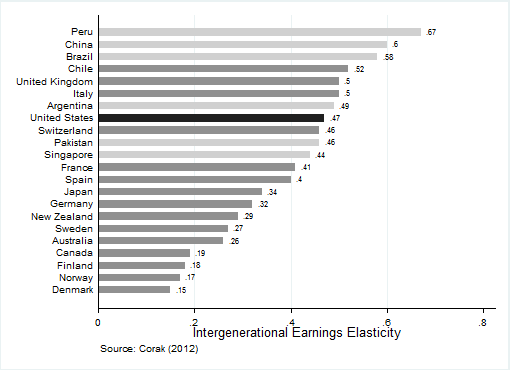
Here is Figure 2, my version of the Great Gatsby Curve for a wider set of countries:

The discussion I offered in an earlier post also uses this information and relates to this theme: Inequality and Occupy Wall Street 5: decline of the American Dream

Here is the text of Krueger’s speech Alan Krueger, The Rise and Consequences of Inequality, Text, and here are the associated slides Alan Krueger, The Rise and Consequences of Inequality, Slides .

[Update: this post was updated on January 27, 2012 with a new version of the text “Inequality from Generation to Generation…” and the associated figure. This text can be cited as:

Miles Corak (2013), “Inequality from Generation to Generation:  The United States in Comparison,” in Robert Rycroft (editor), The Economics of Inequality, Poverty, and Discrimination in the 21st Century, ABC-CLIO.

A complete list of references used to develop the estimates of the Intergenerational Earnings Elasticity is available here: References for intergenerational earnings elasticities. The following is a graph showing the exact values of the estimates.

Update, July 12, 2016: the published version of “Inequality from Generation to Generation …” is available as IZA Discussion Paper No. 9929. ]

Who is Alan Krueger? And why is he speaking for the White House on Inequality?

Alan Krueger is a labour economist who teaches at Princeton University.

On August 29th President Obama appointed him the Chairman of the Council of Economic Advisors, and his appointment was confirmed in November.

In this role he will be giving what is only his second speech on Thursday January 12th at the Center for American Progress in Washington on “The Rise and Consequences of Inequality.”

Continue reading “Who is Alan Krueger? And why is he speaking for the White House on Inequality?”

Is the U.S. Still a ‘Land of Opportunity’?

The New York Times posed this question to a group of experts, Richard Florida, Isabel Sawhill, Timothy Smeeding, and five others, including me.

More specifically, they asked:

There is a growing consensus that it is harder to move up the economic ladder in the United States than in many other places, like Canada. Should more Americans consider leaving the U.S. to get ahead? Or can the U.S. make changes to be more of a “land of opportunity”?

Continue reading “Is the U.S. Still a ‘Land of Opportunity’?”

Facts about the labour market, the hidden and the missing

This morning Statistics Canada released–as it does on the first Friday of every month–estimates of employment and unemployment for the previous month.

As usual the headline number is the change in the number of employed, and the Agency’s press release announces that “Following two months of declines, employment rose slightly in December, up 18,000.

But this masks as much as it reveals.

Continue reading “Facts about the labour market, the hidden and the missing”

Inequality and CEO compensation are more important than the CBC suggests

The Canadian Broadcasting Corporation’s senior correspondent Terry Milewski does a disservice in conveying the facts about inequality in his coverage of the now infamous report released earlier this week by the Canadian Centre for Policy Alternatives.

The report graphically documents the income gap between top earners and the rest of the population, the so-called average Joe, by pointing out that by noon on January 3rd—the first working day of the year—the top 100 CEOs in the country made as much as the average Canadian will during the entire year.

Continue reading “Inequality and CEO compensation are more important than the CBC suggests”

Three questions to ask the Minister of Finance

“Jobs and Growth the Priorities as Minister Flaherty Hosts Pre-Budget Consultations”, screams the title of a press release from the Department of Finance issued about a month ago.

Jim Flaherty wants to hear from Canadians about how he can maintain the federal government’s “focus on jobs and economic growth while reducing the deficit.”

But this week is a particularly good time to first pose a few questions to him in the hope of clarifying some facts about jobs, unemployment, and the role of government policy.

Continue reading “Three questions to ask the Minister of Finance”