Higher inequality leads children to drop out of high school

I am in Washington DC at the Brookings Institution participating in a conference based on the papers that will appear in the next issue of the Brookings Papers on Economic Activity, and specifically to discuss a paper called “Income Inequality, Social Mobility, and the Decision to Drop Out of High School.”

The authors, Melissa Kearney and Phillip Levine, say in the abstract of their paper:

we posit that greater levels of income inequality could lead low-income youth to perceive a lower return to investment in their own human capital. Such an effect would offset any potential “aspirational” effect coming from higher educational wage premiums. The data are consistent with this prediction: low-income youth are more likely to drop out of school if they live in a place with a greater gap between the bottom and middle of the income distribution. This finding is robust to a number of specification checks and tests for confounding factors. This analysis offers an explanation for how income inequality might lead to a perpetuation of economic disadvantage and has implications for the types of interventions and programs that would effectively promote upward mobility among low-SES youth.

You can learn more and download the paper from the Brookings Papers on Economic Activity web site for the 2016 Spring conference.

The slides for my discussion of the paper are here.
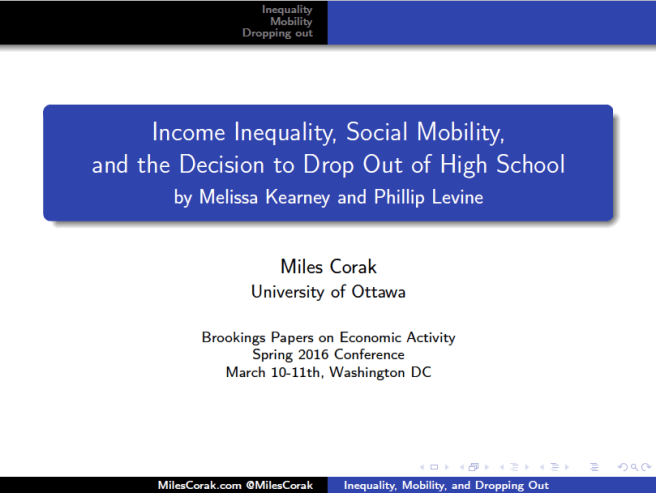
Corak Comments on Kearney and Levine income Inequality Social Mobility and the Decision to Drop Out of High School

My comments revolve around three questions raised by this nicely crafted paper:

  1. Inequality of what?
    • the authors focus our attention on the degree of inequality in the lower half of the income distribution
    • but they also use a measure of inequality based upon all sources of income, including benefits from government transfers
    • so policy makers might wonder about the scope and design for government transfers to lower inequality in the lower half, and in particular of expanding the EITC to include men
  2. Social Mobility for whom?
    • state-level inequality raises the chances that boys from low status backgrounds will drop out of high school, there is no statistically significant influence for girls
    • but these patterns also depend upon the abilities that these boys have when they start high school
    • I show that these abilities are actually correlated with the abilities children have when they were kindergarten age, so we might also wonder about whether policy should be directed to individuals and high schools, or to families and young children
  3. Whither Dropping Out?
    • the trend in dropping out of high school has actually been on the decline since about 2000, yet inequality has not changed that much during this period
    • but this paper helps us to think more constructively about trends, it may be that the degree of disenchantment about future prospects have changed
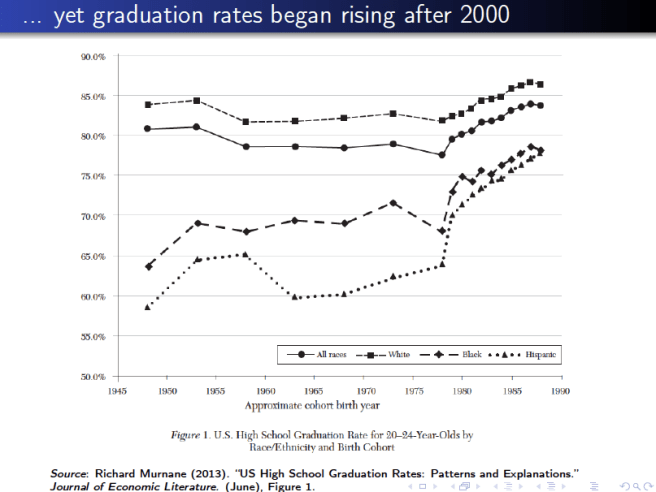

Figure 1 Richard Murnane US High School Graduation Rates Journal of Economic Literature

Inequality: a fact, an interpretation, and a policy recommendation

Tackling inequality and poverty aren’t mutually exclusive; rather, efforts devoted to fighting the former contribute to solving the latter.

Continue reading “Inequality: a fact, an interpretation, and a policy recommendation”

Baffled by the middle class debate? Here’s some background about Canadian Middle Class prosperity beating out the US

If you are interested in more details about the commentary I wrote for today’s Toronto Star, “The Inequality Debate: Canada’s middle class is losing ground,” you can find the original version in this post. You might also have an interest in this post, imaginatively entitled: “Who are the middle class?

A number of journalists have recently addressed the topic, nicely offering a broader perspective. Whether you like to listen, watch, or read, you have some good choices.

Listen to this Ira Basen documentary called “What We Talk About When We Talk About The Middle Class,” which was broadcast on CBC Radio’s program “The Sunday Edition”; watch this documentary by Holly Doan for CPAC, which also features the much-cited New York Times article (look down the right column of the page to find it as “Vote 2015 Special: The Middle Class”); or read this Globe and Mail article, “The Middle Class: Just Who are They, Anyways?” by Erin Anderssen.

I hope all this helps to inform you about the talking point that, by waving around a New York Times article, leads our policy makers to dismiss the very fundamental and long-standng changes in the nature of work and incomes that are generating more insecurity for many Canadians, particularly young Canadians.

The main messages of “Too Many Children Left Behind,” a book published by the Russell Sage Foundation

Here are the slides for the presentation “Too many children left behind: The U.S. Achievement Gap in Comparative Perspective”, which I gave to the conference “Causes and Consequences of Inequality and Social Mobility: What Can Be Done?”

Click to access corak_too_many_children_left_behind_sapienza_rome_2015.pdf

The conference was held at the Faculty of Economics, Sapienza University of Rome on September 25th and 26th, 2015, and you can see the full program here: http://www.eticaeconomia.it/ee/wp-content/uploads/2015/09/Evento-n28_pdf.pdf

Who are the middle class?

slice of pieOne economist recently suggested that there are as many as 156 definitions of the middle class. If this statistical potluck isn’t complicated enough, pollsters also tell us that a very large fraction of the population describe themselves as “middle class.”

You can see why politicians have made the “middle class” an election issue, but also why they might hesitate to answer the question: “Who are the middle class?”

It isn’t a contradiction for many people to feel they are in the “middle” even if their incomes are well above average or well below. There’s a certain truth to this because most Canadians share a set of common concerns that go beyond just their incomes.

You are “middle class” if you aspire to a better tomorrow, and have a hope for growth and progress in your circumstances; you are “middle class” if you are struggling with uncertainty, and worried if you and your family will be able to weather the storms that tomorrow will surely bring; and you are “middle class” if you have an expectation that your children should be treated fairly once you have done all you can to help them.

But while many people share these three concerns, their circumstances and capacities to manage them differ, something that is the result of growing inequality in access to secure and well-paying jobs.

Ninety percent of the population may belong to the “middle class”, but that doesn’t mean there is a one-size-fits-all-policy.

One way to get our heads around this is to let the answer to “Who are the middle class?” fall out of an answer to another question: “How is the economic pie divided?”

Continue reading “Who are the middle class?”

An inclusive society seeks to eliminate child poverty

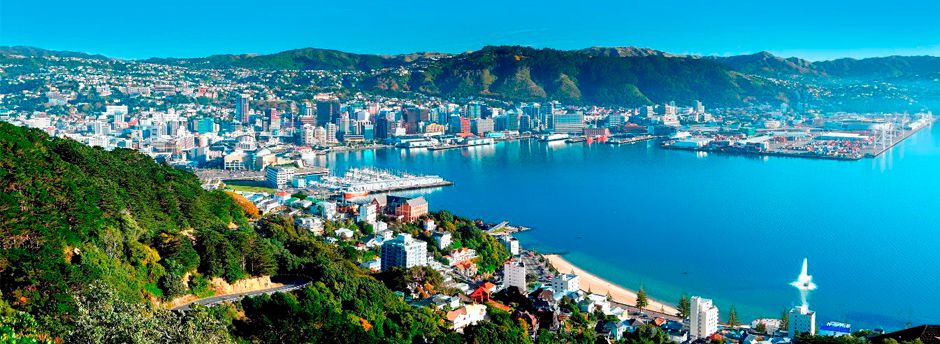
Wellington New Zealand

My meeting with senior Treasury officials began with the nonchalantly stated advice “In the event of an earthquake we like to get under the tables and hold on to the legs so that they don’t get away from us.”

As a Canadian, albeit one who has visited New Zealand three times in the past decade, I naively took this as a metaphor for the earth-shattering ideas the public service expects from its consultations with outside experts.

I assure you that the dozen or more participants gathered to discuss how the government might contribute to building “a more inclusive New Zealand” offered advice that was far from ground breaking.

How possibly could they?

Continue reading “An inclusive society seeks to eliminate child poverty”