On a hot evening in July I flew back home to Ottawa from Washington DC after having testified before The United States Senate Committee on Finance. But that was not the end of it. A few days later an email arrived with a list of questions. The Senators gave me homework!
If there is a thread running through the books I read this summer I suppose it is inequality: its causes and consequences; the real life and not so real life—but no less true—experiences of living these causes and experiencing the consequences; and what can—or for that matter can’t—be done about it.
The original ad in the Princeton University newspaper announcing the publication of F. Scott Fitzgerald’s novel. Fitzgerald had been a student at the university. Source: The Daily Princetonian, April 18 1925 .
Inequality in earnings and incomes has been a very hot topic in labour economics for the last two decades, but the relevance of this research and its use in public policy discussion has now become strikingly clear.
My last academic year was dominated by the rise of inequality on the public and public policy radar screen, and I have been so tied up in these discussions that I was carried, as if on a train leaving the station, right along throughout the entire summer.
I re-read a speech President Obama made on the topic. Last December he spoke about a type of inequality that “hurts us all”, and made a link between equality of outcomes and equality of opportunities.
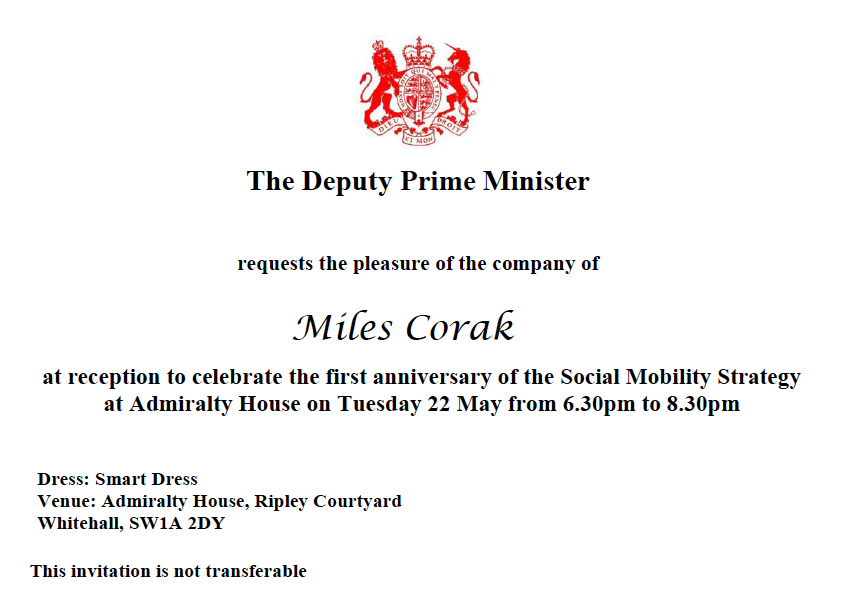
In a speech given this morning to announce an update on the government’s Strategy for Social Mobility, Nick Clegg, the Deputy Prime Minster of the United Kingdom, said that “We need an open society where people choose their place”; he said that “The effect of social class and class attitudes on Social Mobility are the ghost in the machine.”; and, in summary, he said that “We are a long distance from being a classless society”.
Yet in the same breath, he also said that it is a myth to suggest that reducing inequality will promote social mobility.
This is surely an inappropriate representation of the role of inequality in determining opportunity.
[These are the opening remarks I made to the Senate Standing Committee on Social Affairs, Science and Technology of the Parliament of Canada. I appeared as a witness at the May 2nd meeting of the Committee dealing with Social inclusion and cohesion in Canada to address the topic of inequality. These remarks do not substitute for the official transcripts that will be produced by the Standing Committee.]
A quick post to thank Scott Winship for his response to my feedback on his original article. His comments are now on the National Review web site.
But I am afraid they do not advance the discussion. I addressed all of the technical issues in my original paper (see the appendix). The internationally comparable estimates I offered account for these concerns.
But let me repeat the picture of the Great Gatsby Curve using the most recent information on the largest available set of countries.
In an article on the Brookings Institution website that was originally posted by the National Review, Scott Winship questions the idea that greater inequality at a point in time is associated with less generational mobility over time — what the Chairman of the Council of Economic Advisors, Alan Krueger, called the “Great Gatsby Curve” in a speech given on January 12th.
Winship’s article does a disservice to a well-established literature on generational mobility by suggesting that the basic information Krueger used is in some sense invalid. Krueger’s Great Gatsby Curve is in fact well-rooted in the labour economics literature, and debate would be better placed addressing the policy implications he draws than to suggest that President Obama’s top economist feels compelled to create his own facts.
So in the spirit of moving evidence-based public policy forward here is a quick review of the underpinning of the Great Gatsby Curve in both theory and practice.



 Economics for public policy