Long live the mandatory census! or maybe not?

[This post is based on my comments at “Celebrating the Census,”  a panel discussion organized by the McGill University Centre on Population Dynamics held in Montreal on April 29th, 2016. Other members of the panel were Jean-Yves Duclos, Sebastien Breau, Ian Culbert, Ariane Krol, Mary Jo Hoeksema, and the moderator Celine LeBourdais.]

The Census is built block-face by block-face. It is built sub-division by sub-division. Village, township, city, municipality, it is built until the entire country is perfectly and completely tiled.

The Census is a machine, complicated and intricate. And the public servants working at Statistics Canada should be rightly proud of the hard work and dedication devoted to the development, maintenance, and management of this machine. Even the most jaundiced among us, regardless of political persuasion, should recognize and acknowledge this accomplishment.
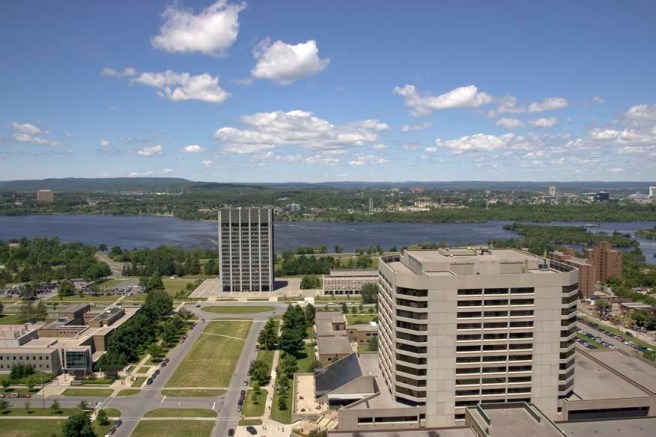
RH Coast looking north over Jean Talon S0001
The Jean Talon building, in the bottom right, was originally called the “Census Building.” Photograph by Philip Smith.

The value of this machine is that it lets us see ourselves in detail more precise than any other mirror, and the return of a mandatory long form, in which Canadians are required to offer up a description of some of the most private aspects of their lives, is hailed by many as a major turn in public policy that will allow this picture to stay clearly focused.

But the Census is more than a machine. Jean Talon knew that. The very first Census he conducted, beginning in the later part of 1666, was clearly an act of nation building. He used it to help him, and France, develop and build a viable colony extending from the shores of the Saint Lawrence River, transforming the countryside into a prosperous agricultural region that would prepare the way for waves and waves of more immigrants. The Census is an act of political imagination.

And the public servants who work at Statistics Canada are not well placed to exercise that imagination, even if at times what they do in managing the machine casts them in that role.

There is still much to be done for Canadians to accept and appreciate the benefits of the Census, and for the federal government to give them ownership of the results. The Census is mandatory—by law it must be filled out—but we should strive to think of it as voluntary, our participation to be both exercised and celebrated as an act of citizenship in a way that fosters each Canadian’s political imagination.

Continue reading “Long live the mandatory census! or maybe not?”
Higher inequality leads children to drop out of high school

I am in Washington DC at the Brookings Institution participating in a conference based on the papers that will appear in the next issue of the Brookings Papers on Economic Activity, and specifically to discuss a paper called “Income Inequality, Social Mobility, and the Decision to Drop Out of High School.”

The authors, Melissa Kearney and Phillip Levine, say in the abstract of their paper:

we posit that greater levels of income inequality could lead low-income youth to perceive a lower return to investment in their own human capital. Such an effect would offset any potential “aspirational” effect coming from higher educational wage premiums. The data are consistent with this prediction: low-income youth are more likely to drop out of school if they live in a place with a greater gap between the bottom and middle of the income distribution. This finding is robust to a number of specification checks and tests for confounding factors. This analysis offers an explanation for how income inequality might lead to a perpetuation of economic disadvantage and has implications for the types of interventions and programs that would effectively promote upward mobility among low-SES youth.

You can learn more and download the paper from the Brookings Papers on Economic Activity web site for the 2016 Spring conference.

The slides for my discussion of the paper are here.

Corak Comments on Kearney and Levine income Inequality Social Mobility and the Decision to Drop Out of High School

My comments revolve around three questions raised by this nicely crafted paper:

  1. Inequality of what?
    • the authors focus our attention on the degree of inequality in the lower half of the income distribution
    • but they also use a measure of inequality based upon all sources of income, including benefits from government transfers
    • so policy makers might wonder about the scope and design for government transfers to lower inequality in the lower half, and in particular of expanding the EITC to include men
  2. Social Mobility for whom?
    • state-level inequality raises the chances that boys from low status backgrounds will drop out of high school, there is no statistically significant influence for girls
    • but these patterns also depend upon the abilities that these boys have when they start high school
    • I show that these abilities are actually correlated with the abilities children have when they were kindergarten age, so we might also wonder about whether policy should be directed to individuals and high schools, or to families and young children
  3. Whither Dropping Out?
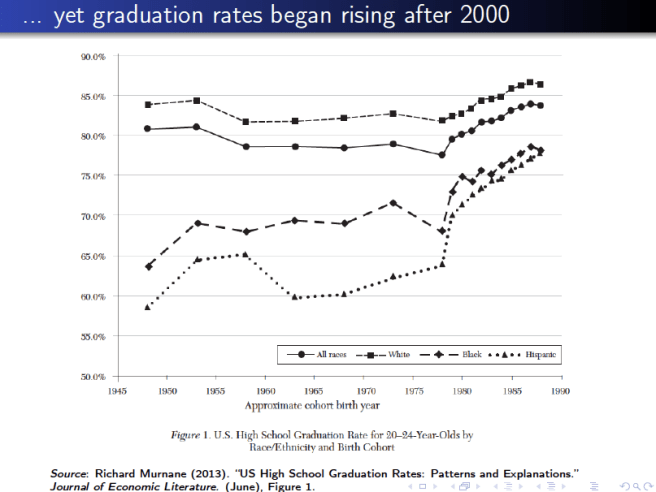
    • the trend in dropping out of high school has actually been on the decline since about 2000, yet inequality has not changed that much during this period
    • but this paper helps us to think more constructively about trends, it may be that the degree of disenchantment about future prospects have changed

Figure 1 Richard Murnane US High School Graduation Rates Journal of Economic Literature

Why Canada should foster a ‘second-chance’ society

[This is the unabridged version of an article published in the Globe and Mail on February 22nd, 2016.]

Canadians should be thumping their chests, after all many others are patting us on the back. When it comes to social mobility we are among the world leaders. Even U.S. President Obama acknowledged that a poor child is more likely to move up in life in Canada than in the United States.

This kind of mobility, the capacity for children to become all that they can be without regard to their starting point in life, is the bedrock of fairness.

For sure this distinct Canadian accomplishment of making the American Dream more of a reality north of the border was never without its imperfections, ringing rather hollow for many native communities, some immigrant groups, and certain visible minorities. Great accomplishments on average never reveal the full diversity of experience.

But just as importantly winning the social mobility sweepstakes is something for the record books, not a guarantee for the future. The foundations of fairness are shifting; luck will matter more, meritocracy will be perverted by growing inequality, and our public policies haven’t really changed to prepare for the new reality that is already pressing on young people.

Continue reading “Why Canada should foster a ‘second-chance’ society”

Inequality: a fact, an interpretation, and a policy recommendation

Tackling inequality and poverty aren’t mutually exclusive; rather, efforts devoted to fighting the former contribute to solving the latter.

Continue reading “Inequality: a fact, an interpretation, and a policy recommendation”

The OECD Centre for Opportunity & Equality will address some important questions

OECD Centre for Opportunity & Equality Launch Agenda

The OECD is continuing to expand its highly regarded work on inequality by launching a new research centre. The announcement will be formally made in Paris on Monday with a series of panel discussions, featuring economists, policy makers and government officials from a number of countries. I’m pleased to be a participant, but I’m looking for advice on how to answer to some questions that may be asked. I’d love to hear your ideas, so send them along.

Continue reading “The OECD Centre for Opportunity & Equality will address some important questions”

Baffled by the middle class debate? Here’s some background about Canadian Middle Class prosperity beating out the US

If you are interested in more details about the commentary I wrote for today’s Toronto Star, “The Inequality Debate: Canada’s middle class is losing ground,” you can find the original version in this post. You might also have an interest in this post, imaginatively entitled: “Who are the middle class?

A number of journalists have recently addressed the topic, nicely offering a broader perspective. Whether you like to listen, watch, or read, you have some good choices.

Listen to this Ira Basen documentary called “What We Talk About When We Talk About The Middle Class,” which was broadcast on CBC Radio’s program “The Sunday Edition”; watch this documentary by Holly Doan for CPAC, which also features the much-cited New York Times article (look down the right column of the page to find it as “Vote 2015 Special: The Middle Class”); or read this Globe and Mail article, “The Middle Class: Just Who are They, Anyways?” by Erin Anderssen.

I hope all this helps to inform you about the talking point that, by waving around a New York Times article, leads our policy makers to dismiss the very fundamental and long-standng changes in the nature of work and incomes that are generating more insecurity for many Canadians, particularly young Canadians.