Charles Murray, a Libertarian who worries about America coming apart along the seams of class

The major point in Charles Murray‘s book—Coming Apart: The State of White America, 1960-2010—is that the United States “is coming apart at the seams—not ethnic seams, but the seams of class.”

You can watch him summarize the major messages of his book in this February 14th interview hosted by the TVO program The Agenda.

The book has proved to be instantly provocative. Toward the end of this interview, at about 13 minutes and 50 seconds, Murray states: “I don’t do solutions very well.”

So why all the buzz?

Continue reading “Charles Murray, a Libertarian who worries about America coming apart along the seams of class”

Immigrants face challenges in finding jobs that are not of their own making

The challenges immigrants face in finding jobs have to do with not just the characteristics and skills they bring to the labour market, but also the state of our economy and the barriers put in their way. More and more tinkering with the selection rules used to admit immigrants will not on its own address these challenges.

In a post on my blog I called for lower rates of immigration during business cycle downturns, and a reader commented by saying:

I arrived in Canada in July 2011 with my family and was called for exactly one job interview a couple of weeks ago. To say I am scarred is putting it mildly. I left a very successful career with the knowledge that it will be difficult to get a similar position but I never anticipated that I would end up feeling invisible and a non-entity with absolutely nothing to offer. Since coming here I have been shelling out money for everything, university fees for my kids and so on. Other than contributing to the Canadian economy through our expenses, I feel immigrants are not considered to be of any particular value.

It struck me how odd and incomplete the public policy response by Canadian opinion makers and governments is to this kind of concern.

Continue reading “Immigrants face challenges in finding jobs that are not of their own making”

The Economics of the Great Gatsby Curve: a picture is worth a thousand words

A quick post to thank Scott Winship for his response to my feedback on his original article. His comments are now on the National Review web site.

But I am afraid they do not advance the discussion. I addressed all of the technical issues in my original paper (see the appendix). The internationally comparable estimates I offered account for these concerns.

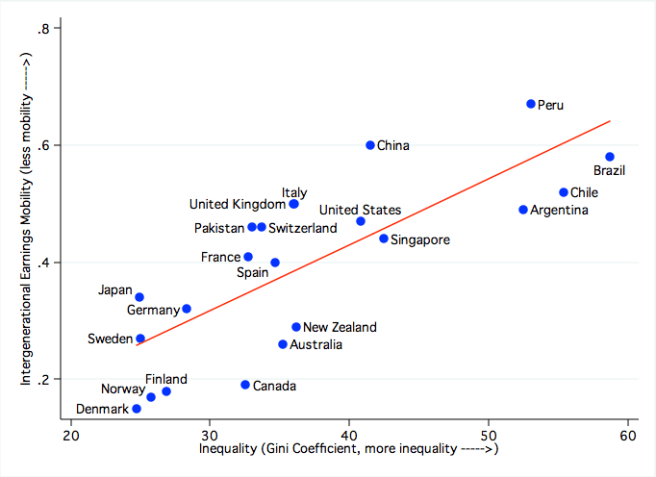
But let me repeat the picture of the Great Gatsby Curve using the most recent information on the largest available set of countries.

Continue reading “The Economics of the Great Gatsby Curve: a picture is worth a thousand words”

The Economics of the Great Gatsby Curve

In an article on the Brookings Institution website that was originally posted by the National Review, Scott Winship questions the idea that greater inequality at a point in time is associated with less generational mobility over time — what the Chairman of the Council of Economic Advisors, Alan Krueger, called the “Great Gatsby Curve” in a speech given on January 12th.

Winship’s article does a disservice to a well-established literature on generational mobility by suggesting that the basic information Krueger used is in some sense invalid. Krueger’s Great Gatsby Curve is in fact well-rooted in the labour economics literature, and debate would be better placed addressing the policy implications he draws than to suggest that President Obama’s top economist feels compelled to create his own facts.

So in the spirit of moving evidence-based public policy forward here is a quick review of the underpinning of the Great Gatsby Curve in both theory and practice.

Continue reading “The Economics of the Great Gatsby Curve”

Here is the source for the “Great Gatsby Curve” in the Alan Krueger speech at the Center for American Progress on January 12

In the speech he gave at the Center for American Progress on January 12th, Alan Krueger, the Chairman of the Council of Economic Advisors, presented the “Great Gatsby” curve: the relationship between inequality and generational earnings mobility, citing in part a 2011 paper of mine.

Here is the draft of the paper from which some of the data he used were drawn, in particular see Figures 1 and 2:

Inequality from generation to generation the United States in comparison

Here is Figure 2, my version of the Great Gatsby Curve for a wider set of countries:
The discussion I offered in an earlier post also uses this information and relates to this theme: Inequality and Occupy Wall Street 5: decline of the American Dream

Here is the text of Krueger’s speech Alan Krueger, The Rise and Consequences of Inequality, Text, and here are the associated slides Alan Krueger, The Rise and Consequences of Inequality, Slides .

[Update: this post was updated on January 27, 2012 with a new version of the text “Inequality from Generation to Generation…” and the associated figure. This text can be cited as:

Miles Corak (2013), “Inequality from Generation to Generation:  The United States in Comparison,” in Robert Rycroft (editor), The Economics of Inequality, Poverty, and Discrimination in the 21st Century, ABC-CLIO.

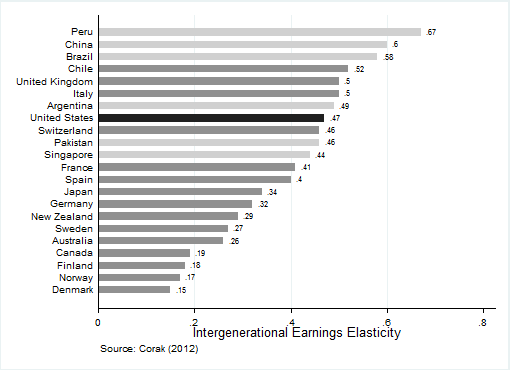
A complete list of references used to develop the estimates of the Intergenerational Earnings Elasticity is available here: References for intergenerational earnings elasticities. The following is a graph showing the exact values of the estimates.

Update, July 12, 2016: the published version of “Inequality from Generation to Generation …” is available as IZA Discussion Paper No. 9929. ]

Who is Alan Krueger? And why is he speaking for the White House on Inequality?

Alan Krueger is a labour economist who teaches at Princeton University.

On August 29th President Obama appointed him the Chairman of the Council of Economic Advisors, and his appointment was confirmed in November.

In this role he will be giving what is only his second speech on Thursday January 12th at the Center for American Progress in Washington on “The Rise and Consequences of Inequality.”

Continue reading “Who is Alan Krueger? And why is he speaking for the White House on Inequality?”