Ever wonder where to find the Trump Tower? Then take this “Trump Walking Tour” with me, and learn even more

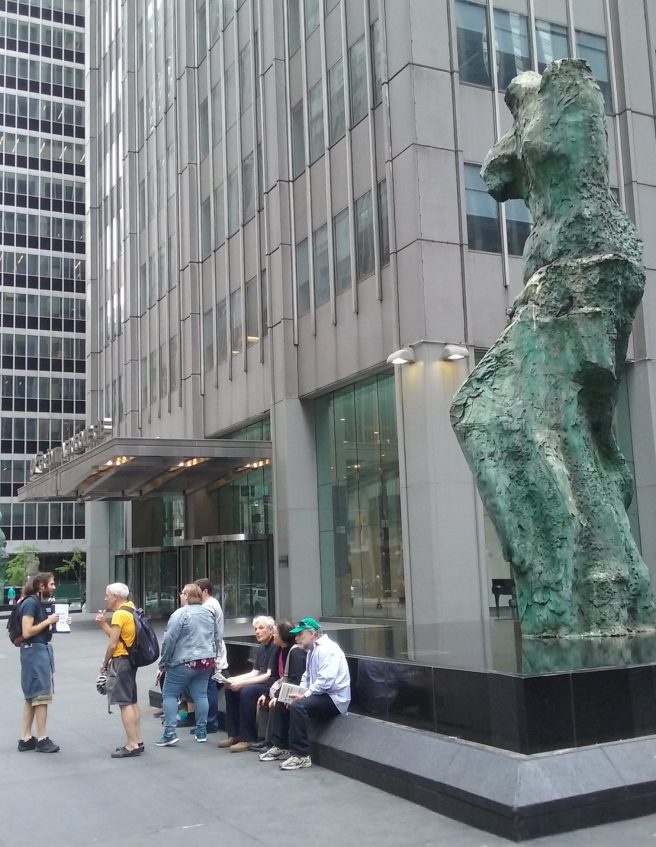
Meet at the southwest corner of 53rd Street and 6th Avenue, under the large statue across from the Hilton Hotel, the tour guide will be holding a “Social Justice Tours” sign.

That is what The Municipal Arts Society of New York website counsels, and indeed, Dan is there … Social Justice Tours being the non-profit he started three years ago, that is taking off quite nicely, nicely enough—thank you very much—to have its website hacked by someone with a Russian IP address. You might have a little trouble reaching them at socialjusticetours.com for at least the next week or so, until the volunteer IT guy gets things fixed.

But this much I could get from my web search “Social Justice Tours engages New Yorkers in critical dialogue by exposing injustice & highlighting inequality in an effort to encourage thought & inspire action.” So who better than to run a Jane’s Walk—the grassroots celebration of the famous urban activist Jane Jacobs—called Trump Walking Tour.

Sounds like the walking tour for me. Last week a tourist on 5th Avenue gingerly approached me in halting English to ask for directions to”Tower Trump?”, so maybe I should know a bit more about Trump’s New York than just simple directions when standing a half a block away from the famed (sometimes inflamed) building.

This is a tour about Trump history, not Trump presidency. Dan assures us that he has read four books about Donald Trump. We are going to stick to the facts about the man himself. But we also recognize that other agents—whether the shady underworld, the commercial banks, the criminal justice system, or failures of public policy—facilitated his rise: he is not just an individual.

His story shows us how the real estate industry has shaped New York into a billionaire’s city, in many ways trampling over the commoners, but not without observing some lessons about the importance of organizing and collectively fighting back against bullies and bulldozers.

This is a social justice tour after all.

“I have yet to have a Trump supporter on my tour.” The crowd of 16 New Yorkers cheers this opening line with approval, one proudly proclaiming “I’m a Never Trumper.” And we’re off.

Continue reading “Ever wonder where to find the Trump Tower? Then take this “Trump Walking Tour” with me, and learn even more”

The Caledon Institute of Social Policy is Canadian social policy

To understand the development of Canadian social policy during the last 25 years, you must appreciate the role of the Caledon Institute of Social Policy, which closed it doors on November 30th, 2017.

The Maytree Foundation hosted a conference celebrating the Institute’s accomplishments, and paying tribute to the vision and energy of its principles: Michael Mendelson, Sherri Torjman, and its founder Ken Battle (whose engagement in social policy advocacy began under the pseudonym Grattan Gray).

The Institute’s publications are archived on the Maytree Foundation site. Maytree also published a tribute volume:  25 years of informing the debate: A tribute to the Caledon Institute of Social Policy .

The volume includes a timeline of major milestones in the impact Caledon had on social policy, and over 30 tributes from colleagues, social policy analysts, and public servants, including three Canadian Prime Ministers. Collectively they make interesting, informative, and very touching reading.

Here is my contribution, included in the volume, which you can download in its entirety.

Continue reading “The Caledon Institute of Social Policy is Canadian social policy”

The Canada Child Benefit is an important innovation in cash benefits to families with children

The Canada Child Benefit offers a policy option that the United States should consider in pursuing a goal to reduce child poverty by half.

The commitment to address child poverty has waxed and waned in Canada since an all-party resolution was passed in the House of Commons in late 1989 committing the federal government to “seek to eliminate child poverty by the year 2000.”

Poverty and social policy are now high on the agenda of the current federal government, which intends—over the course of the next six months—to articulate a poverty reduction strategy, but which has already taken a major step toward this goal by introducing the “Canada Child Benefit” in its first budget. This program came into effect in July 2016, and represents a major revamping of cash support to families with children.

The Canada Child Benefit represents an important improvement in the incomes of families with children, the government forecasting that by the end of its first full year of operation in 2017 the program would almost halve the number of children in poverty from the level prevailing in 2013. This innovation merits attention from policy makers in the United States and other countries.

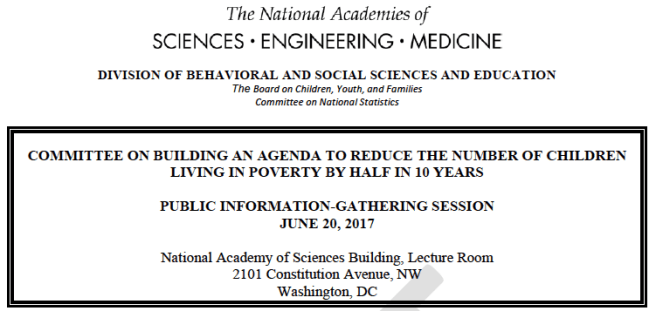
I made a presentation to the “The Committee on Building an Agenda to Reduce the Number of Children in Poverty by Half in 10 Years” of the National Academies of Sciences, Engineering, and Medicine.

The program of the June 20th public information gathering included presentations from eight experts. I was the only participant from outside of the United States. Download the slides of my presentation: Presentation-Corak-National-Academy-Sciences-Engineering-Medicine-Child-Poverty.

It was based on a background report I prepared for the committee, which you can also download: Text-Corak-National-Academy-Sciences-Engineering-Medicine-Child-Poverty. The report details the nature of the program, compares it to the programs it replaced, and offers links to additional resources helpful in simulating the impact a similar design could have in other countries.

Poor children are twice as likely to grow up to be poor adults in some Canadian communities than in others

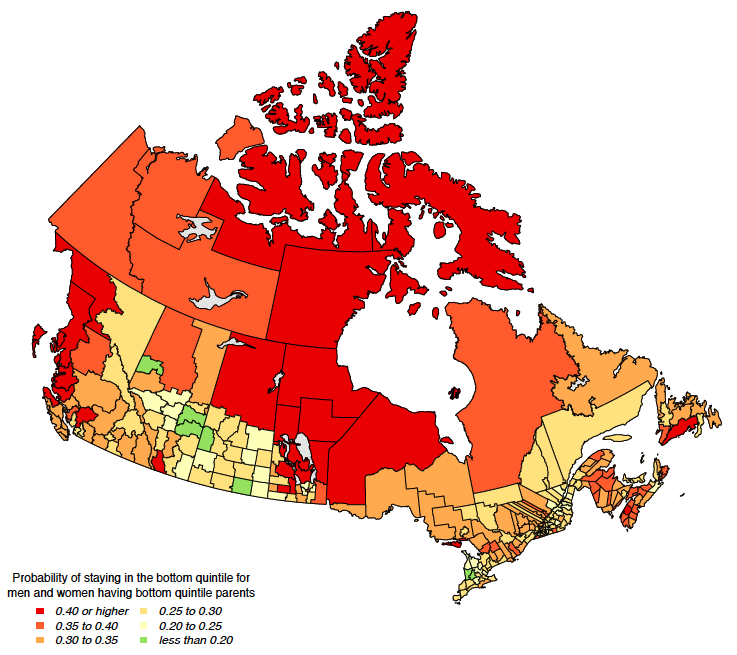
Intergenerational cycles of poverty vary across Canada, with low income children in some places facing a less than one-in-five chance of growing up to be poor adults, but in others the rate is more than double. The strong majority of children raised by lower income parents face a greater than one-in-four chance of growing up to be low income adults, and for many these odds were at least as high as one-in-three.

The chance that poverty will be passed on across the generations is 30 percent for the country as a whole, and the majority of children, 54 percent, live in 97 of a total of 266 municipalities where the chances of falling into an intergenerational cycle of low income are between 25 and 30 percent. A further 24 percent of poor live in a community where these chances are at least 0.30 but under 0.35.

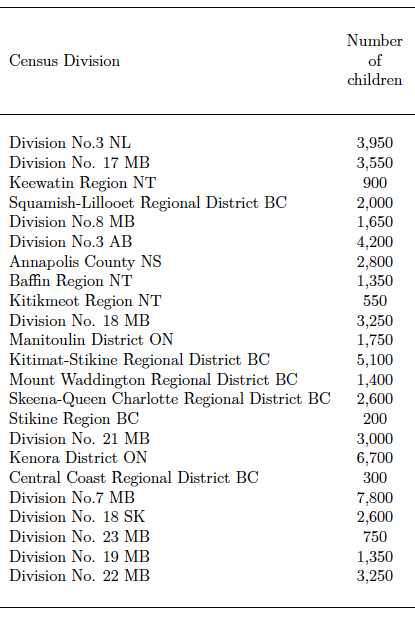
There are 23 municipalities with a 40 percent or greater chance of an intergenerational cycle of low income. These communities are all small in population, and account for two percent of the total number of children.

There is a greater than 40% chance of intergenerational poverty In 23 Census Divisions

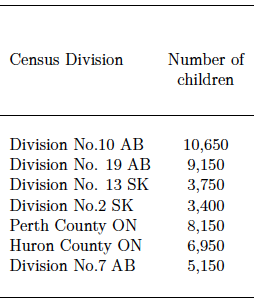
There are only seven of 266 communities in which the probability of a cycle of low income is less than 20 percent, representing only 1.6  percent of all children.

There is less than a 20% chance of intergenerational poverty in seven Census Divisions

The average parent income in these communities is below the national average. This raises the possibility that geographic mobility may be an important aspect of intergenerational mobility. The two Ontario communities listed in the above table are not areas in which there was significant economic growth, but the distances and costs associated with moving to nearby regions that were poles of growth—more specifically Toronto—were likely low.


[ The findings described in this post are drawn from my recently released research paper called “Divided Landscapes of Economic Opportunity: The Canadian Geography of Intergenerational Income Mobility.” You can learn more about this research, and download a copy of the paper and host of other information by reading the page devoted to this project at: MilesCorak.com/Equality-of-Opportunity . ]

Can you change your mind about inequality? Read my just published paper

The Pope has strong views about inequality because he has a theory, and doesn’t need data.

pope-francis-tweet-inequality-is-the-root-of-social-evil

One of Canada’s most prominent pundits has strong views about inequality because he has data, and doesn’t need theory.

andrew-coyne-tweet-november-24-2016-inequality-is-an-utter-crock

I’ll probably never convince either of them to change their views, but maybe I can convince you with both theory and data.

Give me the chance by reading my just published paper, Inequality is the root of social evil,’ or Maybe Not? Two Stories about Inequality and Public Policy.”

I tell two stories about inequality. The first is from the perspective of those who feel it is not a problem worth the worry, and the second from the perspective of those who see it as “the defining challenge of our time.” I tell these stories to clarify their underlying logic, but also to clarify both the challenges facing Canadians and our understanding of what public policy should do about them.

But I have another motive. I would like you to appreciate the value of economic theory and statistical methods to a public policy discussion of this sort. It seems to me that without an appreciation of some basic elements of theory and measurement, it is too easy for the policy conversation to go astray.

Download a free copy from the publisher’s website—Canadian Public Policy, December 2016—and tell me what you think.


How The Great Gatsby Curve got its name

Great Gatsby Curve

On January 4th, 2012 The New York Times published an article called “Harder for Americans to Rise from Lower Rungs.” I had spent a considerable amount of time during the New Year’s holidays talking with Jason DeParle about the comparative literature on intergenerational income mobility, and was pleased to see his article on the front page.

So pleased that I emailed Alan Krueger, the Princeton University economist who at the time was the Chairman of the Council of Economic Advisors, to draw his attention to it, though I don’t know why I imagined that Krueger and his staff in the White House would not be reading The Times.

That is how “The Great Gatsby Curve” was born.

Continue reading “How The Great Gatsby Curve got its name”