An inclusive society seeks to eliminate child poverty

Wellington New Zealand

My meeting with senior Treasury officials began with the nonchalantly stated advice “In the event of an earthquake we like to get under the tables and hold on to the legs so that they don’t get away from us.”

As a Canadian, albeit one who has visited New Zealand three times in the past decade, I naively took this as a metaphor for the earth-shattering ideas the public service expects from its consultations with outside experts.

I assure you that the dozen or more participants gathered to discuss how the government might contribute to building “a more inclusive New Zealand” offered advice that was far from ground breaking.

How possibly could they?

Continue reading “An inclusive society seeks to eliminate child poverty”
UNICEF gives Canada a passing grade, child poverty actually fell during the recession … or did it?

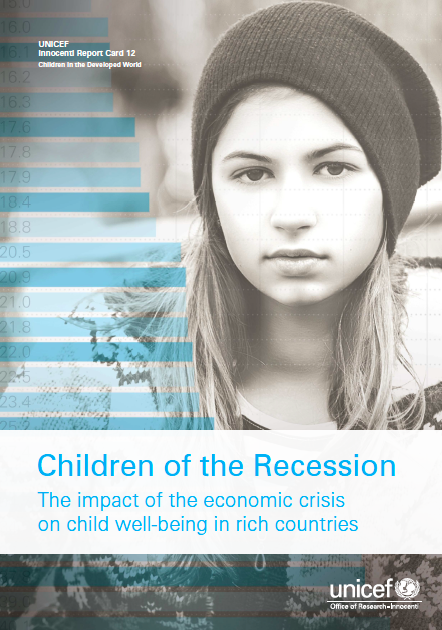
UNICEF Children of the Recession Innocenti Report Card 12 CoverLet’s see if we can make sense of this.

UNICEF has just given Canada a passing grade, mind you barely a pass, when it comes to the fight against child poverty. In a report released today it claims that 21% of Canadian children live in poverty, nothing to brag about, but at least this is lower than the 23% who were poor just before the recession started in 2008.

Interestingly, Statistics Canada also says child poverty is down, but that only 8.5% of kids are poor. However, at the same time it says child poverty is up, reaching almost 14%. And finally, if this is not confusing enough, it says that, yes, 14% of kids are poor, but this is down since 2008.

Up or down? One-in-five kids poor, or one-in-seven, or maybe even as few as only one-in-eleven?

Continue reading “UNICEF gives Canada a passing grade, child poverty actually fell during the recession … or did it?”

UNICEF reports that child poverty in the US was held in check during the Great Recession

UNICEF Children of the Recession Innocenti Report Card 12 CoverIt is an understatement to say that the US welfare reforms of the 1990s were intended to give a little spring to the social safety net.

The intention was much more radical, involving a major make-over of income support, and turning what was imagined as a net ensnarling many Americans behind a welfare wall, into a trampoline, a springboard that would incentivize work and allow them to ride a wave of prosperity to higher incomes that would lift their children out of poverty.

But this is hardly what is needed when times turn bad.

The only virtue of a trampoline when employment falls by more than 8 million, when the unemployment rate more than doubles, and when median incomes drop by over $10,000, is that it catches you on the way down.

American families needed a safety net during the Great Recession, and a report released by UNICEF on child poverty suggests, surprisingly enough, that is exactly what they got.

The rate of child poverty, in spite of all the macroeconomic turbulence of the last six years, has hardly budged. This is in large measure because of discretionary policy changes on the part of the Federal government that quickly turned the clock back to the welfare system of the 1980s.

Continue reading “UNICEF reports that child poverty in the US was held in check during the Great Recession”

Families need insurance for wages and for family responsibilities

[ This post is a summary of a presentation called “Public insurance to promote social mobility” that I made to the “Social Mobility Summit” held at the Brookings Institution in Washington DC on January 13th, 2014. It is intended for an American readership, and is also posted in an abridged form on the Brookings website. ]

Continue reading “Families need insurance for wages and for family responsibilities”

An American idea about the Canadian middle class

The suggestion that the middle class is stagnating, the linchpin of Justin Trudeau’s economic platform—to the extent it exists—is an idea shamelessly borrowed from the United States.

Shameless it may be, but it is, nonetheless, true.

Clearly there are some ways in which we are all better off not withstanding what President Obama tells the American public, and notwithstanding how closely Canadian political leaders listen to him.

In 1980, a cell phone was something carried in a brief case; and a Sony Walkman—you surely recall the portable cassette player the size of a thick paperback that strapped “conveniently” to your belt?—was the cutting edge musical accessory.

But shops filled with more variety, and more quality, make us and our kids better off only to a degree, and not only because the power to blow your ear drums out has increased exponentially.

In 1980 middle-income Canadian families reported a total of $57,000 on their tax returns, and 30 years later, … well exactly $57,000.

Continue reading “An American idea about the Canadian middle class”

The right way to think about social and economic rights

The Universal Declaration on Human Rights, which we celebrate every December 10th, offers both a powerful and beautiful statement of what it means to be human and the goals we should pursue as a society. But the Declaration is an incomplete guide to designing the programs to meet these goals: it offers inspiration to advocates, but not a guidebook for pragmatists.

Pragmatists and policy makers need to read the Universal Declaration through the lens of economists, rather than don the robes of lawyers.

Human Rights Day 2012, click to enlarge

Continue reading “The right way to think about social and economic rights”