A little secret Denmark shares with Canada about social mobility that Americans and Brits should know

In an article that appeared earlier this year, The New York Times described the extent to which rich parents can expect to see their children grow up to be rich adults, as well as the likelihood that the poor raise children destined for poverty.

Surprisingly enough, the article came close to concluding that if Americans are interested in living the American Dream—where family background has little influence on adult outcomes—they should move to, of all places, Denmark, or if crossing the Atlantic seems daunting, then, as a second best, to Canada.

Indeed, Denmark has been a darling of sorts ever since Richard Wilkinson and Kate Pickett highlighted in their book, The Spirit Level, that Danish life is so much better along a whole host of dimensions because income inequality is so much lower.

But Denmark has a little secret, one it shares with Canada, about how kids get jobs, and about how this determines life chances even in places with low inequality.
Continue reading “A little secret Denmark shares with Canada about social mobility that Americans and Brits should know”

Inequality and social mobility

[These are the opening remarks I made to the Senate Standing Committee on Social Affairs, Science and Technology of the Parliament of Canada. I appeared as a witness at the May 2nd meeting of the Committee dealing with Social inclusion and cohesion in Canada to address the topic of inequality. These remarks do not substitute for the official transcripts that will be produced by the Standing Committee.]

Continue reading “Inequality and social mobility”

The ten trends that have shaped the last century, and that will shape the next

Ten forces have defined how we have lived our lives during the last one hundred years, but the “rights” revolution is at their core and will shape how we live the next hundred years.

Daron Acemoglu, the MIT labour economist and co-author of Why Nations Fail, begins a recently released paper on a very personal note: “I write this as I await the birth of my second son.”

Continue reading “The ten trends that have shaped the last century, and that will shape the next”

“Are We Headed toward a Permanently Divided Society?”

This is the question Isabel Sawhill of the Brookings Institution asks in a tightly written discussion of the factors relating inequality with opportunity.

Sawhill’s answer: “at current levels of inequality in the U.S. it likely does. However, this answer is qualified in several ways.”

Continue reading ““Are We Headed toward a Permanently Divided Society?””

Over 90% of the income gains in the first year of the recovery went to the top 1%

Emmanuel Saez of the University of California at Berkeley has updated his work with Thomas PIketty on the evolution of US Top Incomes to 2010.

He finds that:

“In 2010, average real income per family grew by 2.3% … but the gains were very uneven. Top 1% incomes grew by 11.6%, while bottom 99% incomes grew only by 0.2%. Hence, the top 1% captured 93% of the income gains in the first year of recovery. Such an uneven recovery can help explain the recent public demonstrations against inequality.”

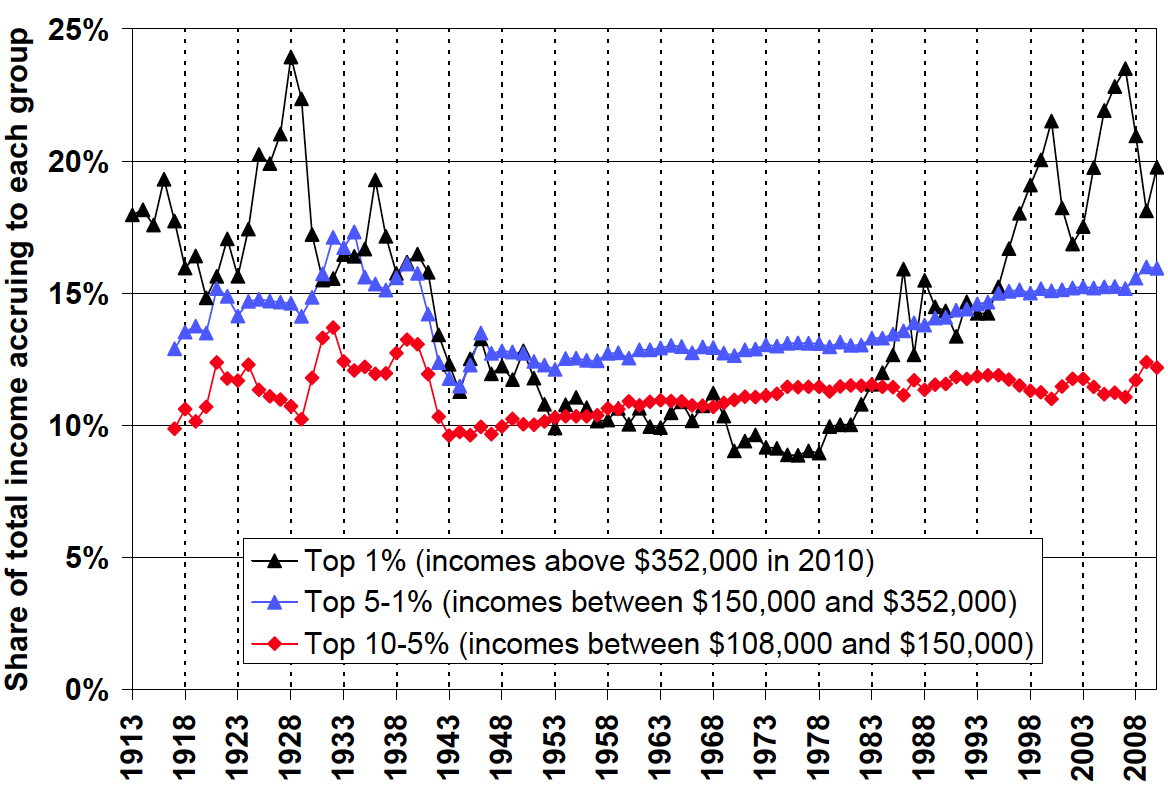
The 10 page update offers a clear picture of how income shares have varied over different business cycles, as well as the long-term trends since 1917. Top income shares fell dramatically after World War II, stayed flat, then began to rise in the early 1980s and have returned to their pre-War levels.

The top 10% in the US take now take home about 47% of all income, but this is driven by the top 1% who account for 20%.

The difference between the business cycle of the 1990s and the 2000s is that the incomes of the bottom 99% grew by 20% between 1993 and 2000, but only by 6.8% between 2002 and 2007.

Saez suggests that this “may … help explain why the dramatic growth in top incomes during the Clinton administration did not generate much public outcry while there has been a great level of attention to top incomes in the press and in the public debate since 2005.”

Inequality begets inequality, according to the Economic Report of the President

On a warm evening last spring I found myself at a dinner party in the lush suburbs of a small Ivy League town not far from New York City.

The main concern of a fellow economist was the trouble his son was having raising his new family: that would be the son living in Manhattan, the one making $10 million a year.

It appears there is a bidding war for spaces in good kindergartens and, as we all know, prices skyrocket when demand outstrips supply.

And demand has been rising. We also know that.

So the most striking claim in the Economic Report of the President for 2012 is not that the share of earnings accruing to the top 1%—a share that was about 8% during the early 1980s—stands at close to 20%. After all, this is old news, the stuff of Occupy Wall Street.

Continue reading “Inequality begets inequality, according to the Economic Report of the President”