Inequality and CEO compensation are more important than the CBC suggests

The Canadian Broadcasting Corporation’s senior correspondent Terry Milewski does a disservice in conveying the facts about inequality in his coverage of the now infamous report released earlier this week by the Canadian Centre for Policy Alternatives.

The report graphically documents the income gap between top earners and the rest of the population, the so-called average Joe, by pointing out that by noon on January 3rd—the first working day of the year—the top 100 CEOs in the country made as much as the average Canadian will during the entire year.

Continue reading “Inequality and CEO compensation are more important than the CBC suggests”
Inequality and Occupy Wall Street 8: causes of growing inequality and policies to address it

This video of a panel discussion called “The Challenges of Growing Inequality” organized by the Kennedy School of Government at Harvard University features a discussion by Lawerence Katz, a prominent labour economist. Katz speaks on the causes of inequality and offers advice to Occupiers on what should be done about it.

Continue reading “Inequality and Occupy Wall Street 8: causes of growing inequality and policies to address it”

Inequality and Occupy Wall Street 7: tax policy for occupiers

Perhaps a bit more politely than others in the mainstream media, but nonetheless pretty emphatically, the Ottawa Citizen columnist Joanne Chianello tells Occupiers that it’s time to leave, and she offers some advice:

“I don’t know what the answer is to the growing income gap. Unfortunately, neither do the people at Occupy Ottawa or Occupy Toronto or Occupy Vancouver. They could have contacted a lefty economist (yes, they exist) to help frame specific policy issues or demands, but they didn’t. Perhaps that’s the protest’s “stage two” we keep hearing about.”

Contact a lefty economist!

Well, if economists are going to be at the centre of “stage two” why don’t we forget about “lefty” or “righty”, and just consult the “best”?

Continue reading “Inequality and Occupy Wall Street 7: tax policy for occupiers”

Inequality and Occupy Wall Street 6: tax principles for occupiers

Believe it or not, there is such a thing as a good tax.

A good tax raises the required government revenue by not only treating equals equally, but also by requiring more from those who will be hurt the least.

However, that is not all: a good tax is also a tax that is administered simply, transparently, and in a “neutral” way.

“Neutral” means it does not cause individuals and corporations to behave differently; in other words, the tax respects the outcomes of the marketplace (unless of course prices do not accurately reflect the true costs and benefits of an activity. In this case the tax might be used to explicitly correct these market failures.)

This confronts Occupiers with a dilemma.

Continue reading “Inequality and Occupy Wall Street 6: tax principles for occupiers”

Inequality and Occupy Wall Street 5: decline of the American Dream

There is nothing wrong with inequality … until it starts limiting opportunity.

Well that might be a bit too strongly put, but it is certainly one thing to live in an unequal society where the chances of changing places with the rich, of seeing your children move on and upward, are high. Indeed, if this is the case we may even want a certain degree of inequality: people would have both the incentive and the possibility to better their situation.

But it is another thing altogether to live in an unequal society where there is little chance of moving on, where there are barriers preventing our talents and energies from being rewarded, where the accident of birth determines a child’s life chances.

This type of inequality should worry Occupiers and the 99% because it cuts sharply against what we commonly understand to be the American Dream.

Continue reading “Inequality and Occupy Wall Street 5: decline of the American Dream”

Inequality and Occupy Wall Street 4: daddy put you in the top 1% !

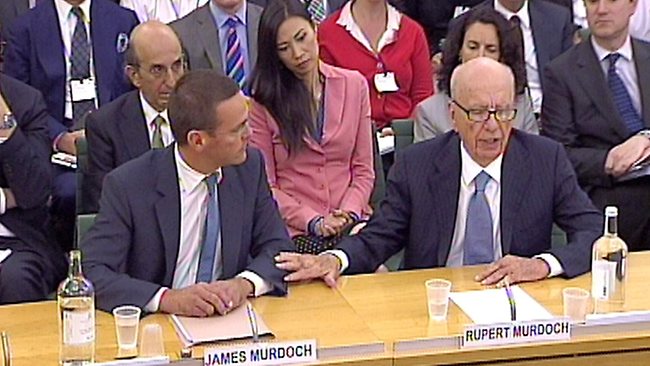
rupert-and-james-murdoch

It was almost a sad sight to see Rupert Murdoch’s son sitting beside the famed newspaper publisher in the televised committee hearings conducted by the British parliament last July.

James seems so out of depth.

Superstar salary he certainly has, but superstar talent?

If the members of the top 1% are there because of connections or political power—rather than by the force of their talent, energy, and motivation—then we should be rightly critical about claims that they merit their fortunes, and question the contribution they make to economic productivity.

Continue reading “Inequality and Occupy Wall Street 4: daddy put you in the top 1% !”