
Tackling inequality and poverty aren’t mutually exclusive; rather, efforts devoted to fighting the former contribute to solving the latter.
Continue reading “Inequality: a fact, an interpretation, and a policy recommendation”
Tackling inequality and poverty aren’t mutually exclusive; rather, efforts devoted to fighting the former contribute to solving the latter.
Continue reading “Inequality: a fact, an interpretation, and a policy recommendation”
If you are interested in more details about the commentary I wrote for today’s Toronto Star, “The Inequality Debate: Canada’s middle class is losing ground,” you can find the original version in this post. You might also have an interest in this post, imaginatively entitled: “Who are the middle class?”
A number of journalists have recently addressed the topic, nicely offering a broader perspective. Whether you like to listen, watch, or read, you have some good choices.
Listen to this Ira Basen documentary called “What We Talk About When We Talk About The Middle Class,” which was broadcast on CBC Radio’s program “The Sunday Edition”; watch this documentary by Holly Doan for CPAC, which also features the much-cited New York Times article (look down the right column of the page to find it as “Vote 2015 Special: The Middle Class”); or read this Globe and Mail article, “The Middle Class: Just Who are They, Anyways?” by Erin Anderssen.
I hope all this helps to inform you about the talking point that, by waving around a New York Times article, leads our policy makers to dismiss the very fundamental and long-standng changes in the nature of work and incomes that are generating more insecurity for many Canadians, particularly young Canadians.
“What are the areas of policy and institutional strength that have a particularly strong bearing on social participation in the process (productive employment) and outcomes (median household income) of economic growth?”
In other words, what promotes inclusive growth?
This is the question that animates a report released by the World Economic Forum, which suggests that three policies appear to be holding back the process in Canada: limited social protection, particularly an inappropriately designed and not terribly generous Unemployment Insurance program, the lack of affordable child care, and lackluster entrepreneurship.
 One economist recently suggested that there are as many as 156 definitions of the middle class. If this statistical potluck isn’t complicated enough, pollsters also tell us that a very large fraction of the population describe themselves as “middle class.”
You can see why politicians have made the “middle class” an election issue, but also why they might hesitate to answer the question: “Who are the middle class?”
It isn’t a contradiction for many people to feel they are in the “middle” even if their incomes are well above average or well below. There’s a certain truth to this because most Canadians share a set of common concerns that go beyond just their incomes.
You are “middle class” if you aspire to a better tomorrow, and have a hope for growth and progress in your circumstances; you are “middle class” if you are struggling with uncertainty, and worried if you and your family will be able to weather the storms that tomorrow will surely bring; and you are “middle class” if you have an expectation that your children should be treated fairly once you have done all you can to help them.
But while many people share these three concerns, their circumstances and capacities to manage them differ, something that is the result of growing inequality in access to secure and well-paying jobs.
Ninety percent of the population may belong to the “middle class”, but that doesn’t mean there is a one-size-fits-all-policy.
One way to get our heads around this is to let the answer to “Who are the middle class?” fall out of an answer to another question: “How is the economic pie divided?”
The unemployment rate in the United States fell to 5.3% in June, while the Canadian rate as of May stands at 6.8%. When Statistics Canada releases the June numbers on July 10th they are unlikely to show much improvement.
But when comparing the two countries it is important to remember that there are subtle differences in statistical methods that tend to push the Canadian statistic higher than the American. The unemployment rate in Canada would be 6.1% if it were calculated using US methods, rather than 6.8%
The gap between the two may be significant and it may grow even larger, but it is not as big as the official statistics suggest. See this 2012 post for an explanation.
You could almost hear the air rushing out of a political agenda tailored around middle class malaise immediately after The New York Times published a story last April called “The American Middle Class Is No Longer the World’s Richest.” Here, with hard data, was that bastion of liberal thinking showing that the Canadian middle class was about to overtake the American on its way to becoming the richest in the world.
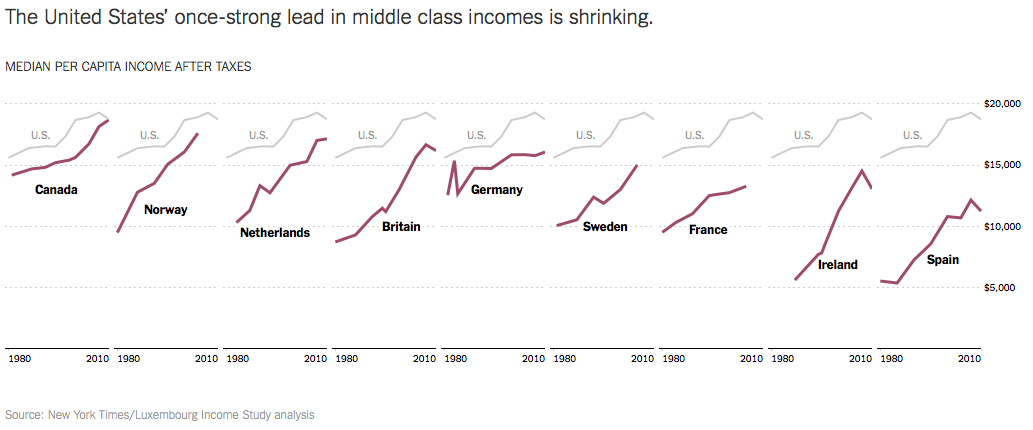
The story made the talking points of the federal opposition parties—that the Canadian middle class was under threat, not well served by current government policy, and in need of something better—look more like limp balloons on the floor of a party that’s gone on too long, than a front line of battle ready troops about to seize power.
Trouble is, the claim that the Canadian middle class was doing better than the American lost sight of deeper trends. All bets are off now that oil prices have plunged, but the revised talking points of politicians are still no better at focusing on the underlying drivers of prosperity.
Continue reading “Middle incomes, oil prices, and the fickle promise of prosperity”
 Economics for public policy