No job growth for Canada’s youth

There has been virtually no growth in employment among young Canadians over the course of the last three years. Employment plummeted in late 2008 for those younger than 25, and has gone nowhere but sideways since . This is in sharp contrast for older groups: their employment levels recapturing all the recessionary losses by 2010.

Tavia Grant, a reporter with the Globe and Mail, offers a nice summary of a Statistics Canada report that describes recent economic developments in an article called “Older workers have the edge in the current recovery.” But a picture from the study by Cyndi Bloskie and Guy Gellaty tells this story most clearly.
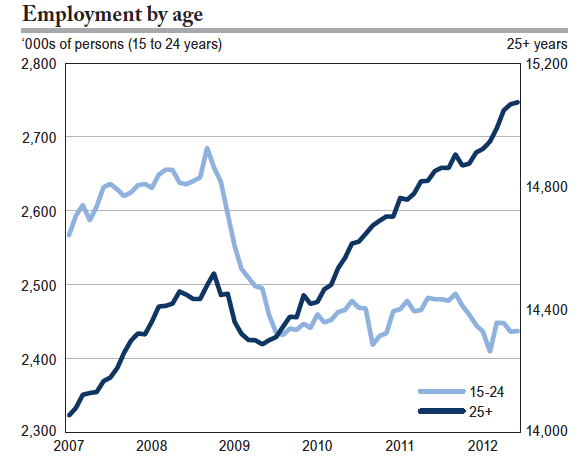
Source: Bloskie and Gellaty (2012), Chart 2.

Read the employment levels for 15 to 24 year olds in thousands off of the left scale, and that for those 25 and older off of the right scale. Between September 2008 and August 2009 employment among the young fell by a quarter of a million, and has been virtually stagnant since.

These patterns have been clear for some time, and in fact might be worse than the picture suggests because they do not even correct for the growth in the underlying population.

Why there are better ways to measure unemployment

The state of the jobs market is best assessed by a number that is not given enough attention by Statistics Canada, and the many media reports based upon its monthly press release.

The headline attention is all soaked up by the unemployment rate and the level of employment, when it really should be something Paul Krugman—the Princeton University economist and New York Times columnist—calls his “favorite gauge” of the employment situation.

Continue reading “Why there are better ways to measure unemployment”

Employment Insurance reform doesn’t need consitutional change

In a recent column in the Globe and Mail, Tom Flanagan bemoans the fact that the premium structure of Employment Insurance is not lined up with expected benefits. As a result, provinces to the west of the Ottawa River have long paid a good deal more into the program than they receive in benefits.

The solution: a constitutional amendment allowing Quebec to run its own EI program.

Quebec and Alberta interests certainly line up on this issue: one wrestles more control over federal powers, the other sees smaller government and lower taxes.

But let’s be clear, devolution of EI responsibilities—which constitutionally rests with the Federal Government—is about this sort of politics, not at all about the underlying economics of social insurance.

There are a host of legislative changes that the Federal government can introduce to make EI more efficient without even whispering the C-word.

Continue reading “Employment Insurance reform doesn’t need consitutional change”

Statistics Canada cuts long data short: another longitudinal survey is cancelled

The Survey of Labour and Income Dynamics died this morning.

The notice was given quietly by Statistics Canada: “This is the last release of longitudinal data from the Survey of Labour and Income Dynamics. Effective with next year’s release of 2011 data, only cross-sectional estimates will be available.”

A short, simple, and slightly obtuse, statement of a profound change for the user community and Canadians in general.

When I recently described the loss of a similar survey to a co-author over the telephone, she paused and said with sadness, “Ahhh…,” as if a friend had died.

There is no doubt that Statistics Canada also recognizes the value of this survey, and others like it. But there are important challenges in managing the information derived from so-called “longitudinal surveys”, and Canadians might be wondering whether or not they are being sold short.

Continue reading “Statistics Canada cuts long data short: another longitudinal survey is cancelled”

The gap between US and Canadian unemployment rates is bigger than it appears

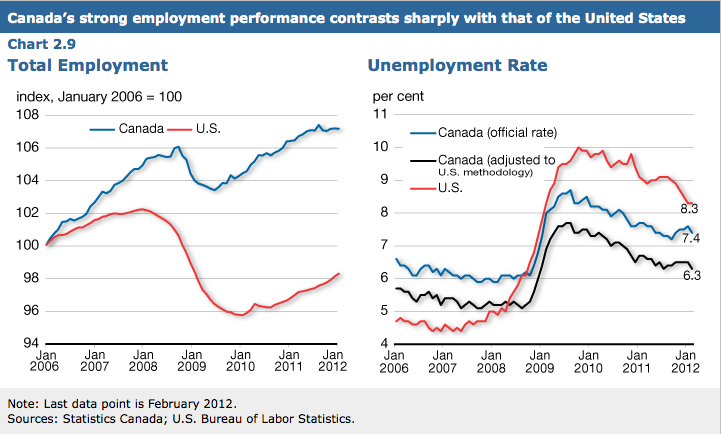
At 8.1% the unemployment rate in the United States is about one percentage point above the 7.2% currently reported for Canada, but this gap would be almost two percentage points if the Canadian rate was measured in the same way as the American.

This revealing picture from the recent Canadian federal government Budget paints a more accurate portrait by using unemployment rates defined in a similar way across the two countries.

Continue reading “The gap between US and Canadian unemployment rates is bigger than it appears”

Three policies to promote the dignity and rights of children

On April 19th 2012 I made a presentation called “Promoting the dignity and rights of children” to the Dignity for All campaign summit held in Ottawa Canada. The presentation offered three policy recommendations to the Federal government that if undertaken would improve the well-being of children and respect their rights as citizens.

Continue reading “Three policies to promote the dignity and rights of children”