
Statistics Canada cuts long data short: another longitudinal survey is cancelled

The Survey of Labour and Income Dynamics died this morning.

The notice was given quietly by Statistics Canada: “This is the last release of longitudinal data from the Survey of Labour and Income Dynamics. Effective with next year’s release of 2011 data, only cross-sectional estimates will be available.”

A short, simple, and slightly obtuse, statement of a profound change for the user community and Canadians in general.

When I recently described the loss of a similar survey to a co-author over the telephone, she paused and said with sadness, “Ahhh…,” as if a friend had died.

There is no doubt that Statistics Canada also recognizes the value of this survey, and others like it. But there are important challenges in managing the information derived from so-called “longitudinal surveys”, and Canadians might be wondering whether or not they are being sold short.

Continue reading “Statistics Canada cuts long data short: another longitudinal survey is cancelled”
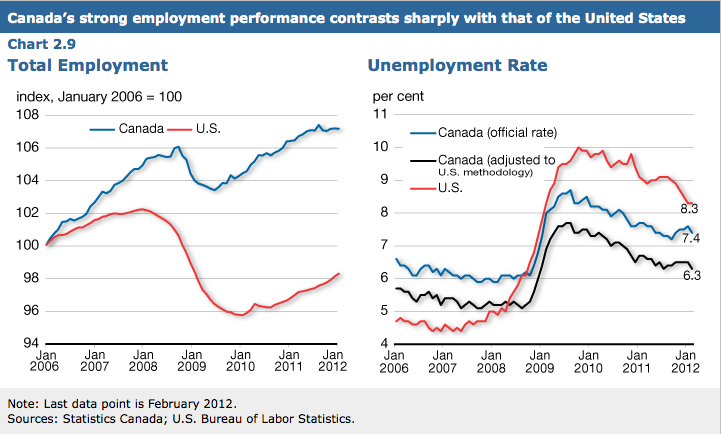
The gap between US and Canadian unemployment rates is bigger than it appears

At 8.1% the unemployment rate in the United States is about one percentage point above the 7.2% currently reported for Canada, but this gap would be almost two percentage points if the Canadian rate was measured in the same way as the American.

This revealing picture from the recent Canadian federal government Budget paints a more accurate portrait by using unemployment rates defined in a similar way across the two countries.

Continue reading “The gap between US and Canadian unemployment rates is bigger than it appears”

Three policies to promote the dignity and rights of children

On April 19th 2012 I made a presentation called “Promoting the dignity and rights of children” to the Dignity for All campaign summit held in Ottawa Canada. The presentation offered three policy recommendations to the Federal government that if undertaken would improve the well-being of children and respect their rights as citizens.

Continue reading “Three policies to promote the dignity and rights of children”

A youth employment strategy would look like this

Canada’s youth are still waiting.

The 2012 federal budget not only missed the opportunity to create a youth employment strategy, it actually eliminated Katimavik, a program that could have been reoriented, redefined and expanded to meet our labour market needs.

Continue reading “A youth employment strategy would look like this”

Immigrants face challenges in finding jobs that are not of their own making

The challenges immigrants face in finding jobs have to do with not just the characteristics and skills they bring to the labour market, but also the state of our economy and the barriers put in their way. More and more tinkering with the selection rules used to admit immigrants will not on its own address these challenges.

In a post on my blog I called for lower rates of immigration during business cycle downturns, and a reader commented by saying:

I arrived in Canada in July 2011 with my family and was called for exactly one job interview a couple of weeks ago. To say I am scarred is putting it mildly. I left a very successful career with the knowledge that it will be difficult to get a similar position but I never anticipated that I would end up feeling invisible and a non-entity with absolutely nothing to offer. Since coming here I have been shelling out money for everything, university fees for my kids and so on. Other than contributing to the Canadian economy through our expenses, I feel immigrants are not considered to be of any particular value.

It struck me how odd and incomplete the public policy response by Canadian opinion makers and governments is to this kind of concern.

Continue reading “Immigrants face challenges in finding jobs that are not of their own making”

The burden of unemployment is worse than Statistics Canada’s official number suggests

This morning Statistics Canada reported that the unemployment rate increased to 7.6%, confirming a rising trend since July of last year and still significantly above the low of about 6% just before the recession took hold in the autumn of 2008.

This statistic is probably the closest a number can come to having a human face; it relates directly to the hardship Canadians experience in providing for their families, saving for their retirement, and just meeting their day-to-day needs.

But in the end we can’t clearly see the faces of real people behind this number, which at best is an incomplete picture of waste and hardship.

Continue reading “The burden of unemployment is worse than Statistics Canada’s official number suggests”