
[These are the opening remarks I made to the Senate Standing Committee on Social Affairs, Science and Technology of the Parliament of Canada. I appeared as a witness at the May 2nd meeting of the Committee dealing with Social inclusion and cohesion in Canada to address the topic of inequality. These remarks do not substitute for the official transcripts that will be produced by the Standing Committee.]
Tag: economic mobility
“Are We Headed toward a Permanently Divided Society?”
This is the question Isabel Sawhill of the Brookings Institution asks in a tightly written discussion of the factors relating inequality with opportunity.
Sawhill’s answer: “at current levels of inequality in the U.S. it likely does. However, this answer is qualified in several ways.”
Continue reading ““Are We Headed toward a Permanently Divided Society?””
Inequality begets inequality, according to the Economic Report of the President
On a warm evening last spring I found myself at a dinner party in the lush suburbs of a small Ivy League town not far from New York City.
The main concern of a fellow economist was the trouble his son was having raising his new family: that would be the son living in Manhattan, the one making $10 million a year.
It appears there is a bidding war for spaces in good kindergartens and, as we all know, prices skyrocket when demand outstrips supply.
And demand has been rising. We also know that.
So the most striking claim in the Economic Report of the President for 2012 is not that the share of earnings accruing to the top 1%—a share that was about 8% during the early 1980s—stands at close to 20%. After all, this is old news, the stuff of Occupy Wall Street.
Continue reading “Inequality begets inequality, according to the Economic Report of the President”
The Economics of the Great Gatsby Curve: a picture is worth a thousand words
A quick post to thank Scott Winship for his response to my feedback on his original article. His comments are now on the National Review web site.
But I am afraid they do not advance the discussion. I addressed all of the technical issues in my original paper (see the appendix). The internationally comparable estimates I offered account for these concerns.
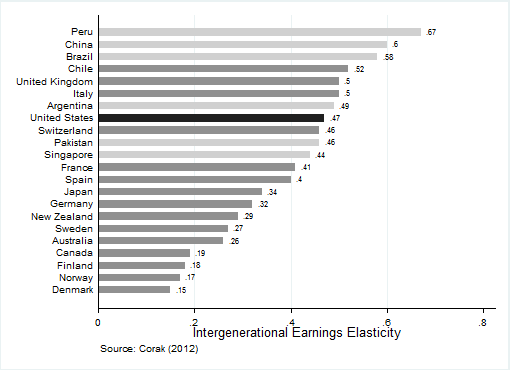
But let me repeat the picture of the Great Gatsby Curve using the most recent information on the largest available set of countries.
Continue reading “The Economics of the Great Gatsby Curve: a picture is worth a thousand words”
The Economics of the Great Gatsby Curve
In an article on the Brookings Institution website that was originally posted by the National Review, Scott Winship questions the idea that greater inequality at a point in time is associated with less generational mobility over time — what the Chairman of the Council of Economic Advisors, Alan Krueger, called the “Great Gatsby Curve” in a speech given on January 12th.
Winship’s article does a disservice to a well-established literature on generational mobility by suggesting that the basic information Krueger used is in some sense invalid. Krueger’s Great Gatsby Curve is in fact well-rooted in the labour economics literature, and debate would be better placed addressing the policy implications he draws than to suggest that President Obama’s top economist feels compelled to create his own facts.
So in the spirit of moving evidence-based public policy forward here is a quick review of the underpinning of the Great Gatsby Curve in both theory and practice.
Here is the source for the “Great Gatsby Curve” in the Alan Krueger speech at the Center for American Progress on January 12
In the speech he gave at the Center for American Progress on January 12th, Alan Krueger, the Chairman of the Council of Economic Advisors, presented the “Great Gatsby” curve: the relationship between inequality and generational earnings mobility, citing in part a 2011 paper of mine.
Here is the draft of the paper from which some of the data he used were drawn, in particular see Figures 1 and 2:
Inequality from generation to generation the United States in comparison
Here is Figure 2, my version of the Great Gatsby Curve for a wider set of countries:

The discussion I offered in an earlier post also uses this information and relates to this theme: Inequality and Occupy Wall Street 5: decline of the American Dream
Here is the text of Krueger’s speech Alan Krueger, The Rise and Consequences of Inequality, Text, and here are the associated slides Alan Krueger, The Rise and Consequences of Inequality, Slides .
[Update: this post was updated on January 27, 2012 with a new version of the text “Inequality from Generation to Generation…” and the associated figure. This text can be cited as:
Miles Corak (2013), “Inequality from Generation to Generation: The United States in Comparison,” in Robert Rycroft (editor), The Economics of Inequality, Poverty, and Discrimination in the 21st Century, ABC-CLIO.
A complete list of references used to develop the estimates of the Intergenerational Earnings Elasticity is available here: References for intergenerational earnings elasticities. The following is a graph showing the exact values of the estimates.
Update, July 12, 2016: the published version of “Inequality from Generation to Generation …” is available as IZA Discussion Paper No. 9929. ]
 Economics for public policy