A letter to the Canadian Prime Minister, with two suggestions for next steps in dealing with #COVID19

Prime Minister,

I certainly hope you and yours are well.

I was in New York City up until last weekend. Earlier in the previous week the university where I work announced that it was moving all courses online, and closing the campus. There was really no further need for me to stay in the City, but my initial thought was to wait it out, and decide later on when to return to Canada.

I started to have second thoughts when a student emailed me for advice just after President Trump announced that travel from Europe to the United States would be banned. He’s from Mexico, and said that he trusted the Mexican health care system more than the American, and wanted my advice on whether he should return home.

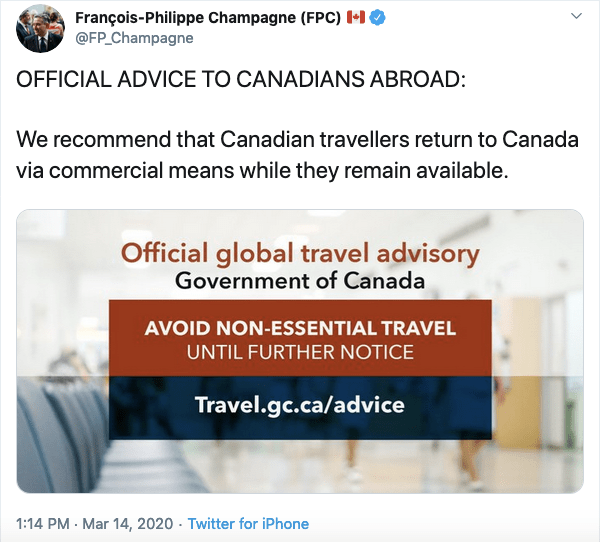
If that wasn’t enough to give me pause, when I saw the twitter feed of the Minister of Foreign Affairs  on Saturday evening recommending “that Canadian travellers return to Canada via commercial means while they remain availableI immediately bought myself a ticket for a next day flight to Canada. I arrived last Sunday evening, and have been in self-isolation since. I’m glad to be home given the events of the last week.
It is certainly time for government to step up, and history will judge the fall out of this pandemic in terms of how well societies govern themselves: professionally and efficiently, scientifically and socially, and with a sense of reciprocity and trust that strengthens community. I hope you and your cabinet take to heart a message that one of my colleagues has written in an article called “The Real Pandemic Danger Is Social Collapse.”

… the main (perhaps even the sole) objective of economic policy today should be to prevent social breakdown. Advanced societies must not allow economics, particularly the fortunes of financial markets, to blind them to the fact that the most important role economic policy can play now is to keep social bonds strong under this extraordinary pressure.

Good governance, not just a good health care system, is one of the reasons I’m glad to be home. I have been watching your daily press briefings with a good deal of admiration. And I am also impressed with both the design and speed with which the government has been able to roll out the package of reforms earlier this week, an effort that has no doubt been supported by legions of professional public servants working around the clock.

You promised that these reforms are just the first step in a fast moving and dynamic situation. I can’t pretend to understand the complete situation, hardly have full information, and can’t offer wide-ranging suggestions on what the next steps might be. But here are two suggestions that come from my limited areas of expertise. Continue reading “A letter to the Canadian Prime Minister, with two suggestions for next steps in dealing with #COVID19”
My Mandate Letter for the Minister of Families, Children and Social Development

The first step a newly elected Prime Minister takes on the road to governing is choosing the members of cabinet and giving them their marching orders. Prime Minister Trudeau set to this task with zeal when he was first elected in the autumn of 2015, and surprised many by making the mandate letters public. The CD Howe Institute asked a number of experts to draft their versions, and this post offers a slightly longer version of the mandate letter I wrote for the Minister of Families, Children and Social Development published by the Institute.

Click on image to link to the 2015 Mandate Letter

All Canadians have a right to live the life they value with dignity.

As Minister of Families, Children and Social Development, your actions should be governed by this principle, and directed to three concerns:

  1. promoting economic well-being and ensuring that those facing challenging circumstances are able to fully participate in our society with dignity;
  2. fostering equal opportunities and inclusion for all, regardless of family background, gender, ethnicity, or sexual orientation;
  3. enhancing economic and social resilience, whether Canadians live in families or on their own.

With these in mind, I will expect you to work with your colleagues through established legislative, regulatory, and Cabinet processes to deliver on your top priorities.

Continue reading “My Mandate Letter for the Minister of Families, Children and Social Development”

Three enhancements to Employment Insurance to reduce income inequality, promote income security, and support families

Social policy in Canada faces three challenges having to do with income inequality, income insecurity, and the imbalance between work and family life. My presentation at the Queen’s University conference, “Social Canada Revisited,” begins by outlining three facts that illustrate these challenges:

  1. The share of total market income going to bottom-income Canadians has fallen
  2. Workers with steady employment suffer significant and long-lasting income losses after a layoff
  3. Families have changed to help cushion and support middle incomes, but the family-work balance is titled

I suggest that there are precedents in the existing Employment Insurance program that can be enhanced and built upon to more fully offer Canadians the social insurance they need and want, and put forward three enhancements that will move social policy in this direction.

  1. Enhance Working While on Claim and integrate it seamlessly with the Working Income Tax Benefit to offer steady and increased income support to lower-income Canadians in a way that mimics some versions of a Basic Income
  2. Introduce wage insurance that would top up weekly earnings for workers with a steady employment history who have suffered a permanent layoff
  3. Expand so-called “Special Benefits” by creating individual accounts over which individuals have complete sovereignty

Download a copy of my presentation for the details.

Employment Insurance reform doesn’t need consitutional change

In a recent column in the Globe and Mail, Tom Flanagan bemoans the fact that the premium structure of Employment Insurance is not lined up with expected benefits. As a result, provinces to the west of the Ottawa River have long paid a good deal more into the program than they receive in benefits.

The solution: a constitutional amendment allowing Quebec to run its own EI program.

Quebec and Alberta interests certainly line up on this issue: one wrestles more control over federal powers, the other sees smaller government and lower taxes.

But let’s be clear, devolution of EI responsibilities—which constitutionally rests with the Federal Government—is about this sort of politics, not at all about the underlying economics of social insurance.

There are a host of legislative changes that the Federal government can introduce to make EI more efficient without even whispering the C-word.

Continue reading “Employment Insurance reform doesn’t need consitutional change”

Three policies to promote the dignity and rights of children

On April 19th 2012 I made a presentation called “Promoting the dignity and rights of children” to the Dignity for All campaign summit held in Ottawa Canada. The presentation offered three policy recommendations to the Federal government that if undertaken would improve the well-being of children and respect their rights as citizens.

Continue reading “Three policies to promote the dignity and rights of children”

Facts about the labour market, the hidden and the missing

This morning Statistics Canada released–as it does on the first Friday of every month–estimates of employment and unemployment for the previous month.

As usual the headline number is the change in the number of employed, and the Agency’s press release announces that “Following two months of declines, employment rose slightly in December, up 18,000.

But this masks as much as it reveals.

Continue reading “Facts about the labour market, the hidden and the missing”