Inequality may be complex, but that doesn’t mean we can’t make sense of it

The Fraser Institute has weighed in on the income inequality debate with a report called “Income inequality: measurement sensitivities” that reviews the statistical measurement of income inequality in Canada.

The report quite rightly points out that there are many nuances in the measurement of income, and income inequality, and that the results vary substantially depending upon how economists and statisticians deal with them. Is income measured by earnings, or by total income that includes not just business and investment income but also government transfers? Should it be measured before or after taxes? And should we be looking at total family income or try to represent this as individual income by accounting for family size?

The analysis is carefully done and clearly presented, and though it covers ground that is pretty well standard for many economists working in this area, it helps to clarify the issues for a broader audience.

But the study concludes, in the words of the screaming press release, that there is “No income inequality crisis in Canada when it’s properly measured.”

That is the wrong inference to be making. What the study is missing is a coherent understanding of the link the different measures it so accurately calculates. As a result it misses important policy lessons.

Continue reading “Inequality may be complex, but that doesn’t mean we can’t make sense of it”
Building a more inclusive society requires a conversation about inequality

[ This post is based on the opening address I gave on the invitation of the New Zealand Treasury to the “A More Inclusive New Zealand Forum” held in Wellington, New Zealand on July 27th, 2015. ]

I would like to open this gathering with a statement of admiration for both its content, and its process. The organizers have asked us to deliberate on “inclusion”, and to do so through conversation.

As a part of my contribution to this conversation I would ask you to consider four major messages, all four of which revolve around the question: What does inclusion mean?

I use “mean” in the sense of how we define inclusion, and “mean” in the sense of its implications for policy.

What does “inclusion” mean, and how can we give it enough precision to inform public policy?

My four messages are:

  1. an inclusive society means that all children can become all that they can be;
  2. an inclusive society seeks to eliminate child poverty;
  3. income inequality has the potential to erode inclusion;
  4. public policy must address many dimensions of inequality.


A More Inclusive New Zealand Forum

Continue reading “Building a more inclusive society requires a conversation about inequality”

Middle incomes, oil prices, and the fickle promise of prosperity

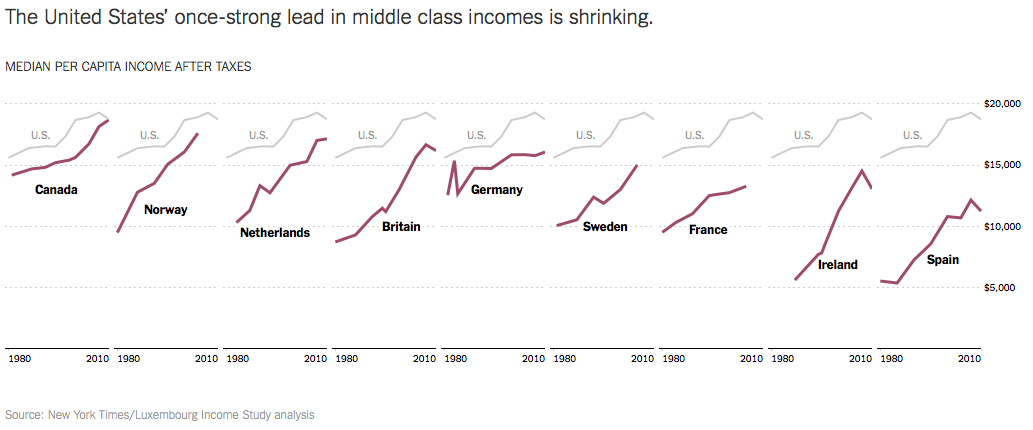
You could almost hear the air rushing out of a political agenda tailored around middle class malaise immediately after The New York Times published a story last April called “The American Middle Class Is No Longer the World’s Richest.” Here, with hard data, was that bastion of liberal thinking showing that the Canadian middle class was about to overtake the American on its way to becoming the richest in the world.

click on image to enlarge
Source: David Leonhardt and Kevin Quealy (2014). The New York Times. April 22nd.

The story made the talking points of the federal opposition parties—that the Canadian middle class was under threat, not well served by current government policy, and in need of something better—look more like limp balloons on the floor of a party that’s gone on too long, than a front line of battle ready troops about to seize power.

Trouble is, the claim that the Canadian middle class was doing better than the American lost sight of deeper trends. All bets are off now that oil prices have plunged, but the revised talking points of politicians are still no better at focusing on the underlying drivers of prosperity.

Continue reading “Middle incomes, oil prices, and the fickle promise of prosperity”

Two stories about inequality

In many rich countries the “hard” facts describing the income distribution are easily available. Yet, discussions about inequality are animated by two different stories with very different public policy implications.

You can listen to a caricature of these points of view in this pair of interviews on CBC radio: http://www.cbc.ca/radiowest/2015/01/21/two-different-takes-on-the-worlds-wealthiest-one-per-cent/

I offer more detail on the way Canadians have framed these stories as a part of a presentation to the School of Policy Studies at Queen’s university.

Here is Story 1 in pictures

(click on an image to start the slideshow and press Escape to return to this page).

Here is Story 2 in pictures

(click on an image to start the slideshow and press Escape to return to this page).

My presentation argued that context—rooted in economic theory and the appropriate use of statistics—is needed to understand the truth behind these stories, and to turn them into a conversation useful for public policy.

Here is the full set of slides I used.

Corak_Two_Stories_about_Inequality_and_Public_Policy_presentation_to_Queens_University_February_5_2015

“After Piketty”, 12 policy proposes to reduce inequality of outcomes

“The media storm surrounding the publication of Thomas Piketty’s remarkable Capital in the Twenty-First Century (2014) has ensured that inequality is now in the forefront of public debate. But what next?”

Sir Tony Atkinson

Thus begins an essay in The British Journal of Sociology by the dean of inequality studies, A. B. Atkinson of Oxford University. This is a must read for anyone interested in public policy addressed to the growing inequality in the rich countries.

Professor Atkinson’s focus is on the United Kingdom, but his far-reaching set of policy prescriptions address many aspects of public policy (not just tax and transfer policy), and have relevance well beyond the European context.

Tony Atkinson is an economist of the highest order who has been studying and contributing to the economics of inequality since the 1960s. In this paper he offers 12 proposals that, he says, “could bring about a genuine shift in the distribution of income towards less inequality.”

Continue reading ““After Piketty”, 12 policy proposes to reduce inequality of outcomes”

How to think about “think” tanks

Kady O'Malley Tweet on Think Tanks 1

It is sometimes said that think tanks are good for democracy; indeed the more of them, the better. If there are more ideas in the public arena battling it out for your approval, then it’s more likely that the best idea will win, and that we will all have better public policies. But intuitively many of us have trouble believing this, have trouble knowing who is being truthful, and don’t know who to trust.

This battle of ideas, studies, and statistics has the potential to make many of us cynical about the whole process, and less trusting of all research and numbers. If a knowledgeable journalist like the Canadian Kady O’Malley expresses a certain exasperation that think-tank studies always back up “the think-tank’s existing position,” what hope is there for the rest of us? A flourishing of think tanks just let’s politicians off the hook, always allowing them to pluck an idea that suits their purposes, and making it easier to justify what they wanted to do anyways.

Maybe we shouldn’t be so surprised that think tanks produce studies confirming their (sometimes hidden) biases. After all this is something we all do. We need to arm ourselves with this self-awareness. If we do, then we can also be more aware of the things in a think tank’s make-up that can help in judging its credibility, and also how public policy discussion should be structured to help promote a sincere exchange of facts and ideas.

Continue reading “How to think about “think” tanks”