Who’s Your Daddy? Some feedback from the top 1% on my New York Times article

Among the readers of an opinion piece I wrote in the New York Times on July 21st, Who’s Your Daddy? Job Opportunities for the children of the top 1 percent,  are two top 1 percenters who kindly took the time to email me their thoughts.

One of the goofiest most nonsensical things I have ever seen filled with
contradictions as you twist opposite conclusions to fit your thesis of
inequality. Just bizarre.

Sent from my iPad

My article was based on a soon to be published paper, Income Inequality, Equality of Opportunity, and Intergenerational Mobility , so I would hope that it has some logic to it.

The following comments are from another top 1 percenter who offers a more nuanced view on my logic, such as it is. Continue reading “Who’s Your Daddy? Some feedback from the top 1% on my New York Times article”

Income Inequality, Equality of Opportunity, and Intergenerational Mobility

The summer issue of the Journal of Economic Perspectives will feature a collection of articles on inequality and the top 1%, some of which are now being circulated by the authors.

The paper by Tony Atkinson and his coauthors, “The top 1 percent in international and historical perspective,” is available in this post, and “The Pay of Corporate Executives and Financial Professionals as Evidence of Rents in Top 1 Percent Incomes,” by Josh Bivens and Lawerence Mishel, is available on the Economic Policy Institute website.

Greg Mankiw has also posted a copy of his paper, “Defending the One Percent“, on his blog.

My contribution to the collection is based on the notion that the inequality literature has paid little attention to the intergenerational consequences of increasing top income shares, and it can be read as a counterpoint to Mankiw’s piece, or at least to his claim that inequality of opportunity is not a reason to worry about the top 1%.

Here is the final draft: Income Inequality, Equality of Opportunity, and Intergenerational Mobility. But if you just want a quick read, an excerpt from the conclusion follows. Either way, feedback is—as always—welcomed.

[NOTE added December 10, 2013: the published version of this paper is available from the American Economics Association website for the Summer 2013 issue of the Journal of Economic Perspectives, as is the table of contents for the entire issue.]

Continue reading “Income Inequality, Equality of Opportunity, and Intergenerational Mobility”

Inequality and social mobility, an interesting discussion

Canada2020 event February 26 2013

“The idea that all citizens should have an equal chance to succeed in life, regardless of where they start, is fundamental to liberal societies and emblematic of the American—and Canadian—dream” is the way a Canadian think tank, Canada2020, introduces a panel discussion it hosted that explored the idea of economic mobility, why it is important, and how it is related to inequality of outcomes.

I was a member of the panel and had a very interesting—and at times humorous and entertaining—discussion with Zanny Minton Beddoes the economics editor of The Economist, Carolyn Acker the founder of Pathways to Education, and Ron Haskins a senior fellow at the Brookings Institution. You can view the entire discussion, which was moderated by Diana Carney, by clicking on the following screen shot (and waiting a bit for it to load):

The short presentation I made at the beginning of the talk is, if you are interested, available here: Equality_of_Opportunity_A_Canadian_Dream_for_Canada2020

I plan on revising the background document I wrote for the event—which you can download from the Canada2020 website—and would therefore be very pleased to hear your views on the discussion, and any specific feedback you might have.

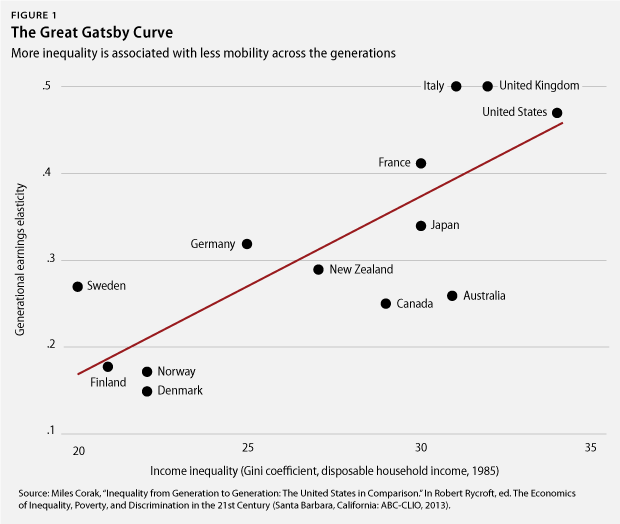
How to Slide Down the Great Gatsby Curve: Inequality, Life Chances, and Public Policy in the United States

CorakMiddleClass_fig1

The Center for American Progress has released a study I wrote called “How to Slide Down the Great Gatsby Curve: Inequality, Life Chances, and Public Policy in the United States”. Here is an excerpt:

Continue reading “How to Slide Down the Great Gatsby Curve: Inequality, Life Chances, and Public Policy in the United States”

The US Senate wonders about tax policy for the American Dream: Senator Baucus asks if things are getting worse

Is the American Dream harder to achieve now than a generation ago?

In response to my July 10th testimony to the Senate Committee on Finance hearing on “Helping Young People Achieve the American Dream” I received some homework, a series of questions asking me for a good deal more detail. You can review all of the questions on my November 11th post, but this one posed by the Committee Chairman, Senator Max Baucus of Montana, is particularly relevant.

Compared to many other countries the United States is both more unequal, and more of this inequality is passed on to the next generation.

Knowing where Americans stand compared to other countries is interesting because it helps us to begin to understand the underlying causes, and hence how public policy might influence outcomes.

But for the same reasons it is just as interesting, if not more so, to compare the United States not just to other countries, but to itself in a previous time.

Continue reading “The US Senate wonders about tax policy for the American Dream: Senator Baucus asks if things are getting worse”

The US Senate wonders about tax policy for the American Dream: Senator Hatch asks about the validity of the statistics

Senator Orrin Hatch has a sharp eye.

In response to my July 10th testimony to the Senate Committee on Finance hearing on “Helping Young People Achieve the American Dream” I received some homework, a series of questions asking me for a good deal more detail.

Senator Hatch, who is a US Senator for Utah, asks a thoughtful question about measurement issues. I will offer my answers to all the questions in a series of blog posts over the coming days. You can review the questions at my November 11th post. But I would like to begin with the first question Senator Hatch asks because it gives us the opportunity to clarify what the statistics mean. This is a good place to start.

Continue reading “The US Senate wonders about tax policy for the American Dream: Senator Hatch asks about the validity of the statistics”