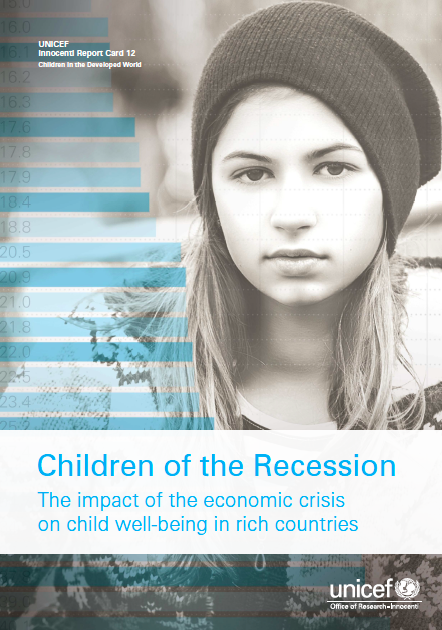
UNICEF reports that child poverty in the US was held in check during the Great Recession

UNICEF Children of the Recession Innocenti Report Card 12 CoverIt is an understatement to say that the US welfare reforms of the 1990s were intended to give a little spring to the social safety net.

The intention was much more radical, involving a major make-over of income support, and turning what was imagined as a net ensnarling many Americans behind a welfare wall, into a trampoline, a springboard that would incentivize work and allow them to ride a wave of prosperity to higher incomes that would lift their children out of poverty.

But this is hardly what is needed when times turn bad.

The only virtue of a trampoline when employment falls by more than 8 million, when the unemployment rate more than doubles, and when median incomes drop by over $10,000, is that it catches you on the way down.

American families needed a safety net during the Great Recession, and a report released by UNICEF on child poverty suggests, surprisingly enough, that is exactly what they got.

The rate of child poverty, in spite of all the macroeconomic turbulence of the last six years, has hardly budged. This is in large measure because of discretionary policy changes on the part of the Federal government that quickly turned the clock back to the welfare system of the 1980s.


Continue reading “UNICEF reports that child poverty in the US was held in check during the Great Recession”

Inequality and social mobility, an interesting discussion

Canada2020 event February 26 2013

“The idea that all citizens should have an equal chance to succeed in life, regardless of where they start, is fundamental to liberal societies and emblematic of the American—and Canadian—dream” is the way a Canadian think tank, Canada2020, introduces a panel discussion it hosted that explored the idea of economic mobility, why it is important, and how it is related to inequality of outcomes.

I was a member of the panel and had a very interesting—and at times humorous and entertaining—discussion with Zanny Minton Beddoes the economics editor of The Economist, Carolyn Acker the founder of Pathways to Education, and Ron Haskins a senior fellow at the Brookings Institution. You can view the entire discussion, which was moderated by Diana Carney, by clicking on the following screen shot (and waiting a bit for it to load):

The short presentation I made at the beginning of the talk is, if you are interested, available here: Equality_of_Opportunity_A_Canadian_Dream_for_Canada2020

I plan on revising the background document I wrote for the event—which you can download from the Canada2020 website—and would therefore be very pleased to hear your views on the discussion, and any specific feedback you might have.

Public policies for equality and social mobility

nov18-609x435

“Inequality matters. It matters because it has the potential to shape opportunity.”

This is how I begin the conclusion to a just finished paper that will serve as a background document for an event called “Equality of Opportunity—a Canadian Dream?” that will take place Tuesday evening, February 26th.

The event is organized by Canada2020, an Ottawa based think tank, and will take the form of a panel discussion moderated by Diana Carney and include as panelists  Carolyn Acker (founder of Pathways to Education), Zanny Minton Beddoes (the economics editor at The Economist), Ron Haskins (senior fellow at The Brookings Institution), and me.

The conclusion to my paper, “Public policies for equality and social mobility”, continues:

Continue reading “Public policies for equality and social mobility”

The US Senate wonders about tax policy for the American Dream: How can income transfers be designed to benefit all children in need?

The tax system is increasingly used to transfer cash benefits to families with children, but the United States accepts the trade-offs in program design very differently than other countries and gives children much less support.

In response to my July 10th testimony to the Senate Committee on Finance hearing on “Helping Young People Achieve the American Dream” I received some homework, a series of questions asking me for a good deal more detail. You can review all of the questions on my November 11th post. Child poverty is central to discussions of social mobility, and it is natural to wonder how tax policy can be designed to support the incomes of the least advantaged.

Continue reading “The US Senate wonders about tax policy for the American Dream: How can income transfers be designed to benefit all children in need?”

The US Senate wonders about tax policy for the American Dream: Do parents act in the best interests of their children?

How should programs intended to support children in low-income families be designed if parents don’t always act in the best interests of their children?

This question, among others, was posed to me in response to my July 10th testimony to the Senate Committee on Finance hearing on “Helping Young People Achieve the American Dream.”  You can review all of the questions on my November 11th post.

In one way or another they address the fundamental drivers of the extent to which children grow up to be adults having the same socio-economic status as their parents. Family background matters for life chances because of three related forces: inequalities originating in the labour market, the capacity of families to invest in the skills and aptitudes of their children, and the degree to which public policy levels the playing field.

What parents do matters a good deal, and a question posed by the Committee Chairperson, Senator Max Baucus, recognizes this, and wonders about the implications for the design of public policy.

Continue reading “The US Senate wonders about tax policy for the American Dream: Do parents act in the best interests of their children?”

Statistics Canada cuts long data short: another longitudinal survey is cancelled

The Survey of Labour and Income Dynamics died this morning.

The notice was given quietly by Statistics Canada: “This is the last release of longitudinal data from the Survey of Labour and Income Dynamics. Effective with next year’s release of 2011 data, only cross-sectional estimates will be available.”

A short, simple, and slightly obtuse, statement of a profound change for the user community and Canadians in general.

When I recently described the loss of a similar survey to a co-author over the telephone, she paused and said with sadness, “Ahhh…,” as if a friend had died.

There is no doubt that Statistics Canada also recognizes the value of this survey, and others like it. But there are important challenges in managing the information derived from so-called “longitudinal surveys”, and Canadians might be wondering whether or not they are being sold short.

Continue reading “Statistics Canada cuts long data short: another longitudinal survey is cancelled”