Understanding inequality and why it is important

My presentation to the All Party Anti-Poverty Caucus of the Canadian House of Commons addressed three questions: (1) has inequality increased in Canada; (2) what explains the changes; and (3) why is it important for public policy?

I pointed out to the members of the Caucus that:

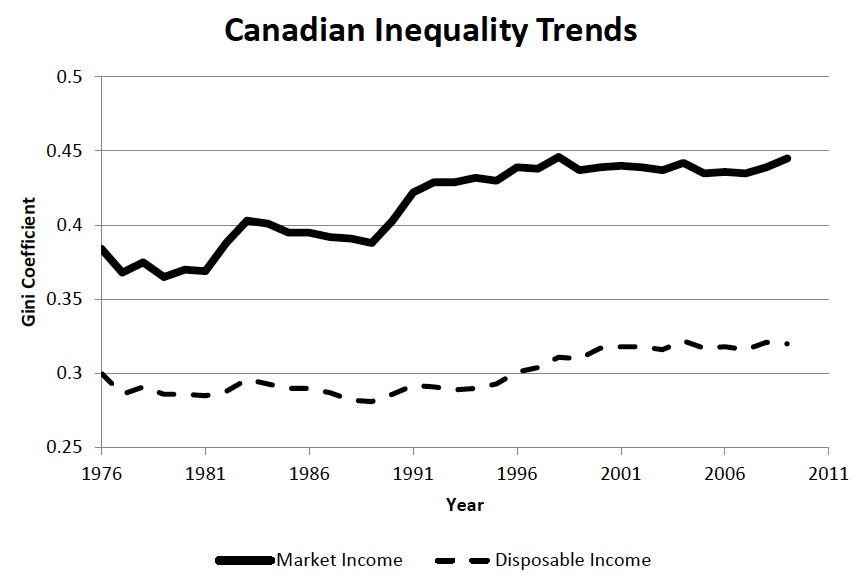
  1. Inequality has been rising in Canada since the early 1980s, driven by stagnant and declining incomes in the middle and lower half during the 1980s and 1990s, and rising top shares throughout the last 30 years.
  2. The tax-transfer system plays an important role in reducing inequality, but has not kept pace after about the mid 1990s.
  3. Rising inequality is a global phenomenon. The change in Canada has been above average when compared to other rich countries, and particularly notable for the increase in top shares.

I also suggested that while we might be interested in these changes because of a sense of fairness or because of concerns over economic efficiency, we should also be interested because inequality shapes opportunity, and that this may be a reason why all parliamentarians—regardless of their political allegiances—should treat it as an important issue for public policy.

You can download the English version here: Understanding_inequality_and_why_it_is_important_a_presentation_to_the_All_Party_Caucus

And the French version here: Understanding_inequality_and_why_it_is_important_a_presentation_to_the_All_Party_Caucus_en_francais


Why the rich don’t want to talk about inequality, and why the 99% do

Everything you need to know about why the rich don’t want to talk about inequality, and why the 99% do, is right here in this chart.

Average incomes and tax rates relative to 1982

The average income of those in the top 1% in Canada has about doubled since 1982, and for the top 0.1% it has increased by about two and a half to three-fold. But over this period the fraction of their income paid in taxes, their average tax rate, has remained about the same, and even a little lower.

Continue reading “Why the rich don’t want to talk about inequality, and why the 99% do”

Inequality and top income shares in Canada: Recent trends and policy implications

Inequality has increased in the majority of rich countries, but the share of income and earnings going to the top has increased most in the anglophone countries.  McMaster University economist Mike Veall says Canada has not escaped this trend, and argues that a public policy response is needed.

The underlying causes of, in his words, “the surge” in the shares of the top 1%, one-tenth of 1% and even the top one-hundredth of 1% in Canada remain elusive. Even so these changes should motivate at least three policy responses that could be supported across the political spectrum.

Professor Veall was the 2012 president of the Canadian Economics Association, the professional association of economists based in Canada, and presented his presidential address at the annual meetings of the Association held last June at the University of Calgary.

Continue reading “Inequality and top income shares in Canada: Recent trends and policy implications”

Understanding inequality and what to do about it

Inequality has been increasing in most countries, in part because top 1% are capturing a higher fraction of all earnings but also for other reasons. I made a presentation to the Occupied Ottawa conference “Take Back Democracy!” on June 2nd, 2012. The presentation explores three issues in search of intelligent conversation, and in order to accomplish something constructive: description, explanation, and prescription.

You can download it as a pdf here: Understanding inequality and what to do about it .

Continue reading “Understanding inequality and what to do about it”

“Canadian Inequality: Recent Development and Policy Options”

While inequality in Canada has increased over the course of the last three decades, the tax and transfer system can significantly reduce disparities in market incomes. But the political will to use the tax system may be limited, and public policy needs to address underlying labour market developments if it is to pursue an agenda of greater equality.

This is one of the major themes arising from a recently released discussion paper by a group of labour economists from the University of British Columbia: Nicole Fortin, David Green, Thomas Lemieux, Kevin Milligan, and Craig Riddell.

Continue reading ““Canadian Inequality: Recent Development and Policy Options””

A little secret Denmark shares with Canada about social mobility that Americans and Brits should know

In an article that appeared earlier this year, The New York Times described the extent to which rich parents can expect to see their children grow up to be rich adults, as well as the likelihood that the poor raise children destined for poverty.

Surprisingly enough, the article came close to concluding that if Americans are interested in living the American Dream—where family background has little influence on adult outcomes—they should move to, of all places, Denmark, or if crossing the Atlantic seems daunting, then, as a second best, to Canada.

Indeed, Denmark has been a darling of sorts ever since Richard Wilkinson and Kate Pickett highlighted in their book, The Spirit Level, that Danish life is so much better along a whole host of dimensions because income inequality is so much lower.

But Denmark has a little secret, one it shares with Canada, about how kids get jobs, and about how this determines life chances even in places with low inequality.

Continue reading “A little secret Denmark shares with Canada about social mobility that Americans and Brits should know”