Middle incomes, oil prices, and the fickle promise of prosperity

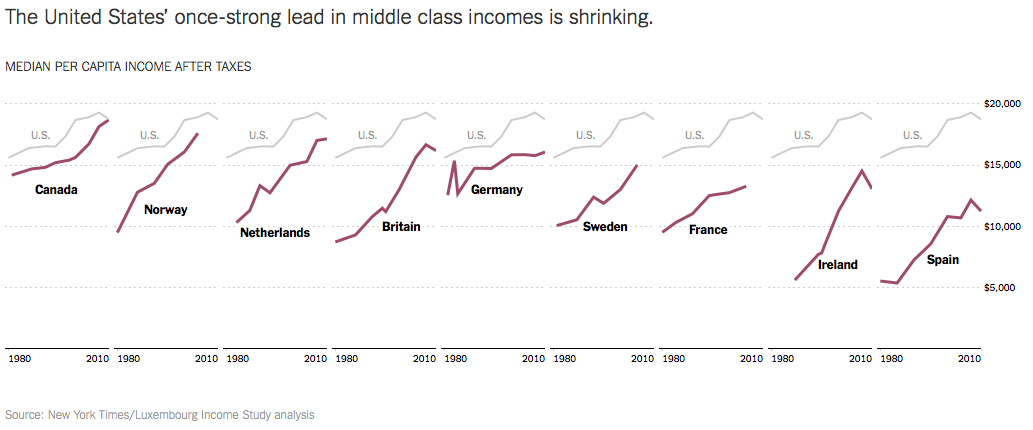
You could almost hear the air rushing out of a political agenda tailored around middle class malaise immediately after The New York Times published a story last April called “The American Middle Class Is No Longer the World’s Richest.” Here, with hard data, was that bastion of liberal thinking showing that the Canadian middle class was about to overtake the American on its way to becoming the richest in the world.
click on image to enlarge
Source: David Leonhardt and Kevin Quealy (2014). The New York Times. April 22nd.

The story made the talking points of the federal opposition parties—that the Canadian middle class was under threat, not well served by current government policy, and in need of something better—look more like limp balloons on the floor of a party that’s gone on too long, than a front line of battle ready troops about to seize power.

Trouble is, the claim that the Canadian middle class was doing better than the American lost sight of deeper trends. All bets are off now that oil prices have plunged, but the revised talking points of politicians are still no better at focusing on the underlying drivers of prosperity.

Continue reading “Middle incomes, oil prices, and the fickle promise of prosperity”

Two stories about inequality

In many rich countries the “hard” facts describing the income distribution are easily available. Yet, discussions about inequality are animated by two different stories with very different public policy implications.

You can listen to a caricature of these points of view in this pair of interviews on CBC radio: http://www.cbc.ca/radiowest/2015/01/21/two-different-takes-on-the-worlds-wealthiest-one-per-cent/

I offer more detail on the way Canadians have framed these stories as a part of a presentation to the School of Policy Studies at Queen’s university.

Here is Story 1 in pictures

(click on an image to start the slideshow and press Escape to return to this page).

Here is Story 2 in pictures

(click on an image to start the slideshow and press Escape to return to this page).

My presentation argued that context—rooted in economic theory and the appropriate use of statistics—is needed to understand the truth behind these stories, and to turn them into a conversation useful for public policy.

Here is the full set of slides I used.

Corak_Two_Stories_about_Inequality_and_Public_Policy_presentation_to_Queens_University_February_5_2015

“After Piketty”, 12 policy proposes to reduce inequality of outcomes

“The media storm surrounding the publication of Thomas Piketty’s remarkable Capital in the Twenty-First Century (2014) has ensured that inequality is now in the forefront of public debate. But what next?”

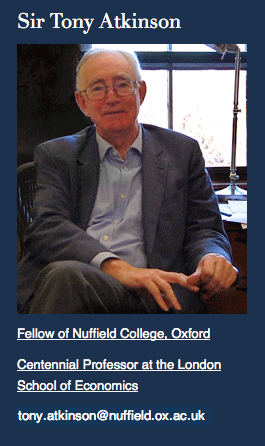
Sir Tony Atkinson

Thus begins an essay in The British Journal of Sociology by the dean of inequality studies, A. B. Atkinson of Oxford University. This is a must read for anyone interested in public policy addressed to the growing inequality in the rich countries.

Professor Atkinson’s focus is on the United Kingdom, but his far-reaching set of policy prescriptions address many aspects of public policy (not just tax and transfer policy), and have relevance well beyond the European context.

Tony Atkinson is an economist of the highest order who has been studying and contributing to the economics of inequality since the 1960s. In this paper he offers 12 proposals that, he says, “could bring about a genuine shift in the distribution of income towards less inequality.”

Continue reading ““After Piketty”, 12 policy proposes to reduce inequality of outcomes”