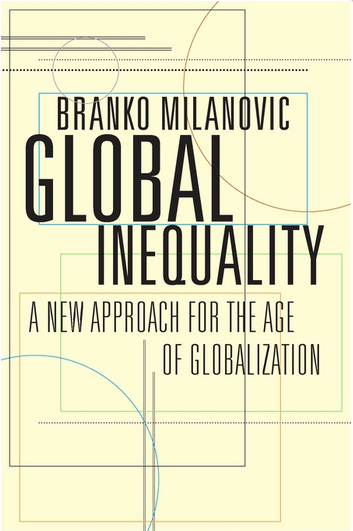
Branko Milanovic begins his book, Global Inequality, by posing a question: “Who has gained from globalization?” Many thoughtful Americans have the confidence to answer in a sentence. The gains have been captured by the top 1 percent. And the book ends with another question: “Will inequality disappear as globalization continues?” Many might be just as quick to answer: Of course not, the rich will get richer!
But life is not so simple. Between these two questions Branko Milanovic offers us not just a plethora of facts about income inequality that will surely make his readers think twice. More importantly, he shows us the power of bringing the facts into focus by putting a new lens over these pressing issues—a global perspective. He takes more than 200 pages to answer the first question, and only a sentence to answer the second.
My year as a visiting professor with the Department of Economics at Harvard is coming to an end, and I am on a pilgrimage of sorts. Today was spent in Mount Auburn Cemetery, visiting the notable and still living dead.
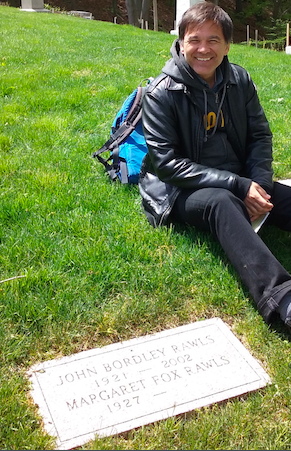
John Rawls died on November 24th, 2002. He is buried in a part of the cemetery called Harvard Hill, where you can see over the tree tops, just barely, the spire of Sanders Theatre in Memorial Hall. Professor Rawls is the author of A Theory of Justice, published in 1971. I read it for the first time in the early 1980s as a graduate student when working on my Master’s degree at McGill University. Rawls asks what kind of social contract would we enter into to govern the workings of our society if we had to negotiate it behind a veil of ignorance, not knowing where we stood in society, knowing nothing at all about ourselves, not our social rank, not even who are parents were. His answer? A good society is one in which the interests of the least advantaged have priority: social welfare is improved only when the least advantaged advance.
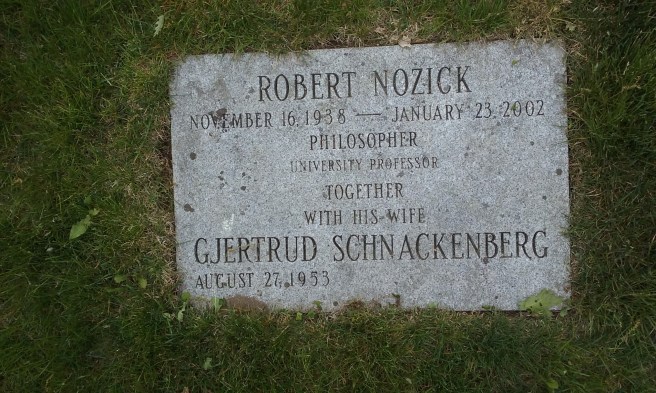
Also buried on Harvard Hill, barely 10 meters away, is Robert Nozick, who died on January 23rd, 2002. Nozick’s great work is Anarchy, State, and Utopia, a forceful response to Rawls, published in 1974. Nozick argued for a minimal state, focusing on the importance of individual property rights. Social welfare is based upon process, the freedom to engage in voluntary exchange in the exercise of property rights is what makes a society good, and the state should play a minimal role providing only those most basic services that uphold property rights. Let the outcomes be what they will be, as long as this process respected.
Two books, still alive, and very much for our times.
The Census is built block-face by block-face. It is built sub-division by sub-division. Village, township, city, municipality, it is built until the entire country is perfectly and completely tiled.
The Census is a machine, complicated and intricate. And the public servants working at Statistics Canada should be rightly proud of the hard work and dedication devoted to the development, maintenance, and management of this machine. Even the most jaundiced among us, regardless of political persuasion, should recognize and acknowledge this accomplishment.
The Jean Talon building, in the bottom right, was originally called the “Census Building.” Photograph by Philip Smith.
The value of this machine is that it lets us see ourselves in detail more precise than any other mirror, and the return of a mandatory long form, in which Canadians are required to offer up a description of some of the most private aspects of their lives, is hailed by many as a major turn in public policy that will allow this picture to stay clearly focused.
But the Census is more than a machine. Jean Talon knew that. The very first Census he conducted, beginning in the later part of 1666, was clearly an act of nation building. He used it to help him, and France, develop and build a viable colony extending from the shores of the Saint Lawrence River, transforming the countryside into a prosperous agricultural region that would prepare the way for waves and waves of more immigrants. The Census is an act of political imagination.
And the public servants who work at Statistics Canada are not well placed to exercise that imagination, even if at times what they do in managing the machine casts them in that role.
There is still much to be done for Canadians to accept and appreciate the benefits of the Census, and for the federal government to give them ownership of the results. The Census is mandatory—by law it must be filled out—but we should strive to think of it as voluntary, our participation to be both exercised and celebrated as an act of citizenship in a way that fosters each Canadian’s political imagination.


 Economics for public policy