I have a new job, and if you want to know more read this post

I have a new job! During the 2017 calendar year I am the “Economist in Residence” at Employment and Social Development Canada. I report to the Deputy Minister of this very large federal government department responsible for the major threads in Canada’s social safety net—insurance, investment, and income distribution that enhance capabilities and opportunities promoting the freedom Canadians have to lead the lives they value.

duclos-tweet-economist-in-residence

Jean-Yves Duclos is the Minister responsible, and his mandate letter is full of challenges, not least of which involves leading the development of a Canadian “Poverty Reduction Strategy,” and improving the Employment Insurance program to reflect the changing nature of work.

I report directly to the Deputy Minister of Employment and Social Development Canada, and my position is formally structured as an “interchange” with the University of Ottawa, where I will return in 2018. You can think of me as being on “loan” from my university to the public service.

The “Economist in Residence” is a new position in this department, but is modeled on a longstanding program at the Department of Finance called the “Clifford Clark Visiting Economist.” This program invites outside experts to visit the Department of Finance and work on relevant public policy issues that depend on department priorities, and also mesh with the visitor’s skills and interests. My appointment is an instance of another department doing something similar, at least for one year.

The Canadian public service is organized very differently than in the United States, where political appointments lead to a major churning of senior levels as each new government starts its mandate. This does not happen at all to the same degree in Canada, leading to greater continuity among senior management and a non-partisan basis for hiring and promotion. Some people see this as a great advantage, fostering a professional public service, but others also note some downsides, stressing the importance and value of renewal.

My job description asks me “to provide rigorous and objective advice on a range of key policy issues.” This is a refreshing opportunity, and it is exactly what I intend to do. Indeed, rigorous and objective advice is the tone I have tried to set on this blog, so if you are curious to know more about me—where I stand, how I think, what I’m interested in—feel free to read on!

Tony Atkinson has died

anthony-atkinson

Tony Atkinson has died.

Tony Atkinson is a great economist because he is a master at all the challenges defining the subject.

He is a theorist of the first order.

And his theory informs measurement.

And better measurement guides the search for, the gathering of, and the presentation of better information.

And theory, measurement, and information are in the service of better public policy, better social decisions for the least advantaged … in his country, and across the globe.

Tony Atkinson is a great economist, and he was a great human being.

Kind.

Generous.

Without ego.

Full of empathy.

And I am grateful to have learned, and to be able to continue to learn, so much from his writings and example.

And I am grateful to have crossed his path.

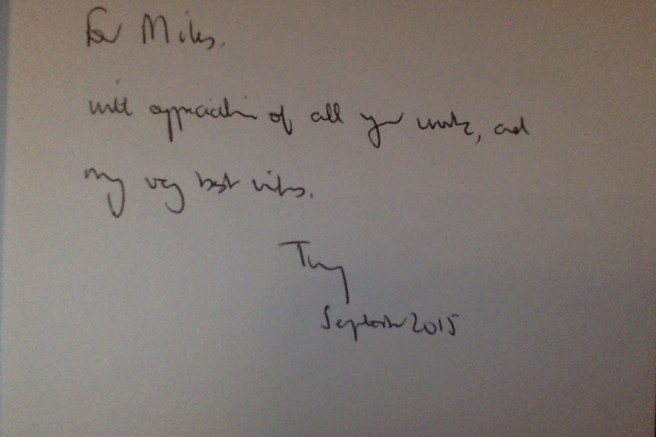
tony-atkinson-inscribes-my-copy-of-his-book-inequality
Tony Atkinson’s inscription in my copy of his last book, Inequality: What can be done?

[ If you want to know more about this great economist, start with this post which will also direct you to his website.

Beatrice Cherrier has written a lovely tribute to Professor Atkinson, paying respect to his fundamental contributions to public economics: “Remembering Tony Atkinson as the architect of modern public economics.”

Thomas Piketty has done the same, paying respect to his empirical work on income inequality: “Passing of Anthony B. Atkinson.”

Andrew Leigh offers both a professional and a touching personal sketch of the man: “Tony Atkinson is the economist who had the measure of inequality.” As does Thomas Piketty: “Passing of Anthony B. Atkinson.”

Tony’s most recent contribution—continuing a long line of work on poverty—-is a World Bank report known as the Atkinson Report. Read Francisco Ferreira’s blog post: “Tony Atkinson (1944-2017) and the measurement of global poverty.”

And read this, from his colleagues at the London School of Economics: Tony Atkinson 1944-2017.

The Financial Times published an obituary on January 2nd, 2017 called “Sir Tony Atkinson, economist and campaigner; 1944-2017;” The New York Times on January 3rd, 2017, “Anthony B. Atkinson, Economist Who Pioneered Study of Inequality, Dies at 72;” and The Economist on January 7th, Anthony Atkinson, a British Economist and expert on inequality, died on January 1st . ]

I’ve been blogging for five years, and here are my 10 favourite posts

With the New Year approaching, permit me the opportunity to wish you and yours peace and prosperity.

The end of 2016 marks the fifth year of my blog, and I’m grateful to my students and readers for making it worthwhile, and particularly to those who have taken the time to reblog, comment on, or otherwise share one of my 148 posts.

Rather than offer you the usual top ten most popular posts, here are links to my favourite posts written at some point since I started blogging in November 2011. They are not necessarily the most viewed, but I like them because they best illustrate the principles motivating my writing:

  1. Write about what you know, and give readers the opportunity and resources to learn more.
  2. Focus on what is relevant—what people want to read, and what contributes to a constructive conversation about public policy.
  3. Do this in a professional way that uses the principles of economics.

Here are links to my ten favourite posts of the last five years.

Continue reading “I’ve been blogging for five years, and here are my 10 favourite posts”

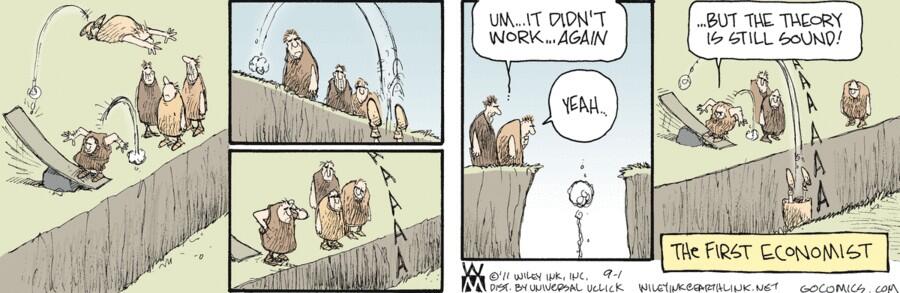
Economics is a science

cartoon-falisfying-theory
(Click on image to enlarge.)

When asked to list the five books that have most influenced his writings, the acclaimed British novelist Ian McEwan put a book called “What Science Offers the Humanities” on the top of his list. He goes on to suggest that science is “a matter of beauty”, to be admired just as we admire our favourite painting, song, or novel. He’s right. Science is beauty, and I would add, economics is a science.

Continue reading “Economics is a science”

Macroeconomics celebrates its 80th birthday this year


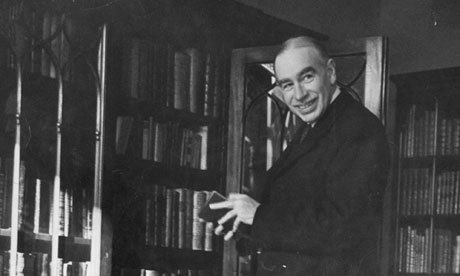
John Maynard Keynes
John Maynard Keynes, the father of macroeconomics.

Macroeconomics was born exactly 80 years ago this year, in 1936.

John Maynard Keynes (pronounced “Canes”) published The General Theory of Employment, Interest and Money in 1936, and it was arguably one of the most influential books of the 20th century.

Macroeconomics was born almost out of necessity. Keynes purposed a new theory of the overall level of employment that sought to explain the sharp rise of joblessness during the late 1920s, and its stubborn persistence in the following years. But even if it was motivated by real life challenges, this was a book about theory, with the good professor from Cambridge University in the United Kingdom clearly stating in the opening sentences of the book’s preface:

This book is chiefly addressed to my fellow economists. I hope that it will be intelligible to others. But its main purpose is to deal with difficult questions of theory, and only in the second place with the applications of this theory to practice. for if orthodox economics is at fault, the error is to be found not in the superstructure, which has been erected with great care for logical consistency, but in a lack of clearness and of generality in the premises. Thus I cannot achieve my object of persuading economists to re-examine critically certain of their basic assumptions except by a highly abstract argument and also by much controversy. I wish there could have been less of the latter. But I have thought it important, not only to explain my own point of view, but also to show in what respects it departs from the prevailing theory. Those, who are strongly wedded to what I shall call ‘the classical theory’, will fluctuate, I expect, between a belief that I am quite wrong and a belief that I am saying nothing new.

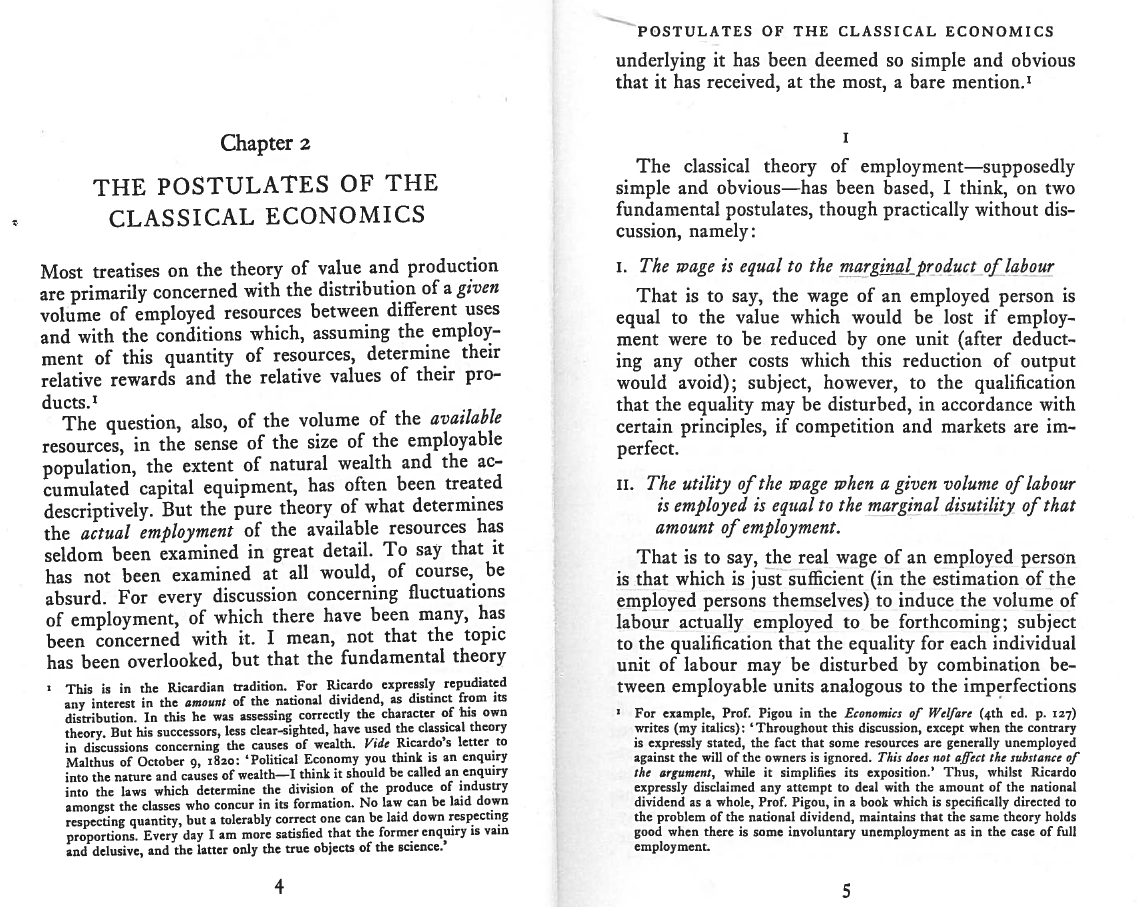
In other words, move aside Dude, I’m starting a revolution. Keynes targets the hapless Arthur C. Pigou, who makes a cameo appearance as the stand-in for the classical theory in the famous Chapter 2 of The General Theory.

The opening pages of Chapter 2 of Keynes's General Theory
The opening pages of Chapter 2 of Keynes’s General Theory. (Click on image to expand.)

The classical model assumes a market for labour services that works like any other perfectly competitive market.  The price of labour—the wage rate—will move up or down to clear any excess supply, or alleviate any excess demand. Unemployment doesn’t really exist, or if it does it is fleeting and transitory, reflecting frictions as workers move between jobs, needing time to gather information and find them. If unemployment persists, it must be because workers are for some reason refusing to take a cut in wages. There is an excess supply of labour—that is, unemployment—because the wage rate is too high.

Keynes objects to this blame-the-victim argument: “the contention that the unemployment which characterizes a depression is due to a refusal by labour to accept a reduction of money-wages is not clearly supported by the facts” (Keynes 1936, page 9). The classical theory does not work, and we need something new, a new set of assumptions and logic that explains the facts.

There are two parts in today’s lecture. In the first we talk about the birth of macro-economics, and show that the high and persistent unemployment of the 1930s which motivated The General Theory, also characterizes what some of the rich countries have been through in the past eight or nine years. In the second, we begin our discussion of some of the basic vocabulary of macroeconomics, particularly the measurement of the macro-economy with national income accounting. Your prime objective is to fully understanding the meaning, the uses, and the abuses of “Gross Domestic Product.”

Rely on the readings listed in the course outline, and be prepared to discuss the meaning of unemployment and inflation for next class. The assignment will help guide you.


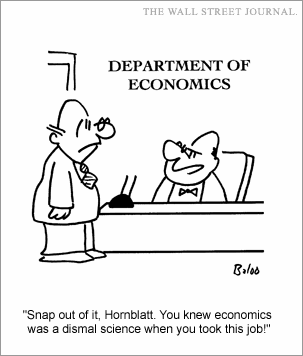
Welcome to your first course in economics

cartoon-dismal-science

This is an exciting time to be studying economics!

The “Great Recession” of 2007/2008 echoed for almost a full decade in high unemployment in European countries, in lower earnings and wage rates in the United States, and is even more strongly imprinted in excessive debt, low employment, and outright despair in other countries like Greece and Italy. Inflation is low, unemployment is exceptionally high (particularly among young people), and exchange rates keep bouncing around. And now twelve years later in the United States, the unemployment rate has fallen from exceptional highs to an historic low, yet the middle class is full of anxiety as globalization has come to be seen as more of a threat than an opportunity, as the computer revolution continues to fundamentally change the way people in all rich countries work and interact with others, and inequality keeps rising!

Every responsible citizen should have an understanding of the basic principles of economics. Without it how can you possibly understand some of the critical debates in almost every recent election in the rich countries: is a balanced government budget a good thing or a bad? how can governments create more jobs? why are interest rates so low, and should inflation be a worry? Is inequality something we should celebrate, or something to question?

This is the first class of a course that is designed to meet the needs of students interested in public policy who may have had only limited exposure to economics. But almost anyone can follow along. Upon completion of the course successful students will be familiar with the basic principles of economics, and be able to apply them critically to issues dealing with American and international public policy.

Your next steps?

Download the course outline, and get the three required books. Then watch one prominent macro-economist—Joseph Stiglitz—explain his views of what caused the Great Recession and what government should do about it in this presentation given about one year after the meltdown was unleashed in the autumn of 2008. Pay attention to the vocabulary he uses: list words that are not familiar to you, try to discern when he is speaking about “microeconomics” and when he is talking about “macroeconomics”, think about the logic he uses and what this says about the way economists think. Here is a list to help guide you.

Our studies start next week with a discussion of what we mean by “economics,” and what is the essence of the economic approach. To be prepared for our discussions read the readings listed in the course outline for February 4th.

[ Updated February 10th, 2020. ]