
Here is the presentation called “Inequality and Opportunity” that I am pleased to make to a luncheon meeting of the Ottawa Economics Association. The paper upon which it is based is called “How to Slide Down the Great Gatsby Curve.”
Category: Great Gatsby Curve
The Great Gatsby: as Hollywood never imagined it
After much anticipation Hollywood finally releases its version of F. Scott Fitzgerald’s classic novel, The Great Gatsby.
Was Gatsby a crook? Or was he a victim of a crooked game, the American Dream as a broken promise?
In this program originally aired on CBC radio last August, Sarah Churchwell of the University of East Anglia, a professor of American literature and author of Careless People, interprets Fitzgerald as saying the American Dream is a lie.
But listen also for my reading of a few passages to appreciate, tongue-in-cheek, why the underlying economics suggest that The Great Gatsby is indeed a novel for our times.
If you want the movie version, and a detailed discussion of The Great Gatsby Curve, here is a lecture I had the honour to give earlier this year at the University of Lethbridge on the invitation of the Prentice Institute and its Director Susan McDaniel.
I have to admit, however, the Hollywood version looks somewhat more exciting!
Public policies for equality and social mobility
“Inequality matters. It matters because it has the potential to shape opportunity.”
This is how I begin the conclusion to a just finished paper that will serve as a background document for an event called “Equality of Opportunity—a Canadian Dream?” that will take place Tuesday evening, February 26th.
The event is organized by Canada2020, an Ottawa based think tank, and will take the form of a panel discussion moderated by Diana Carney and include as panelists Carolyn Acker (founder of Pathways to Education), Zanny Minton Beddoes (the economics editor at The Economist), Ron Haskins (senior fellow at The Brookings Institution), and me.
The conclusion to my paper, “Public policies for equality and social mobility”, continues:
Continue reading “Public policies for equality and social mobility”
How to Slide Down the Great Gatsby Curve: Inequality, Life Chances, and Public Policy in the United States
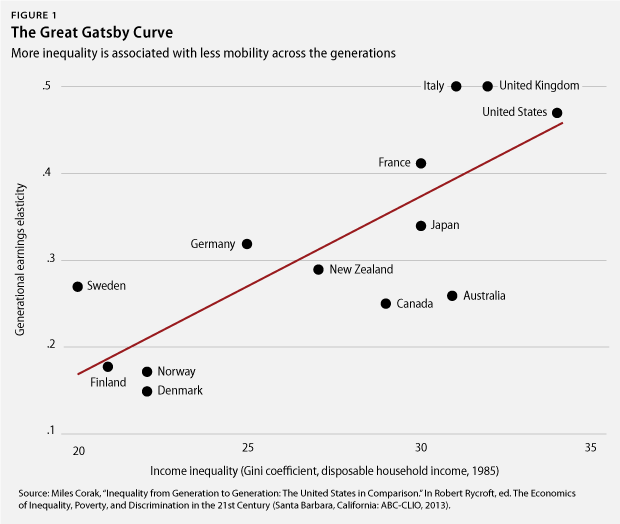
The Center for American Progress has released a study I wrote called “How to Slide Down the Great Gatsby Curve: Inequality, Life Chances, and Public Policy in the United States”. Here is an excerpt:
The US Senate wonders about tax policy for the American Dream: why are schools failing to promote social mobility?
The American education system is of relatively more advantage to the relatively advantaged. As a result it does less than it could to promote opportunity.
In response to my July 10th testimony to the Senate Committee on Finance hearing on “Helping Young People Achieve the American Dream” I received some homework, a series of questions asking me for a good deal more detail. You can review all of the questions on my November 11th post, but a couple of questions posed by the Committee Chairman, Senator Max Baucus of Montana, speak to probably the most important driver of social mobility, and raise particularly important issues for public policies.
The US Senate wonders about tax policy for the American Dream: Senator Hatch asks about the validity of the statistics
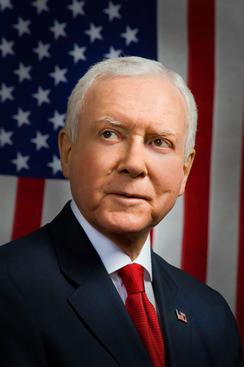
Senator Orrin Hatch has a sharp eye.
In response to my July 10th testimony to the Senate Committee on Finance hearing on “Helping Young People Achieve the American Dream” I received some homework, a series of questions asking me for a good deal more detail.
Senator Hatch, who is a US Senator for Utah, asks a thoughtful question about measurement issues. I will offer my answers to all the questions in a series of blog posts over the coming days. You can review the questions at my November 11th post. But I would like to begin with the first question Senator Hatch asks because it gives us the opportunity to clarify what the statistics mean. This is a good place to start.
 Economics for public policy