Poverty and equality of opportunity: three pictures to motivate policy for social mobility

Read my comments presented to the Public Economics Forum on “Intergenerationally Disadvantaged: Newest Evidence and What it Means for Policy,” organized by the Melbourne Institute for Applied Economic and Social Research, on November 26th, 2019 in Canberra, Australia.

Social mobility varies across countries, but it varies in a particular way, a way that I argue is relevant for the conduct of public policy.

Inequality begets inequality. Up to 50% of income inequality is passed on to the next generation in countries like the United Kingdom, Italy, and the United States, but only 20% or even less in countries like Norway, Denmark and Finland, where there is a much smaller gap between parent incomes.
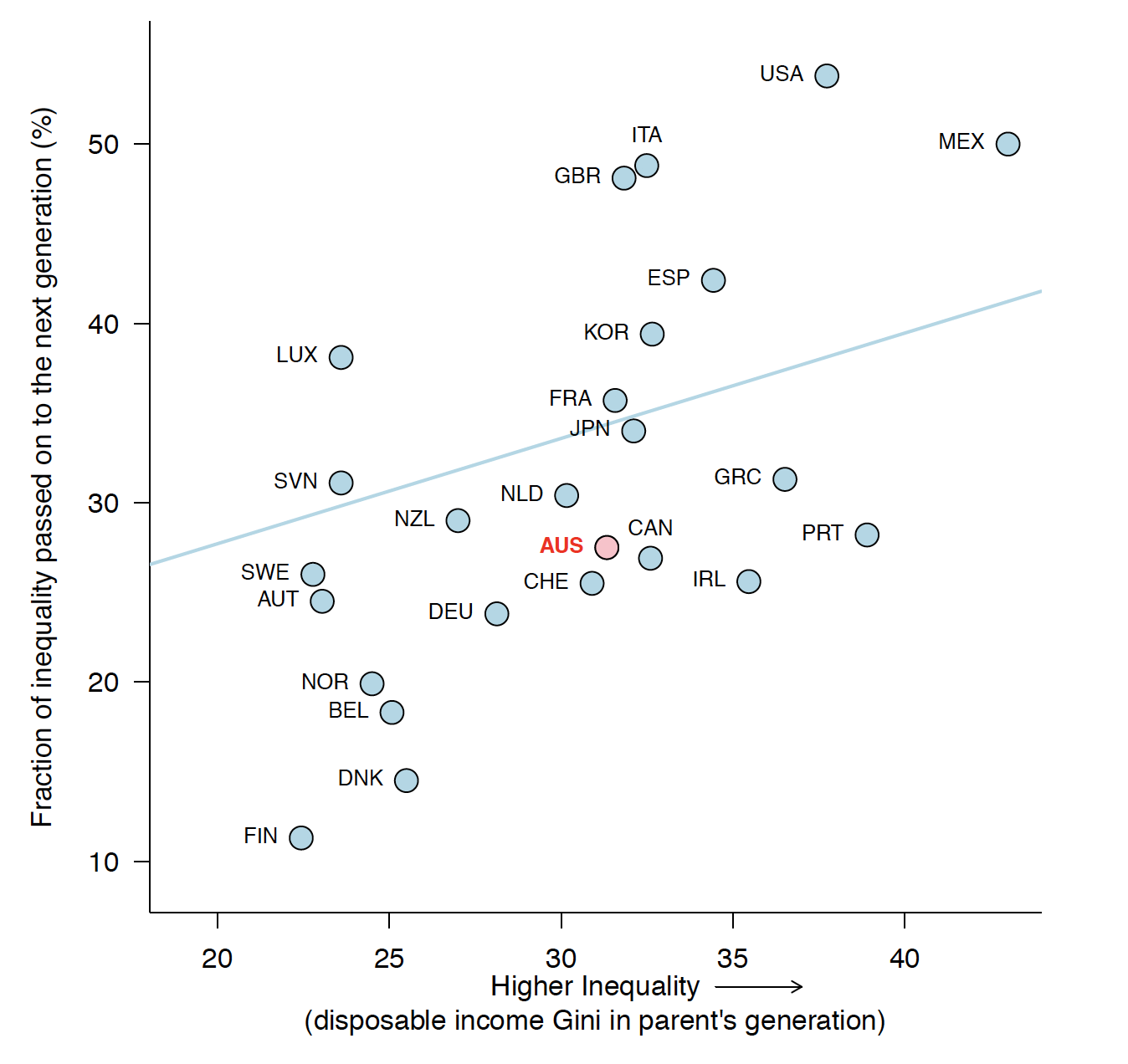
Incomes are stickier across generations where inequality is higher

But different kinds of inequality matter in different ways for social mobility.

Research using the variation of social mobility within countries like the United States and Canada shows that intergenerational cycles of low income are more likely in communities that have more bottom half inequality, the correlation with overall inequality and with top end inequality being much weaker. Upward mobility is easier when the poorest incomes are not that far off from middle incomes.

The bottom line for public policy is don’t let inequality increase in the bottom half of the income distribution, indeed strive to reduce it in a way that encourages labour market and social engagement.
Continue reading “Poverty and equality of opportunity: three pictures to motivate policy for social mobility”

Tax the rich! Tax the rich! Tax the rich? But why?

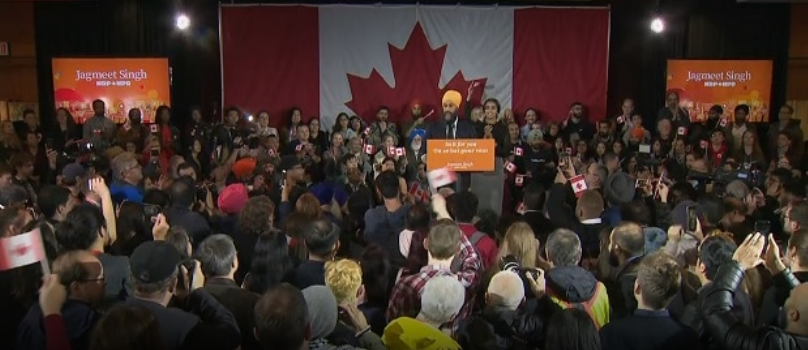
Jagmeet Singh’s promise in his election night speech that “we’re going to make sure the super wealthy start paying their fair share” was met with cheers, the decibel level rising as his fellow New Democrats chanted: “Tax the rich! Tax the rich! Tax the rich!”

The leader of the New Democratic Party addresses his supporters.

It is not entirely true that the federal election ignored big policy issues, but if it was issues-driven, how did a wealth tax fly under the radar?

At some point in the coming weeks Mr. Trudeau will meet Mr. Singh over coffee to talk tax policy. Sadly, the election left Canadians no wiser as to what divides progressives on the issue, but if you want the full picture look south to the Democratic leadership campaign.

Continue reading “Tax the rich! Tax the rich! Tax the rich? But why?”

Equality of opportunity is a choice

Tony Atkinson, the great British economist, encourages us to think of inequality as a choice, something that can be influenced by public policy.

If this is the case for equality of outcomes, then it is surely also so for equality of opportunity; the significant differences in social mobility between the rich countries hinting at the role governments play in determining the degree to which family background is destiny, the rich raising the next generation of rich adults, the poor seeing their children face low chances of upward mobility.

Some of these differences may simply reflect different social priorities, but others may teach us about the power of different policies. Continue reading “Equality of opportunity is a choice”

Ever wonder where to find the Trump Tower? Then take this “Trump Walking Tour” with me, and learn even more

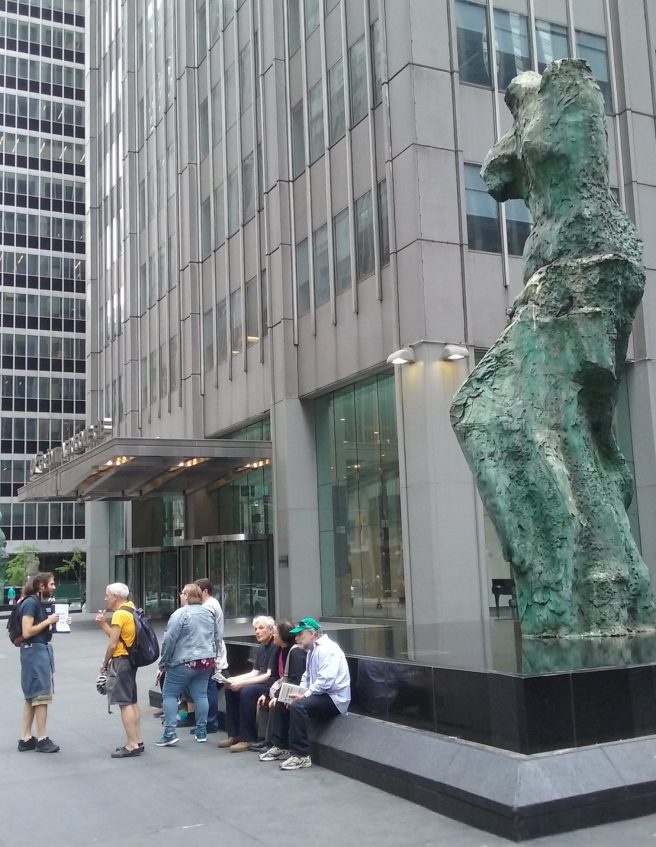
Meet at the southwest corner of 53rd Street and 6th Avenue, under the large statue across from the Hilton Hotel, the tour guide will be holding a “Social Justice Tours” sign.

That is what The Municipal Arts Society of New York website counsels, and indeed, Dan is there … Social Justice Tours being the non-profit he started three years ago, that is taking off quite nicely, nicely enough—thank you very much—to have its website hacked by someone with a Russian IP address. You might have a little trouble reaching them at socialjusticetours.com for at least the next week or so, until the volunteer IT guy gets things fixed.

But this much I could get from my web search “Social Justice Tours engages New Yorkers in critical dialogue by exposing injustice & highlighting inequality in an effort to encourage thought & inspire action.” So who better than to run a Jane’s Walk—the grassroots celebration of the famous urban activist Jane Jacobs—called Trump Walking Tour.

Sounds like the walking tour for me. Last week a tourist on 5th Avenue gingerly approached me in halting English to ask for directions to”Tower Trump?”, so maybe I should know a bit more about Trump’s New York than just simple directions when standing a half a block away from the famed (sometimes inflamed) building.

This is a tour about Trump history, not Trump presidency. Dan assures us that he has read four books about Donald Trump. We are going to stick to the facts about the man himself. But we also recognize that other agents—whether the shady underworld, the commercial banks, the criminal justice system, or failures of public policy—facilitated his rise: he is not just an individual.

His story shows us how the real estate industry has shaped New York into a billionaire’s city, in many ways trampling over the commoners, but not without observing some lessons about the importance of organizing and collectively fighting back against bullies and bulldozers.

This is a social justice tour after all.

“I have yet to have a Trump supporter on my tour.” The crowd of 16 New Yorkers cheers this opening line with approval, one proudly proclaiming “I’m a Never Trumper.” And we’re off.

Continue reading “Ever wonder where to find the Trump Tower? Then take this “Trump Walking Tour” with me, and learn even more”

Poor children are twice as likely to grow up to be poor adults in some Canadian communities than in others

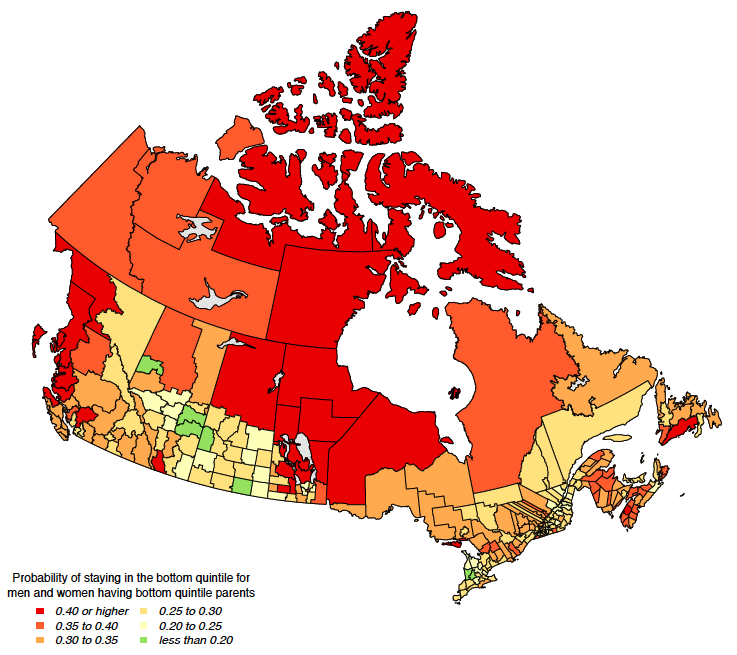
Intergenerational cycles of poverty vary across Canada, with low income children in some places facing a less than one-in-five chance of growing up to be poor adults, but in others the rate is more than double. The strong majority of children raised by lower income parents face a greater than one-in-four chance of growing up to be low income adults, and for many these odds were at least as high as one-in-three.

The chance that poverty will be passed on across the generations is 30 percent for the country as a whole, and the majority of children, 54 percent, live in 97 of a total of 266 municipalities where the chances of falling into an intergenerational cycle of low income are between 25 and 30 percent. A further 24 percent of poor live in a community where these chances are at least 0.30 but under 0.35.

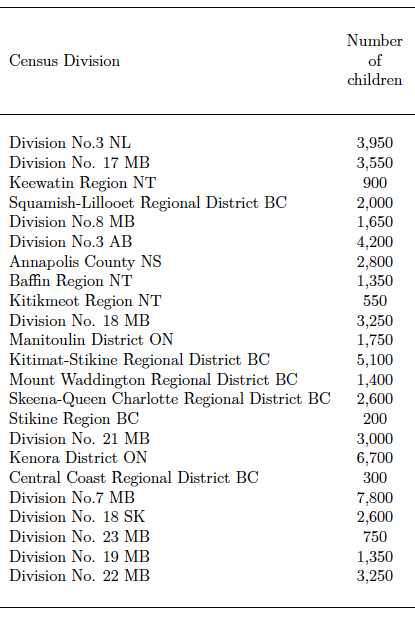
There are 23 municipalities with a 40 percent or greater chance of an intergenerational cycle of low income. These communities are all small in population, and account for two percent of the total number of children.

There is a greater than 40% chance of intergenerational poverty In 23 Census Divisions

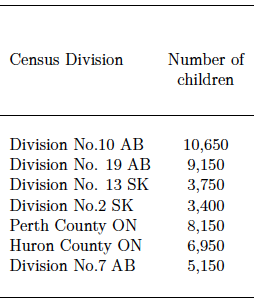
There are only seven of 266 communities in which the probability of a cycle of low income is less than 20 percent, representing only 1.6  percent of all children.

There is less than a 20% chance of intergenerational poverty in seven Census Divisions

The average parent income in these communities is below the national average. This raises the possibility that geographic mobility may be an important aspect of intergenerational mobility. The two Ontario communities listed in the above table are not areas in which there was significant economic growth, but the distances and costs associated with moving to nearby regions that were poles of growth—more specifically Toronto—were likely low.


[ The findings described in this post are drawn from my recently released research paper called “Divided Landscapes of Economic Opportunity: The Canadian Geography of Intergenerational Income Mobility.” You can learn more about this research, and download a copy of the paper and host of other information by reading the page devoted to this project at: MilesCorak.com/Equality-of-Opportunity . ]

Can you change your mind about inequality? Read my just published paper

The Pope has strong views about inequality because he has a theory, and doesn’t need data.

pope-francis-tweet-inequality-is-the-root-of-social-evil

One of Canada’s most prominent pundits has strong views about inequality because he has data, and doesn’t need theory.

andrew-coyne-tweet-november-24-2016-inequality-is-an-utter-crock

I’ll probably never convince either of them to change their views, but maybe I can convince you with both theory and data.

Give me the chance by reading my just published paper, Inequality is the root of social evil,’ or Maybe Not? Two Stories about Inequality and Public Policy.”

I tell two stories about inequality. The first is from the perspective of those who feel it is not a problem worth the worry, and the second from the perspective of those who see it as “the defining challenge of our time.” I tell these stories to clarify their underlying logic, but also to clarify both the challenges facing Canadians and our understanding of what public policy should do about them.

But I have another motive. I would like you to appreciate the value of economic theory and statistical methods to a public policy discussion of this sort. It seems to me that without an appreciation of some basic elements of theory and measurement, it is too easy for the policy conversation to go astray.

Download a free copy from the publisher’s website—Canadian Public Policy, December 2016—and tell me what you think.