Three rules for good pundit behaviour, or if you like: how to obstruct the debate on inequality in three easy steps

Inequality is increasing in Canada. Or is it?

A short report on the topic released by a major Canadian bank includes the bold heading “Income inequality has been unchanged in Canada — say what?”. This apparently contrarian finding has been seized upon by at least one influential pundit in a way that only serves to obstruct constructive public policy discussion.

A debate is in order, not over whether inequality has increased—because it has—but why this is important, and what could, or for that matter should, be done about it.

But this sort of discussion requires the best of our public commentators, and in this post I offer three rules for good pundit behaviour. Economic statistics can be confusing and they can be used in confusing ways, purposely or not, and so these rules might also be a set of general guideposts for the average reader to help separate fact from fiction, since after all we can’t expect pundits to always follow them.
Continue reading “Three rules for good pundit behaviour, or if you like: how to obstruct the debate on inequality in three easy steps”

The right way to think about social and economic rights

The Universal Declaration on Human Rights, which we celebrate every December 10th, offers both a powerful and beautiful statement of what it means to be human and the goals we should pursue as a society. But the Declaration is an incomplete guide to designing the programs to meet these goals: it offers inspiration to advocates, but not a guidebook for pragmatists.

Pragmatists and policy makers need to read the Universal Declaration through the lens of economists, rather than don the robes of lawyers.

Human Rights Day 2012, click to enlarge

Continue reading “The right way to think about social and economic rights”

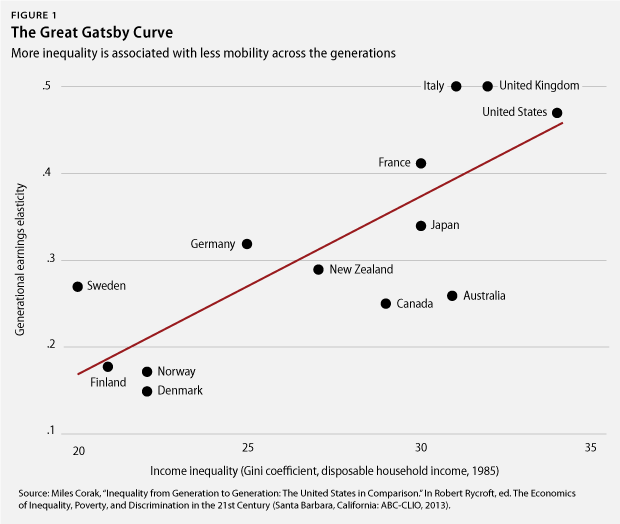
How to Slide Down the Great Gatsby Curve: Inequality, Life Chances, and Public Policy in the United States

CorakMiddleClass_fig1

The Center for American Progress has released a study I wrote called “How to Slide Down the Great Gatsby Curve: Inequality, Life Chances, and Public Policy in the United States”. Here is an excerpt:

Continue reading “How to Slide Down the Great Gatsby Curve: Inequality, Life Chances, and Public Policy in the United States”

The US Senate wonders about tax policy for the American Dream: How can income transfers be designed to benefit all children in need?

The tax system is increasingly used to transfer cash benefits to families with children, but the United States accepts the trade-offs in program design very differently than other countries and gives children much less support.

In response to my July 10th testimony to the Senate Committee on Finance hearing on “Helping Young People Achieve the American Dream” I received some homework, a series of questions asking me for a good deal more detail. You can review all of the questions on my November 11th post. Child poverty is central to discussions of social mobility, and it is natural to wonder how tax policy can be designed to support the incomes of the least advantaged.

Continue reading “The US Senate wonders about tax policy for the American Dream: How can income transfers be designed to benefit all children in need?”

The US Senate wonders about tax policy for the American Dream: Do parents act in the best interests of their children?

How should programs intended to support children in low-income families be designed if parents don’t always act in the best interests of their children?

This question, among others, was posed to me in response to my July 10th testimony to the Senate Committee on Finance hearing on “Helping Young People Achieve the American Dream.”  You can review all of the questions on my November 11th post.

In one way or another they address the fundamental drivers of the extent to which children grow up to be adults having the same socio-economic status as their parents. Family background matters for life chances because of three related forces: inequalities originating in the labour market, the capacity of families to invest in the skills and aptitudes of their children, and the degree to which public policy levels the playing field.

What parents do matters a good deal, and a question posed by the Committee Chairperson, Senator Max Baucus, recognizes this, and wonders about the implications for the design of public policy.

Continue reading “The US Senate wonders about tax policy for the American Dream: Do parents act in the best interests of their children?”

The US Senate wonders about tax policy for the American Dream: why are schools failing to promote social mobility?

The American education system is of relatively more advantage to the relatively advantaged. As a result it does less than it could to promote opportunity.

In response to my July 10th testimony to the Senate Committee on Finance hearing on “Helping Young People Achieve the American Dream” I received some homework, a series of questions asking me for a good deal more detail. You can review all of the questions on my November 11th post, but a couple of questions posed by the Committee Chairman, Senator Max Baucus of Montana, speak to probably the most important driver of social mobility, and raise particularly important issues for public policies.

Continue reading “The US Senate wonders about tax policy for the American Dream: why are schools failing to promote social mobility?”