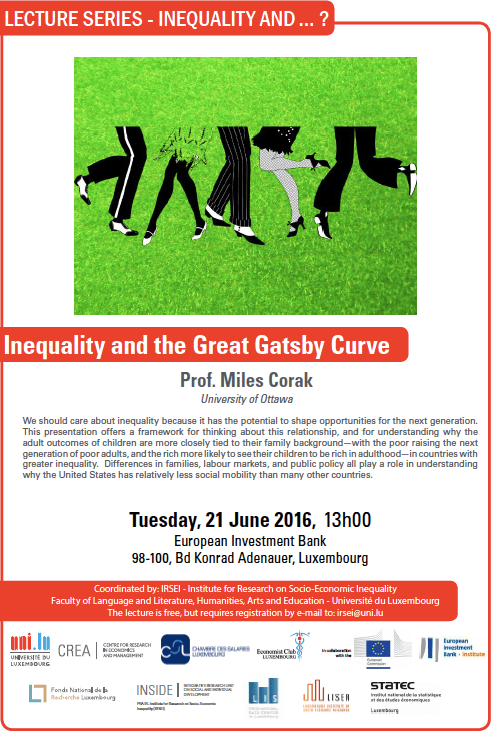
We should care about inequality because it has the potential to shape opportunities for the next generation. My presentation at the European Investment Bank offers a framework for thinking about this relationship, and for understanding why the adult outcomes of children are more closely tied to their family background—with the poor raising the next generation of poor adults, and the rich more likely to see their children to be rich in adulthood—in countries with greater inequality.
Differences in families, labour markets, and public policy all play a role in understanding why the United States and the United Kingdom have relatively less social mobility than many other countries.
One of the responsibilities of being President of the Canadian Economics Association is organizing the conference program; but one of the honours is giving the “Presidential Address” to the entire assembly of the next year’s conference. This year’s address is by Charles Beach of Queen’s University who spoke on “Changing income inequality: A distributional paradigm for Canada.”
This is a particularly special meeting to give the Presidential Address, as it is the association’s 50th anniversary with a record attendance of over 1,200.
Beach’s objective is to pull together a whole host of facts, and offer a framing that can drive a consistent narrative, and in this way to understand underlying drivers of inequality in Canada and guidance for policy. Beach also points out that there are significant differences between Canada and the United States.
There has been a decline in the share of income going to families in the middle over the last 30 years, and there has been a corresponding increase in the share going to the top 10%. Interestingly the share going to the bottom 20% has not changed so much, a big difference from the United States. Median family incomes have also been slightly increasing in Canada, another big difference between these two countries. The other big cross-country difference is that while top 1% shares have gone up in both countries, the rise is bigger in the United States.
It is also true that the returns to education have risen in both countries, but again more so in the United States. Several things could be driving this: immigration policy in the US is more focused on low skilled workers than in Canada where the focus is somewhat more on high skill immigrants; Canada has experienced a boom in the resource and housing sectors that disproportionately employ lower skilled workers, and unionization rates are higher; there was also a big inflow of highly educated women entering in the labour force in both countries, but more so in Canada. All these factors have had the tendency to blunt earnings growth at the top in Canada, and support it somewhat at the bottom, but perhaps done the opposite in the United States.
Typical workers have been benefiting less from overall output gains, but again the patterns differ between the two countries. Labour income as a proportion of GDP has hovered between 50 and 55% in Canada since 1960, but in the United States drifted from about that in the 1960s to below 45% by 2010.
Branko Milanovic begins his book, Global Inequality, by posing a question: “Who has gained from globalization?” Many thoughtful Americans have the confidence to answer in a sentence. The gains have been captured by the top 1 percent. And the book ends with another question: “Will inequality disappear as globalization continues?” Many might be just as quick to answer: Of course not, the rich will get richer!
But life is not so simple. Between these two questions Branko Milanovic offers us not just a plethora of facts about income inequality that will surely make his readers think twice. More importantly, he shows us the power of bringing the facts into focus by putting a new lens over these pressing issues—a global perspective. He takes more than 200 pages to answer the first question, and only a sentence to answer the second.
The Census is built block-face by block-face. It is built sub-division by sub-division. Village, township, city, municipality, it is built until the entire country is perfectly and completely tiled.
The Census is a machine, complicated and intricate. And the public servants working at Statistics Canada should be rightly proud of the hard work and dedication devoted to the development, maintenance, and management of this machine. Even the most jaundiced among us, regardless of political persuasion, should recognize and acknowledge this accomplishment.
The Jean Talon building, in the bottom right, was originally called the “Census Building.” Photograph by Philip Smith.
The value of this machine is that it lets us see ourselves in detail more precise than any other mirror, and the return of a mandatory long form, in which Canadians are required to offer up a description of some of the most private aspects of their lives, is hailed by many as a major turn in public policy that will allow this picture to stay clearly focused.
But the Census is more than a machine. Jean Talon knew that. The very first Census he conducted, beginning in the later part of 1666, was clearly an act of nation building. He used it to help him, and France, develop and build a viable colony extending from the shores of the Saint Lawrence River, transforming the countryside into a prosperous agricultural region that would prepare the way for waves and waves of more immigrants. The Census is an act of political imagination.
And the public servants who work at Statistics Canada are not well placed to exercise that imagination, even if at times what they do in managing the machine casts them in that role.
There is still much to be done for Canadians to accept and appreciate the benefits of the Census, and for the federal government to give them ownership of the results. The Census is mandatory—by law it must be filled out—but we should strive to think of it as voluntary, our participation to be both exercised and celebrated as an act of citizenship in a way that fosters each Canadian’s political imagination.
I am in Washington DC at the Brookings Institution participating in a conference based on the papers that will appear in the next issue of the Brookings Papers on Economic Activity, and specifically to discuss a paper called “Income Inequality, Social Mobility, and the Decision to Drop Out of High School.”
we posit that greater levels of income inequality could lead low-income youth to perceive a lower return to investment in their own human capital. Such an effect would offset any potential “aspirational” effect coming from higher educational wage premiums. The data are consistent with this prediction: low-income youth are more likely to drop out of school if they live in a place with a greater gap between the bottom and middle of the income distribution. This finding is robust to a number of specification checks and tests for confounding factors. This analysis offers an explanation for how income inequality might lead to a perpetuation of economic disadvantage and has implications for the types of interventions and programs that would effectively promote upward mobility among low-SES youth.
The slides for my discussion of the paper are here.
My comments revolve around three questions raised by this nicely crafted paper:
Inequality of what?
the authors focus our attention on the degree of inequality in the lower half of the income distribution
but they also use a measure of inequality based upon all sources of income, including benefits from government transfers
so policy makers might wonder about the scope and design for government transfers to lower inequality in the lower half, and in particular of expanding the EITC to include men
Social Mobility for whom?
state-level inequality raises the chances that boys from low status backgrounds will drop out of high school, there is no statistically significant influence for girls
but these patterns also depend upon the abilities that these boys have when they start high school
I show that these abilities are actually correlated with the abilities children have when they were kindergarten age, so we might also wonder about whether policy should be directed to individuals and high schools, or to families and young children
Whither Dropping Out?
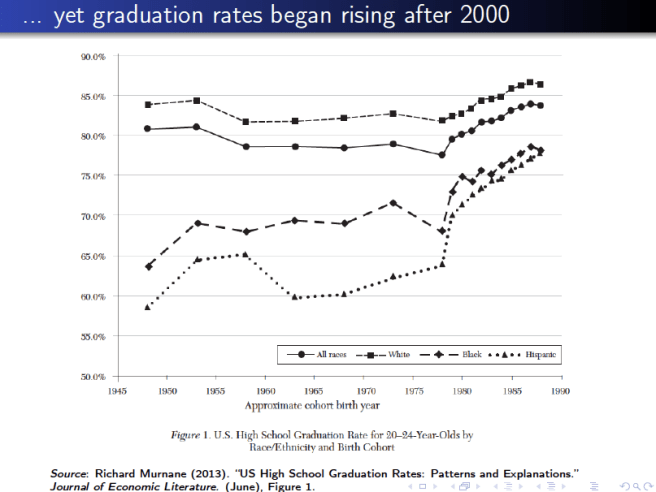
the trend in dropping out of high school has actually been on the decline since about 2000, yet inequality has not changed that much during this period
but this paper helps us to think more constructively about trends, it may be that the degree of disenchantment about future prospects have changed


 Economics for public policy