Why Canada should foster a ‘second-chance’ society

[This is the unabridged version of an article published in the Globe and Mail on February 22nd, 2016.]

Canadians should be thumping their chests, after all many others are patting us on the back. When it comes to social mobility we are among the world leaders. Even U.S. President Obama acknowledged that a poor child is more likely to move up in life in Canada than in the United States.

This kind of mobility, the capacity for children to become all that they can be without regard to their starting point in life, is the bedrock of fairness.

For sure this distinct Canadian accomplishment of making the American Dream more of a reality north of the border was never without its imperfections, ringing rather hollow for many native communities, some immigrant groups, and certain visible minorities. Great accomplishments on average never reveal the full diversity of experience.

But just as importantly winning the social mobility sweepstakes is something for the record books, not a guarantee for the future. The foundations of fairness are shifting; luck will matter more, meritocracy will be perverted by growing inequality, and our public policies haven’t really changed to prepare for the new reality that is already pressing on young people.

Continue reading “Why Canada should foster a ‘second-chance’ society”
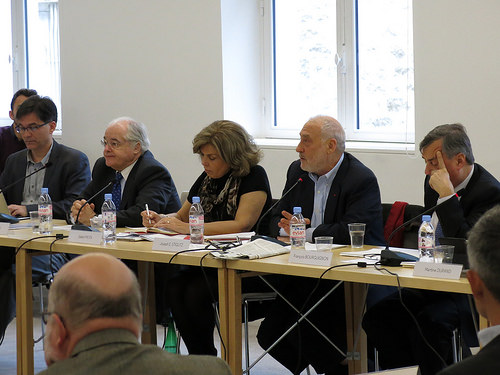
Economic theory and practical lessons for measuring equal opportunities

High Level Expert Group Workshop on Inequality of Opportunity January 2015 Paris OECD
High-Level Expert Group, January 2015, Paris

I’ve written a working paper based upon a presentation I made in January 2015 to a workshop on “Inequality of Opportunity” held by the High-Level Expert Group on the Measurement of Economic Performance and Social Progress. The OECD, which was one of the organizations co-hosting the workshop, is currently reviewing the paper for publication.

You can download the current draft here, and I’d invite any comments before it is finalized and officially released.

You can view the workshop agenda and all the presentations here. The broader program of the Expert Group, which includes the development of “distributional National Accounts”—national accounting that recognizes inequality and the distribution of income—can be found at this link.

What follows for quick reference is the introduction of my paper. If you have a chance to read the whole thing and have some thoughts to make it better, feel free to include your suggestions in the comment section at the end of this post, or email them to me.

~~~~~ ~~ o ~~ ~~~~~

Continue reading “Economic theory and practical lessons for measuring equal opportunities”

Inequality: a fact, an interpretation, and a policy recommendation

Tackling inequality and poverty aren’t mutually exclusive; rather, efforts devoted to fighting the former contribute to solving the latter.

Continue reading “Inequality: a fact, an interpretation, and a policy recommendation”

The OECD Centre for Opportunity & Equality will address some important questions

OECD Centre for Opportunity & Equality Launch Agenda

The OECD is continuing to expand its highly regarded work on inequality by launching a new research centre. The announcement will be formally made in Paris on Monday with a series of panel discussions, featuring economists, policy makers and government officials from a number of countries. I’m pleased to be a participant, but I’m looking for advice on how to answer to some questions that may be asked. I’d love to hear your ideas, so send them along.

Continue reading “The OECD Centre for Opportunity & Equality will address some important questions”

Baffled by the middle class debate? Here’s some background about Canadian Middle Class prosperity beating out the US

If you are interested in more details about the commentary I wrote for today’s Toronto Star, “The Inequality Debate: Canada’s middle class is losing ground,” you can find the original version in this post. You might also have an interest in this post, imaginatively entitled: “Who are the middle class?

A number of journalists have recently addressed the topic, nicely offering a broader perspective. Whether you like to listen, watch, or read, you have some good choices.

Listen to this Ira Basen documentary called “What We Talk About When We Talk About The Middle Class,” which was broadcast on CBC Radio’s program “The Sunday Edition”; watch this documentary by Holly Doan for CPAC, which also features the much-cited New York Times article (look down the right column of the page to find it as “Vote 2015 Special: The Middle Class”); or read this Globe and Mail article, “The Middle Class: Just Who are They, Anyways?” by Erin Anderssen.

I hope all this helps to inform you about the talking point that, by waving around a New York Times article, leads our policy makers to dismiss the very fundamental and long-standng changes in the nature of work and incomes that are generating more insecurity for many Canadians, particularly young Canadians.

The main messages of “Too Many Children Left Behind,” a book published by the Russell Sage Foundation

Here are the slides for the presentation “Too many children left behind: The U.S. Achievement Gap in Comparative Perspective”, which I gave to the conference “Causes and Consequences of Inequality and Social Mobility: What Can Be Done?”

Click to access corak_too_many_children_left_behind_sapienza_rome_2015.pdf

The conference was held at the Faculty of Economics, Sapienza University of Rome on September 25th and 26th, 2015, and you can see the full program here: http://www.eticaeconomia.it/ee/wp-content/uploads/2015/09/Evento-n28_pdf.pdf