Inequality and Economic Opportunity … what do we care about? what do we measure? what should we do?

Inequality erodes opportunity, and limited opportunity exacerbates inequality.

This vicious inter-generational cycle has brought inclusive growth into question, contributed to the rise of populist sentiment, and strained the social contract in many rich countries. The way forward for researchers and policy makers requires not only a clear understanding of the facts about what kind of inequality matters and how it matters, but also an ethical grounding that speaks to the outcomes and opportunities that are important to citizens not only in the here and now, but also in the next generation.

This is the major message of a presentation I will be giving to the faculty and students of the PhD program in Economics at The Graduate Center of The City University of New York, where I am lucky to work and teach. My presentation—which also has the great benefit of being discussed by my soon-to-graduate PhD student, Aman Desai—makes this case by addressing three related questions

  1. What do we care about?
    • We care about self-realization that contributes to an expanding and inclusive community that in turn enhances the capacities of its members to become all that they can be. And this involves caring about a sense of progress, a sense of movement toward security and inclusion, and a sense of fairness.
  2. What do we measure?
    • Empirical researchers studying intergenerational mobility need to align what they measure with what we care about, which asks for an eclectic use of statistics and a sometimes subtle appreciation of how they relate to what we care about.
  3. What should we do?
    • Certainly public policy should be evidence-based, but it needs increasingly to be ethically-grounded, with researchers bringing their numbers to public policy by explicitly making their own values clear. In my view, three values should guide public policy toward what we care about: all humans are equal, and should be treated with dignity; labour has preference over capital; and wealth is created to be shared.

But what gives this presentation an extra spice, at least for me, is that April 10th, 2025 marks the 100th anniversary of the publication of F. Scott Fitzgerald’s novel, The Great Gatsby. So it is fitting for me to begin the presentation with a bit of biography on how the Great Gatsby Curve got its name!

Feel free to download the presentation slides, and certainly if you are at the Graduate Center, to attend the presentation!
Public Policy for Equality and Opportunity: Evidence-based and Ethically Grounded

Inequality erodes opportunity, and limited opportunity exacerbates inequality. This vicious intergenerational cycle has brought inclusive growth into question, contributed to the rise of populist sentiment, and strained the social contract in many rich countries. The way forward for researchers and policy makers requires not only a clear understanding of the facts about what kind of inequality matters and how it matters, but also an ethical grounding that speaks to the outcomes and opportunities that are important to citizens not only in the here and now, but also in the next generation.

This is the argument I make in a keynote lecture that I have had the privilege to give, first on October 20th 2022 to the 8th Annual Congress de Economía y de Políticas Públicas, SobreMéxico in Mexico City, and second on November 17th 2022 to the Conference on Wealth Inequality and Intergenerational Mobility at the Vienna University of Economics and Business in Vienna.

Download the latest version of my presentation.

Watch the presentation .

What will COVID Mean for the Future of Fiscal and Social Policy?

It is the stated goal of the Canadian federal government to foster “a strong and inclusive labour market that provides every Canadian with opportunities for a good quality of life.” The legacy of COVID has, however, led to policy incoherence, with some significant reforms directly putting this goal into question.

Continue reading “What will COVID Mean for the Future of Fiscal and Social Policy?”

“We don’t have a chance in hell …”, Canada’s poverty reduction strategy needs real voice

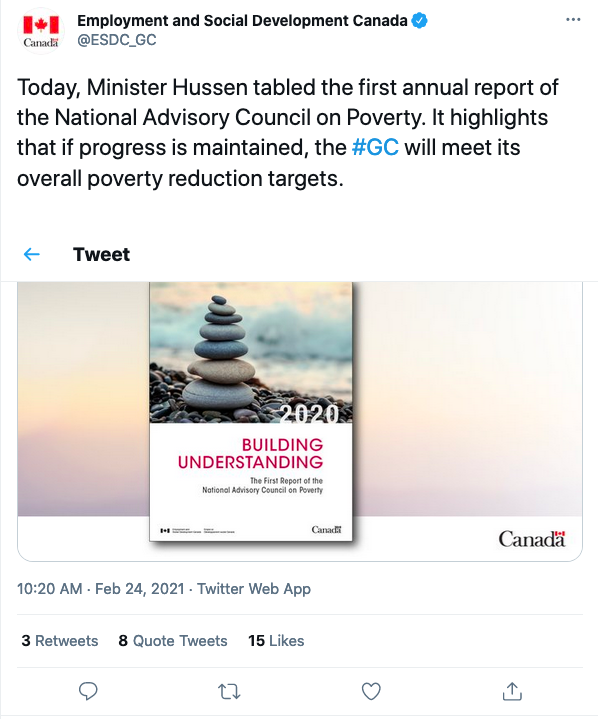
Source: https://twitter.com/ESDC_GC/status/1364596131590791171

The Minister of Employment and Social Development in the Canadian federal government, Ahmed Hussen, recently tabled an annual report taking stock of the country’s poverty reduction strategy.

The advisory council responsible for the reported dedicated it “to all those courageous people who shared their stories, successes and struggles with the Council in the hope that we would in turn share them across Canada. You are at the heart of this report.

People with “Lived experience” is how policy wonks and political staffers refer to them, stressing the importance of consulting citizens who are struggling with the challenges of living in poverty and facing the barriers of moving toward a better life.

My three-year old post explaining Canada’s official poverty line continually garners views because it ranks high on a Google search for “Canada poverty line.”

This means it gets read by a whole group of people who are not policy wonks, and often by people with “lived experience,” who often cry out and share their stories by proposing a comment for my web page, which if it has done any good helped them to realize how far below the poverty line they may well be.

I hesitate approving their comments for public viewing because of their revealing and personal nature.

But maybe I shouldn’t. They have voice, but they need to be listened to. So here is one more voice that encapsulates so much, and in many different ways, of what makes policy to the poor so important, but also reveals the limits of current actions.

Continue reading ““We don’t have a chance in hell …”, Canada’s poverty reduction strategy needs real voice”

Social Policy, Now: Next steps for income support and income insurance in Canada

Three next steps for social policy involve: 1. Maximizing auto-enrollment and just-in-time program delivery; 2. Offering full income support with engagement; and 3. Offering broad income and earnings insurance with agency. In this post I introduce the detailed discussion of these proposals that you can also download.


On March 24th, 2020 the Government of Canada Tabled Bill C-13, “An Act respecting certain measures in response to COVID-19,” in the House of Commons, and the next day the Bill received Royal Assent, unleashing the most extensive and quickest change to Canadian social policy in living memory, if not in the history of the country.

The Canada Emergency Response Benefit is the most notable part of the Bill, offering $2,000 of income support every four weeks to all working age Canadians who made at least $5,000 in the previous 12 months and lost their source of income due to the COVID-19 crisis.

Almost immediately the public policy discussion turned to “what’s next?” Certainly this was so in the short-term as the government and the public service became fully engaged in meeting the evolving needs of citizens and businesses in response to the most serious health and economic crises the country has experienced since World War II.

But increasingly, as the weeks and months passed, it was also so in the longer term: What’s next for the design of social policy in light of the needs and the gaps that the COVID-19 crisis has revealed?

This is the question I address in a detailed presentation that you can download.

In this post I introduce the issues and options for discussing the next steps for social policy, the word “Now” in the title having three meanings that guide this approach.

Continue reading “Social Policy, Now: Next steps for income support and income insurance in Canada”

Poverty and equality of opportunity: three pictures to motivate policy for social mobility

Read my comments presented to the Public Economics Forum on “Intergenerationally Disadvantaged: Newest Evidence and What it Means for Policy,” organized by the Melbourne Institute for Applied Economic and Social Research, on November 26th, 2019 in Canberra, Australia.

Social mobility varies across countries, but it varies in a particular way, a way that I argue is relevant for the conduct of public policy.

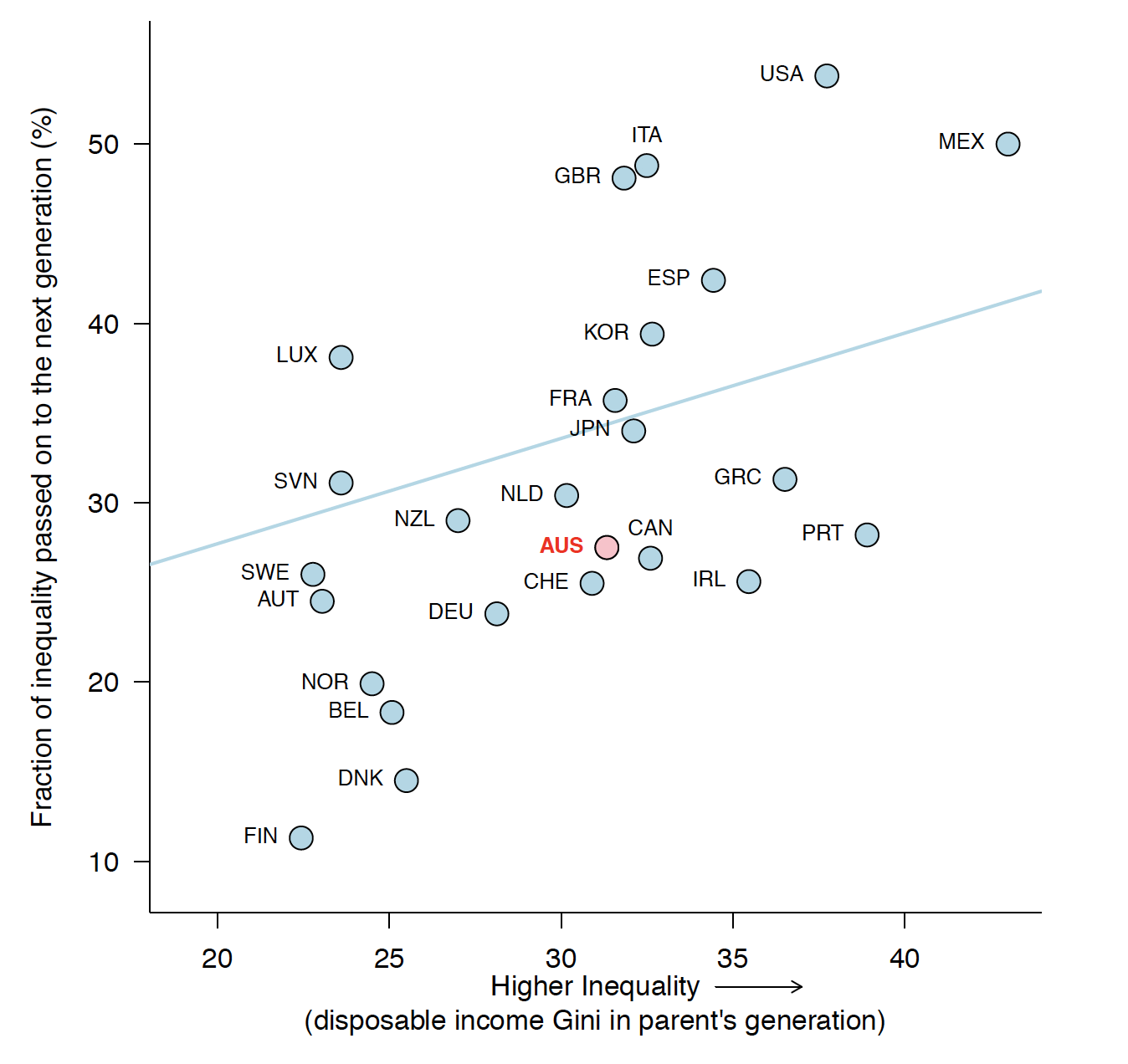
Inequality begets inequality. Up to 50% of income inequality is passed on to the next generation in countries like the United Kingdom, Italy, and the United States, but only 20% or even less in countries like Norway, Denmark and Finland, where there is a much smaller gap between parent incomes.

Incomes are stickier across generations where inequality is higher

But different kinds of inequality matter in different ways for social mobility.

Research using the variation of social mobility within countries like the United States and Canada shows that intergenerational cycles of low income are more likely in communities that have more bottom half inequality, the correlation with overall inequality and with top end inequality being much weaker. Upward mobility is easier when the poorest incomes are not that far off from middle incomes.

The bottom line for public policy is don’t let inequality increase in the bottom half of the income distribution, indeed strive to reduce it in a way that encourages labour market and social engagement.

Continue reading “Poverty and equality of opportunity: three pictures to motivate policy for social mobility”