The Canada Child Benefit is an important innovation in cash benefits to families with children

The Canada Child Benefit offers a policy option that the United States should consider in pursuing a goal to reduce child poverty by half.

The commitment to address child poverty has waxed and waned in Canada since an all-party resolution was passed in the House of Commons in late 1989 committing the federal government to “seek to eliminate child poverty by the year 2000.”

Poverty and social policy are now high on the agenda of the current federal government, which intends—over the course of the next six months—to articulate a poverty reduction strategy, but which has already taken a major step toward this goal by introducing the “Canada Child Benefit” in its first budget. This program came into effect in July 2016, and represents a major revamping of cash support to families with children.

The Canada Child Benefit represents an important improvement in the incomes of families with children, the government forecasting that by the end of its first full year of operation in 2017 the program would almost halve the number of children in poverty from the level prevailing in 2013. This innovation merits attention from policy makers in the United States and other countries.

I made a presentation to the “The Committee on Building an Agenda to Reduce the Number of Children in Poverty by Half in 10 Years” of the National Academies of Sciences, Engineering, and Medicine.

The program of the June 20th public information gathering included presentations from eight experts. I was the only participant from outside of the United States. Download the slides of my presentation: Presentation-Corak-National-Academy-Sciences-Engineering-Medicine-Child-Poverty.

It was based on a background report I prepared for the committee, which you can also download: Text-Corak-National-Academy-Sciences-Engineering-Medicine-Child-Poverty. The report details the nature of the program, compares it to the programs it replaced, and offers links to additional resources helpful in simulating the impact a similar design could have in other countries.
Poor children are twice as likely to grow up to be poor adults in some Canadian communities than in others

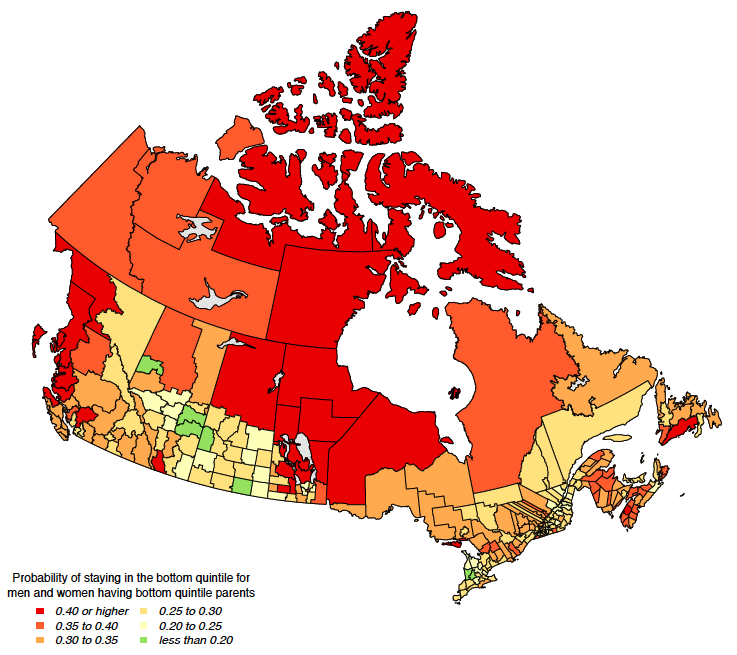
Intergenerational cycles of poverty vary across Canada, with low income children in some places facing a less than one-in-five chance of growing up to be poor adults, but in others the rate is more than double. The strong majority of children raised by lower income parents face a greater than one-in-four chance of growing up to be low income adults, and for many these odds were at least as high as one-in-three.

The chance that poverty will be passed on across the generations is 30 percent for the country as a whole, and the majority of children, 54 percent, live in 97 of a total of 266 municipalities where the chances of falling into an intergenerational cycle of low income are between 25 and 30 percent. A further 24 percent of poor live in a community where these chances are at least 0.30 but under 0.35.

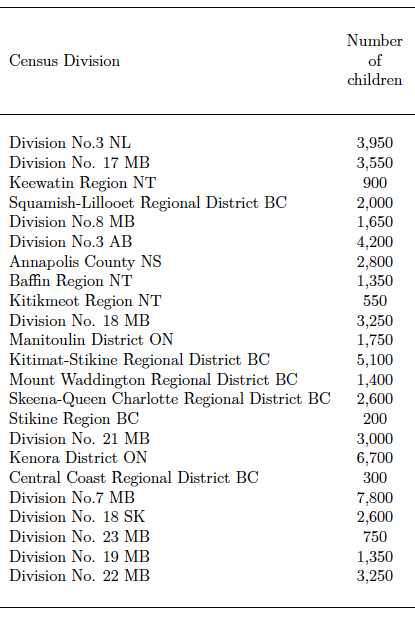
There are 23 municipalities with a 40 percent or greater chance of an intergenerational cycle of low income. These communities are all small in population, and account for two percent of the total number of children.

There is a greater than 40% chance of intergenerational poverty In 23 Census Divisions

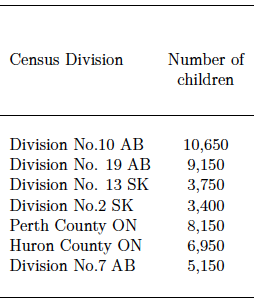
There are only seven of 266 communities in which the probability of a cycle of low income is less than 20 percent, representing only 1.6  percent of all children.

There is less than a 20% chance of intergenerational poverty in seven Census Divisions

The average parent income in these communities is below the national average. This raises the possibility that geographic mobility may be an important aspect of intergenerational mobility. The two Ontario communities listed in the above table are not areas in which there was significant economic growth, but the distances and costs associated with moving to nearby regions that were poles of growth—more specifically Toronto—were likely low.


[ The findings described in this post are drawn from my recently released research paper called “Divided Landscapes of Economic Opportunity: The Canadian Geography of Intergenerational Income Mobility.” You can learn more about this research, and download a copy of the paper and host of other information by reading the page devoted to this project at: MilesCorak.com/Equality-of-Opportunity . ]

How much social mobility for America? More, but it won’t happen without inclusive growth

shania-twain
Shania Twain, the legendary country-pop music star, personifies the “rags to riches” mobility at the core of the American Dream, and what’s so amazing she’s not even American. (Click image to read her bio.)

A common way to think about social mobility is in terms of “rags to riches” movement, a type of mobility that is central to the great defining metaphor of the United States, “The American Dream.” Indeed, policy makers often frame their discussion of social mobility in these terms, as for example in a May 2016 speech by the Chairman of the Council of Economic Advisers.

Upward movement is a natural way to think about social mobility, and Americans should have more of it. But this won’t happen without lowering the chances of intergenerational cycles of poverty, and promoting inclusive economic growth.

Continue reading “How much social mobility for America? More, but it won’t happen without inclusive growth”

Here’s a policy-relevant way to set the poverty line

Angus Deaton, the Princeton University economist, wrote in the opening paragraph of his acceptance speech for the 2015 Nobel Prize in economics that:

Measurement, even without understanding of mechanisms, can be of great importance in and of itself—policy change is frequently based on it—and is necessary if not sufficient for any reasoned assessment of policies, including the many that are advocated for the reduction of national or global poverty. We are wise to remember the importance of good data, and not to neglect the challenges that measurement continuously poses (Deaton 2016, page 1221).

This nicely sums up the tone of a previous post, that a conversation about Canadian public policy directed to poverty has not been well served by the confusing and conflicting information provided by official statistics.

Just how should we measure poverty in a way that is most helpful for public policy?

This is a particularly important issue given the mandate the Prime Minister has given his Minister of Families, Children and Social Development, directing him to “Lead the development of a Canadian Poverty Reduction Strategy that would set targets to reduce poverty and measure and publicly report on our progress.

Continue reading “Here’s a policy-relevant way to set the poverty line”

Understanding what poverty means and how it is measured are the first steps toward a poverty reduction strategy

Poverty rates in Canada LICO and LIM
Two most commonly used Statistics Canada poverty rates show radically different patterns.

The two most commonly used poverty rates produced by Statistics Canada tell very different stories. The patterns are curious, and confusing. The two statistics—the poverty rate according to the Low Income Cut-off and that according to the Low Income Measure—track each other rather closely up to the early 1990s, then diverge quite markedly as the Low Income Cut-off falls steadily to an unprecedented low, while the Low Income Measure drifts upward. Which statistic should we believe?

The cyclical patterns also differ, with the Low Income Measure registering higher poverty during recessions only before the 1990s, and in a way that is more muted and lagging the movement in the Low Income Cut-off. It also signals a rise in poverty only well after the onset of the 1990/92 recession, and both measures show no upturn in poverty during the Great Recession, which began in 2008 and led to a significant fall in employment.

For something that is central to so many policy debates, the Canadian “poverty” rate is notoriously confusing, and it is easy to imagine that public policy may be misled. The first step in devising a poverty reduction strategy is understanding what these numbers mean, and whether they are useful. Is poverty at unprecedented lows, or has it been stuck at high levels for decades? Both views can’t be right, but they can both be wrong.

Continue reading “Understanding what poverty means and how it is measured are the first steps toward a poverty reduction strategy”

Three enhancements to Employment Insurance to reduce income inequality, promote income security, and support families

Social policy in Canada faces three challenges having to do with income inequality, income insecurity, and the imbalance between work and family life. My presentation at the Queen’s University conference, “Social Canada Revisited,” begins by outlining three facts that illustrate these challenges:

  1. The share of total market income going to bottom-income Canadians has fallen
  2. Workers with steady employment suffer significant and long-lasting income losses after a layoff
  3. Families have changed to help cushion and support middle incomes, but the family-work balance is titled

I suggest that there are precedents in the existing Employment Insurance program that can be enhanced and built upon to more fully offer Canadians the social insurance they need and want, and put forward three enhancements that will move social policy in this direction.

  1. Enhance Working While on Claim and integrate it seamlessly with the Working Income Tax Benefit to offer steady and increased income support to lower-income Canadians in a way that mimics some versions of a Basic Income
  2. Introduce wage insurance that would top up weekly earnings for workers with a steady employment history who have suffered a permanent layoff
  3. Expand so-called “Special Benefits” by creating individual accounts over which individuals have complete sovereignty

Download a copy of my presentation for the details.