Tony Atkinson, the great British economist, encourages us to think of inequality as a choice, something that can be influenced by public policy.
If this is the case for equality of outcomes, then it is surely also so for equality of opportunity; the significant differences in social mobility between the rich countries hinting at the role governments play in determining the degree to which family background is destiny, the rich raising the next generation of rich adults, the poor seeing their children face low chances of upward mobility.
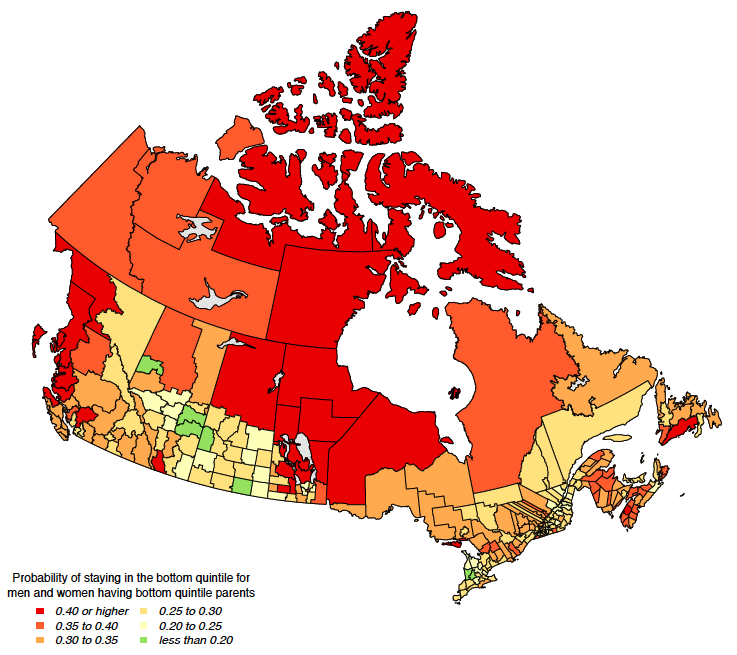
Intergenerational cycles of poverty vary across Canada, with low income children in some places facing a less than one-in-five chance of growing up to be poor adults, but in others the rate is more than double. The strong majority of children raised by lower income parents face a greater than one-in-four chance of growing up to be low income adults, and for many these odds were at least as high as one-in-three.
The chance that poverty will be passed on across the generations is 30 percent for the country as a whole, and the majority of children, 54 percent, live in 97 of a total of 266 municipalities where the chances of falling into an intergenerational cycle of low income are between 25 and 30 percent. A further 24 percent of poor live in a community where these chances are at least 0.30 but under 0.35.
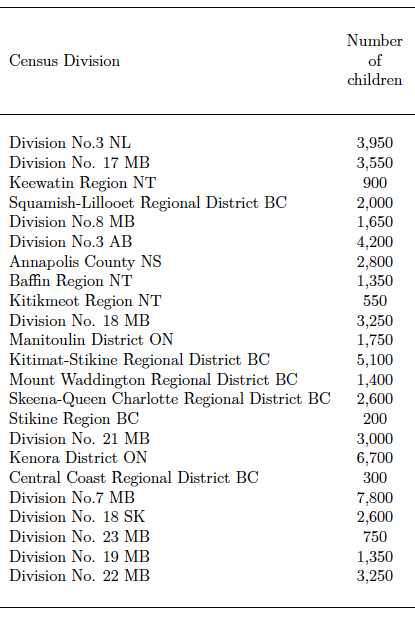
There are 23 municipalities with a 40 percent or greater chance of an intergenerational cycle of low income. These communities are all small in population, and account for two percent of the total number of children.
There is a greater than 40% chance of intergenerational poverty In 23 Census Divisions
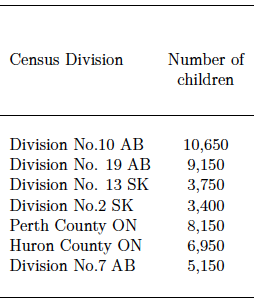
There are only seven of 266 communities in which the probability of a cycle of low income is less than 20 percent, representing only 1.6 percent of all children.
There is less than a 20% chance of intergenerational poverty in seven Census Divisions
The average parent income in these communities is below the national average. This raises the possibility that geographic mobility may be an important aspect of intergenerational mobility. The two Ontario communities listed in the above table are not areas in which there was significant economic growth, but the distances and costs associated with moving to nearby regions that were poles of growth—more specifically Toronto—were likely low.
[ The findings described in this post are drawn from my recently released research paper called “Divided Landscapes of Economic Opportunity: The Canadian Geography of Intergenerational Income Mobility.” You can learn more about this research, and download a copy of the paper and host of other information by reading the page devoted to this project at: MilesCorak.com/Equality-of-Opportunity . ]
The Pope has strong views about inequality because he has a theory, and doesn’t need data.
One of Canada’s most prominent pundits has strong views about inequality because he has data, and doesn’t need theory.
I’ll probably never convince either of them to change their views, but maybe I can convince you with both theory and data.
Give me the chance by reading my just published paper, “Inequality is the root of social evil,’ or Maybe Not? Two Stories about Inequality and Public Policy.”
I tell two stories about inequality. The first is from the perspective of those who feel it is not a problem worth the worry, and the second from the perspective of those who see it as “the defining challenge of our time.” I tell these stories to clarify their underlying logic, but also to clarify both the challenges facing Canadians and our understanding of what public policy should do about them.
But I have another motive. I would like you to appreciate the value of economic theory and statistical methods to a public policy discussion of this sort. It seems to me that without an appreciation of some basic elements of theory and measurement, it is too easy for the policy conversation to go astray.
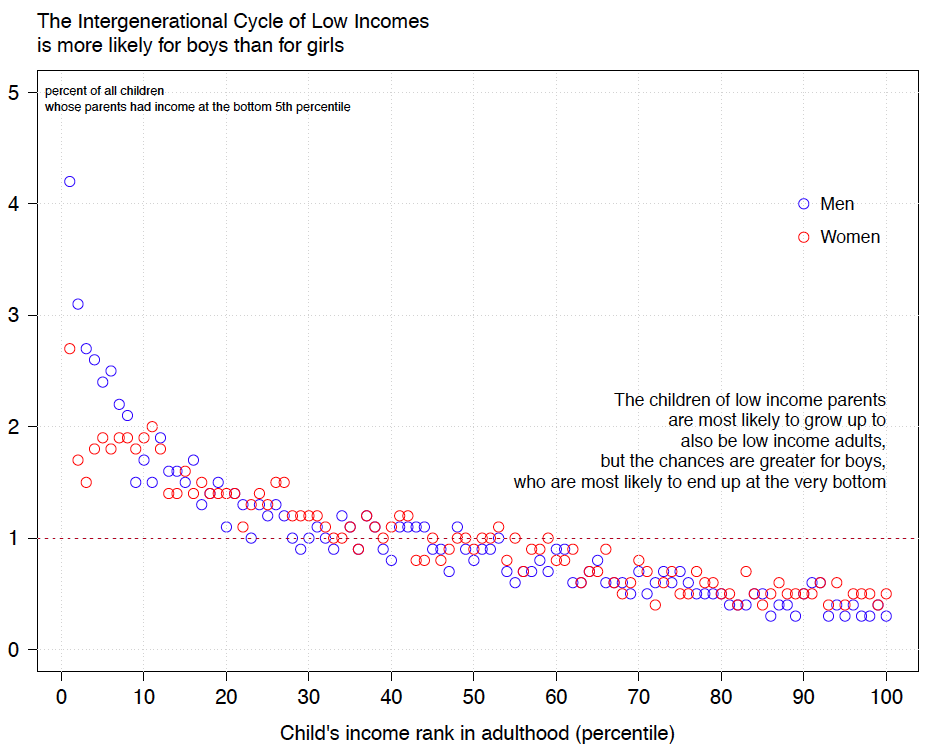
Children of low-income parents are more likely than not to grow up to be low-income adults. This is true for both boys and girls, but more so for boys.
(Click on the image to enlarge.)
This figure shows the rankings of children from low-income Canadian families, what fraction stand on each of the 100 rungs defined to equally divide the population across their adult income distribution. Their parents stood on exactly the bottom 5th rung of their income ladder, and the likelihood of them not advancing very much or even falling lower is clearly evident.
If adult incomes were completely independent of family income background, then we would expect 1 percent of these children to be on each of the 100 divisions of their income distribution. If this were the case children of low-ranking parents would be as likely to rise to middle incomes, or even to the very top, as they would be to stay on the same rung as their parents, or fall lower.
But in fact, this cohort of Canadians (those born in the 1960s) are much more likely to be the low-ranking adults of the next generation and are more likely to repeat the experiences of their parents.
This inter-generational cycle of low-income is more likely for boys. Although there is considerable upward rank mobility among these children, men raised by parents who were outranked by 95 percent of their counterparts are most likely to fall even lower, to be outranked by 99 percent of their cohort. Their chances of falling to the bottom 1 percent are more than 4 percent.
They are most likely to remain in the bottom 10 percent of the income distribution. Although an intergenerational cycle of low-income is also the most likely outcome for women, the chances are significantly lower, hovering in the neighbourhood of 2 percent for each of the rungs up to about the 10th.
[ This post is an edited excerpt from a forthcoming paper I have written called “‘Inequality is the root of social evil,’ or maybe not? Two stories about inequality and public policy”, which is published in the December 2016 issue of Canadian Public Policy. If you have any feedback please feel free to let me know in the comments section. ]
Every Statistics Canada data release on the share of the economic pie going to the top 1% elicits strong opinions, the most recent being no exception. Do top earners elicit rather dishonourable sentiments such as envy that should be given little weight? Or do they challenge our need for community and inclusion, influencing the way we live our lives in more fundamental ways? Should we praise the top 1% or worry about them?
It depends. We would be in a better position to answer this question if we put aside questions of merit and just deserts and focused more on the sources of social mobility and the capacity to conduct policy to support it in an era of higher inequality.
Earnings mobility for children from the very broad middle—parents whose income ranges from the bottom 10 percent all the way to the cusp of the top 10 percent—is not tied strongly to family income. These children tend to move up or down the income distribution without regard to their starting point in life. This may be one element of insecurity among the middle class: in spite of their best efforts, their children may be as likely to lose ground and fall in the income distribution as they are to rise.
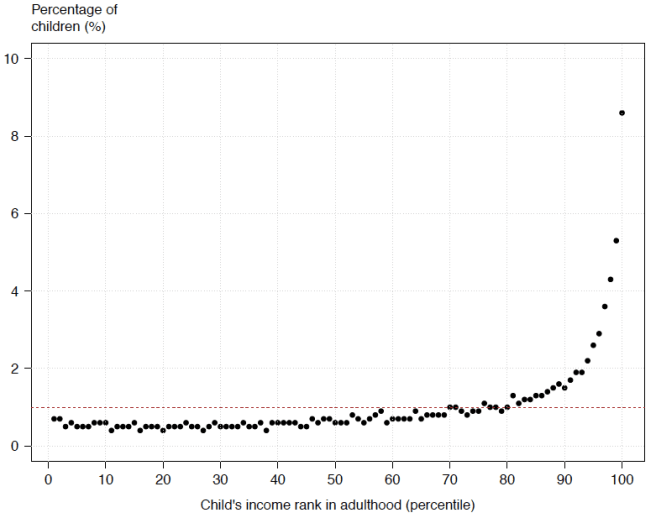
Children raised by parents in the top 1% are most likely to grow up to be the next generation of top earners
The situation is very different for children raised by top-earning parents, as the above figure illustrates. It shows the intergenerational cycle of privilege, the percentile rank in adulthood of children raised by top-1-percent parents. This playing field is clearly not level. If it were, all the points in the figure would be the same, all lining up along the dashed horizontal line drawn for reference at 1 percent.
Shania Twain, the legendary country-pop music star, personifies the “rags to riches” mobility at the core of the American Dream, and what’s so amazing she’s not even American. (Click image to read her bio.)
A common way to think about social mobility is in terms of “rags to riches” movement, a type of mobility that is central to the great defining metaphor of the United States, “The American Dream.” Indeed, policy makers often frame their discussion of social mobility in these terms, as for example in a May 2016 speech by the Chairman of the Council of Economic Advisers.
Upward movement is a natural way to think about social mobility, and Americans should have more of it. But this won’t happen without lowering the chances of intergenerational cycles of poverty, and promoting inclusive economic growth.




 Economics for public policy