#S17 is today, and reminds us of the price of inequality

The twitter hash tag is #S17, and using it will connect you to all those preparing for the first anniversary of the Occupy Wall Street movement, which of course is today, September 17th.

You will find tweets encouraging your participation: “If you feel that the world is on the right track, stay home. If you know things are bad, Join your local #OWS.”

Others will guide you on how to prepare, be it “Escaping from Zip Ties” or “How to pick your way out of handcuffs” (actually just the Smith and Weston model 100s).

But whatever your level of engagement, there is a message that this anniversary has for us all, a reminder of the real price of inequality.

Continue reading “#S17 is today, and reminds us of the price of inequality”

My summer reading list was about inequality and opportunity; you might like some of these books

If there is a thread running through the books I read this summer I suppose it is inequality: its causes and consequences; the real life and not so real life—but no less true—experiences of living these causes and experiencing the consequences; and what can—or for that matter can’t—be done about it.

The original ad in the Princeton University newspaper announcing the publication of F. Scott Fitzgerald’s novel. Fitzgerald had been a student at the university. Source: The Daily Princetonian, April 18 1925 .

Inequality in earnings and incomes has been a very hot topic in labour economics for the last two decades, but the relevance of this research and its use in public policy discussion has now become strikingly clear.

My last academic year was dominated by the rise of inequality on the public and public policy radar screen, and I have been so tied up in these discussions that I was carried, as if on a train leaving the station, right along throughout the entire summer.

I re-read a speech President Obama made on the topic. Last December he spoke about a type of inequality that “hurts us all”, and made a link between equality of outcomes and equality of opportunities.

Continue reading “My summer reading list was about inequality and opportunity; you might like some of these books”

Understanding inequality and what to do about it

Inequality has been increasing in most countries, in part because top 1% are capturing a higher fraction of all earnings but also for other reasons. I made a presentation to the Occupied Ottawa conference “Take Back Democracy!” on June 2nd, 2012. The presentation explores three issues in search of intelligent conversation, and in order to accomplish something constructive: description, explanation, and prescription.

You can download it as a pdf here: Understanding inequality and what to do about it .

Continue reading “Understanding inequality and what to do about it”

“Canadian Inequality: Recent Development and Policy Options”

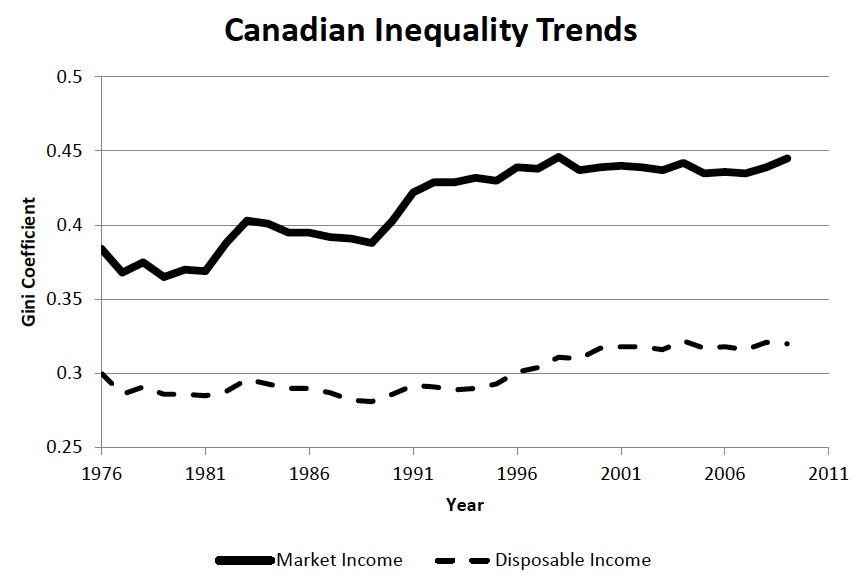
While inequality in Canada has increased over the course of the last three decades, the tax and transfer system can significantly reduce disparities in market incomes. But the political will to use the tax system may be limited, and public policy needs to address underlying labour market developments if it is to pursue an agenda of greater equality.

This is one of the major themes arising from a recently released discussion paper by a group of labour economists from the University of British Columbia: Nicole Fortin, David Green, Thomas Lemieux, Kevin Milligan, and Craig Riddell.

Continue reading ““Canadian Inequality: Recent Development and Policy Options””

Social mobility and inequality in the UK and the US: How to slide down the Great Gatsby Curve

In a speech given this morning to announce an update on the government’s Strategy for Social Mobility, Nick Clegg, the Deputy Prime Minster of the United Kingdom, said that “We need an open society where people choose their place”; he said that “The effect of social class and class attitudes on Social Mobility are the ghost in the machine.”; and, in summary, he said that “We are a long distance from being a classless society”.

Yet in the same breath, he also said that it is a myth to suggest that reducing inequality will promote social mobility.

This is surely an inappropriate representation of the role of inequality in determining opportunity.

Continue reading “Social mobility and inequality in the UK and the US: How to slide down the Great Gatsby Curve”

Social mobility is about twice as great in Australia and Canada than in the United Kingdom and the United States

Social mobility is about twice as great in Australia and Canada than in the United Kingdom and the United States.

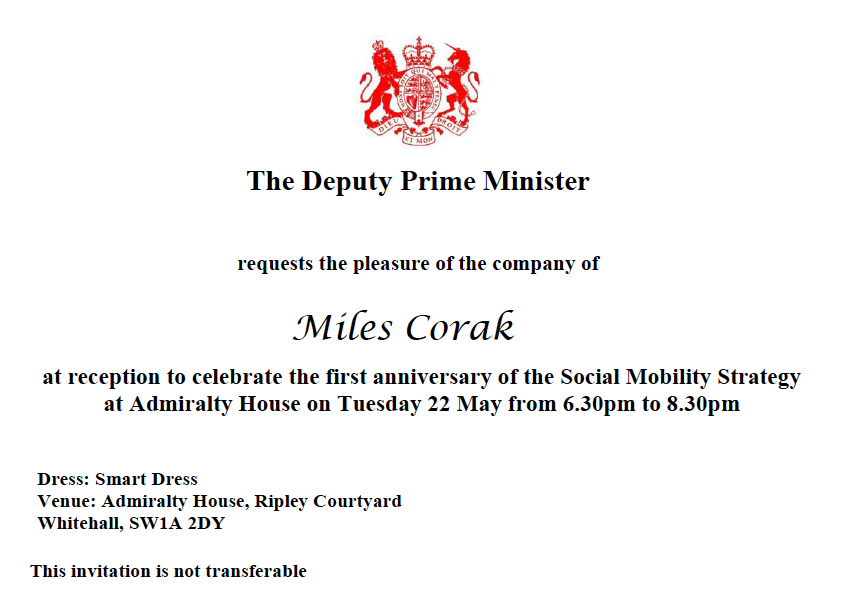
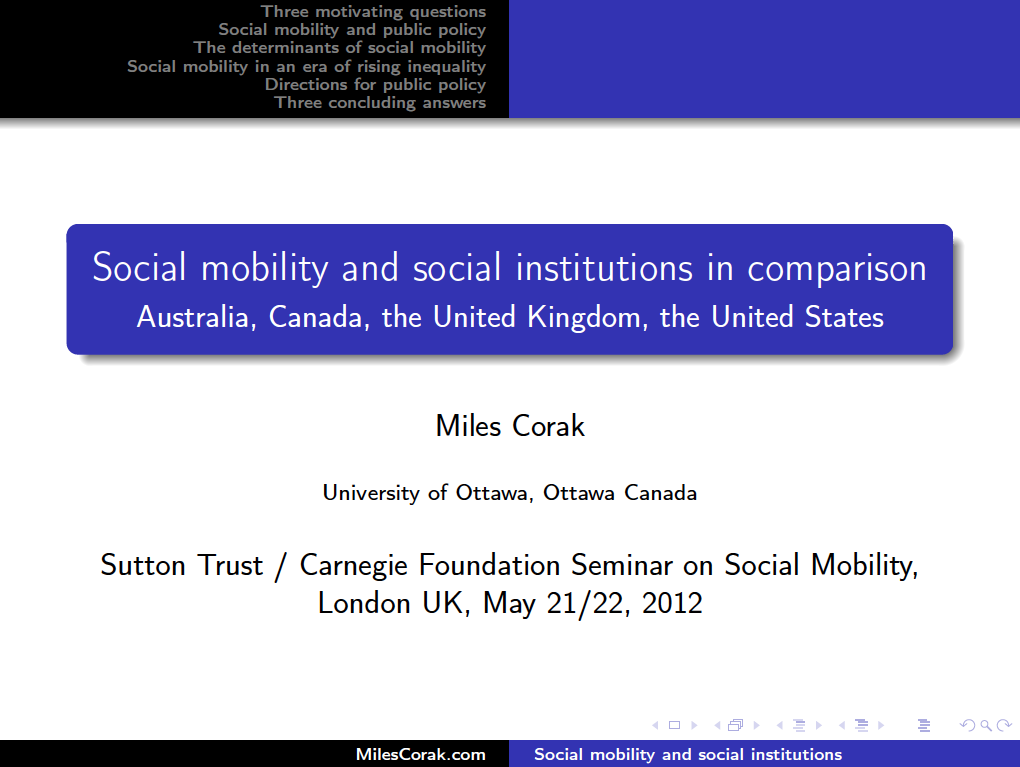
This is the first of three facts upon which my presentation to The Sutton Trust and The Carnegie Corporation workshop on social mobility called: “Social Mobility and Education in the Four Major Anglophone Countries” on May 21st. This summit of academics, politicians, and public policy advocates coincided with the one year anniversary since the Deputy Prime Minister of the United Kingdom, Nick Clegg, released the government’s social mobility strategy.

Continue reading “Social mobility is about twice as great in Australia and Canada than in the United Kingdom and the United States”