Do falling tax rates explain the rising incomes of the top 1%?

Top income shares have increased significantly in some rich countries, but not so much in others. In the United States the fraction of income going to the top 1% has more than doubled since the late 1970s. And while top shares have increased in other countries like Canada and the United Kingdom, they have not gone up all that much elsewhere, say in Germany or Sweden.

Globalization and technological change are often said to be the causes of growing inequality, but all rich countries have been confronted by these forces, and on their own they cannot account for the variation in top income shares between countries. A full explanation has to rely on institutions, policies, or norms of pay that differ across national boundaries.

The first and most obvious place to look is at changes in tax rates.

Continue reading “Do falling tax rates explain the rising incomes of the top 1%?”

The Great Gatsby: as Hollywood never imagined it

After much anticipation Hollywood finally releases its version of F. Scott Fitzgerald’s classic novel, The Great Gatsby.

Was Gatsby a crook? Or was he a victim of a crooked game, the American Dream as a broken promise?

In this program originally aired on CBC radio last August, Sarah Churchwell of the University of East Anglia, a professor of American literature and author of Careless People, interprets Fitzgerald as saying the American Dream is a lie.

But listen also for my reading of a few passages to appreciate, tongue-in-cheek, why the underlying economics suggest that The Great Gatsby is indeed a novel for our times.

If you want the movie version, and a detailed discussion of The Great Gatsby Curve, here is a lecture I had the honour to give earlier this year at the University of Lethbridge on the invitation of the Prentice Institute and its Director Susan McDaniel.

I have to admit, however, the Hollywood version looks somewhat more exciting!

How will the House of Commons look at Income Inequality in Canada?

Screen Shot 2013-04-23 at 9.56.24 PMEveryone has been talking about it: academics for at least a couple of decades; think-tanks and international organizations like the OECD and the IMF as well; and even—at least since the Occupy Wall Street movement went camping—the average taxpayer.

And now, after having adopted a motion introduced almost a year ago by Scott Brison, the honourable Member of Parliament for Kings-Hants, the House of Commons has charged its Standing Committee on Finance to also talk about it: yes, Virginia, Committee hearings on “Income Inequality in Canada” have begun.

Can there be a topic that is least likely to garner consensus among our Members of Parliament than taxes and inequality? Little wonder they are so late to the conversation.

On Thursday the Committee held the second of at least three hearings. Among its terms of reference is to “examine best practices that reduce income inequality and improve per capita gross domestic product.” If the written briefs posted on its website and some of the witness statements to date are any indication, the Committee has its homework cut out for it. At first look these are lofty of principle, short on prescription.

Continue reading “How will the House of Commons look at Income Inequality in Canada?”

Tax policy for equality and social mobility

The Canadian House of Commons has charged its subcommittee on Finance to examine income inequality in Canada.

More specifically the Committee’s mandate is to produce a report that will:

  • review Canada’s federal and provincial systems of personal income taxation and income supports;
  • examine best practices that reduce income inequality and improve per capita gross domestic product;
  • identify any significant gaps in the federal system of taxation and income support that contribute to income inequality;
  • identify any significant disincentives to paid work in the formal economy that may exist as part of a “welfare trap;” and
  • provide recommendations on how best to improve equality of opportunity and prosperity for all Canadians.

Its website contains the written submissions received by the April 5th deadline.

I will appear as a witness in a televised hearing beginning at 8:45 EDT on Thursday April 25th, 2013.  The other witnesses slated to appear at the same meeting are listed here.

You can view it all here as Meeting 116 if you have an interest.

A copy of my written submission is available as a pdf: Corak_Submission_to_Finance_Committee.

Inequality: for the 10th grader in you

Hi my name is Z… and I am in 10th grade, I have a history project relating to economic inequality and social justice. I found your blog on economic inequality online and I was wondering if you could answer my interview questions, the questions are — What has happened to make economic inequality relevant in Canadian history? and To what degree has a commitment to social justice been significant in creating Canada today?

Continue reading “Inequality: for the 10th grader in you”

Inequality and social mobility, an interesting discussion

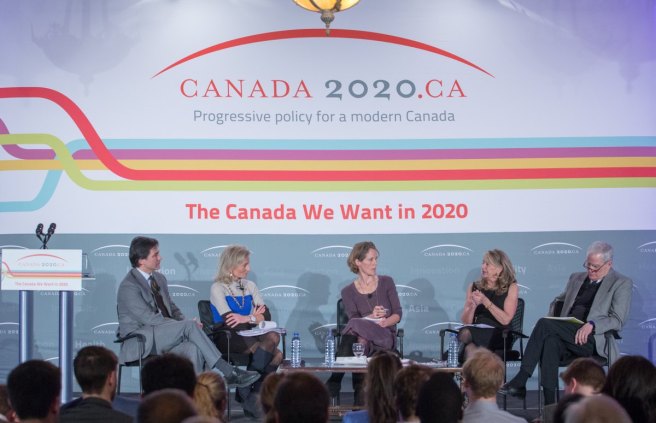
Canada2020 event February 26 2013

“The idea that all citizens should have an equal chance to succeed in life, regardless of where they start, is fundamental to liberal societies and emblematic of the American—and Canadian—dream” is the way a Canadian think tank, Canada2020, introduces a panel discussion it hosted that explored the idea of economic mobility, why it is important, and how it is related to inequality of outcomes.

I was a member of the panel and had a very interesting—and at times humorous and entertaining—discussion with Zanny Minton Beddoes the economics editor of The Economist, Carolyn Acker the founder of Pathways to Education, and Ron Haskins a senior fellow at the Brookings Institution. You can view the entire discussion, which was moderated by Diana Carney, by clicking on the following screen shot (and waiting a bit for it to load):

The short presentation I made at the beginning of the talk is, if you are interested, available here: Equality_of_Opportunity_A_Canadian_Dream_for_Canada2020

I plan on revising the background document I wrote for the event—which you can download from the Canada2020 website—and would therefore be very pleased to hear your views on the discussion, and any specific feedback you might have.