Two stories about inequality

In many rich countries the “hard” facts describing the income distribution are easily available. Yet, discussions about inequality are animated by two different stories with very different public policy implications.

You can listen to a caricature of these points of view in this pair of interviews on CBC radio: http://www.cbc.ca/radiowest/2015/01/21/two-different-takes-on-the-worlds-wealthiest-one-per-cent/

I offer more detail on the way Canadians have framed these stories as a part of a presentation to the School of Policy Studies at Queen’s university.

Here is Story 1 in pictures

(click on an image to start the slideshow and press Escape to return to this page).

Here is Story 2 in pictures

(click on an image to start the slideshow and press Escape to return to this page).

My presentation argued that context—rooted in economic theory and the appropriate use of statistics—is needed to understand the truth behind these stories, and to turn them into a conversation useful for public policy.

Here is the full set of slides I used.
Corak_Two_Stories_about_Inequality_and_Public_Policy_presentation_to_Queens_University_February_5_2015

A FactBook about employment in Canada based upon Statistics Canada’s Labour Force Survey

Employment of young people in Canada

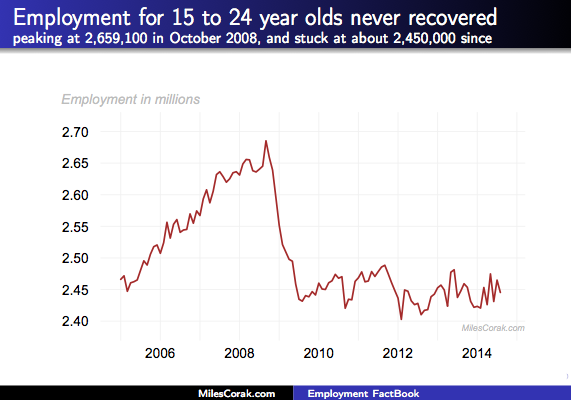
Every month Statistics Canada releases employment and other labour market indicators. They are much used, much discussed, and arguably much misinterpreted. Here is a short FactBook about employment, using information from January 2005 to August 2014, clarifying some of the definitions, offering some suggestions on how to use the numbers, and highlighting some of the recent trends.

Employment Factbook using Labour Force Survey from Statistics Canada January 2005 to August 2014

There are three major messages:

  1. If you want to be “really” certain that a month to month change in employment is not just statistical noise, then it has to be pretty large, say larger than 57,000
  2. Employment has barely kept up with population growth during the last five years; for young people this is not even the case, there being no growth at all
  3. The fraction of the working age population employed has yet to return to pre-recession levels, and has been falling during the past year, which seems to be due to a fall in the employment rate of women

Two facts about “The prospects for this generation in an unequal world”

Keith Davey Forum Invitation Victoria University at the University of Toronto 2014

On Wednesday evening, September 17th, I was at the University of Toronto as one of the panelists participating in the Keith Davey Forum on Public Affairs to discuss “The prospects for this generation in an unequal world”. You can watch the full event, which also involved Jeffrey Arnett and Rod Haddow, by clicking on this link.

Here are two facts that I think are important for understanding the economic prospects of the young, and the public policy concerns that arise

Continue reading “Two facts about “The prospects for this generation in an unequal world””

I am honoured to have won the “Doug Purvis Memorial Prize” for my research on inequality and social mobility

It is a particular honour to have my paper, “Income Inequality, Equality of Opportunity, and Intergenerational Mobility,” chosen for the 2014 Doug Purvis Memorial Prize. The prize is awarded annually by the Canadian Economics Association “to the authors of a highly significant, written contribution to Canadian economic policy.”

That is certainly honour enough, but I’m particularly grateful for another reason.

Continue reading “I am honoured to have won the “Doug Purvis Memorial Prize” for my research on inequality and social mobility”

Families need insurance for wages and for family responsibilities

[ This post is a summary of a presentation called “Public insurance to promote social mobility” that I made to the “Social Mobility Summit” held at the Brookings Institution in Washington DC on January 13th, 2014. It is intended for an American readership, and is also posted in an abridged form on the Brookings website. ]

Continue reading “Families need insurance for wages and for family responsibilities”

Employment in Canada is up by a million … but that is hardly enough

one-in-a-million

“Employment is up by one million since the recession ended.”

A statement like this may indeed be a big talking point when Statistics Canada releases the results of its monthly Labour Force Survey on Friday.

While a million more people at work sounds like a lot, the Canadian population has also increased by roughly the same amount with the result that the fraction of Canadians working has been pretty well unchanged for the last five years, and has yet to return to rates before the recession.

A million is a big number, but it’s not enough to signal a complete recovery from the recession.

Continue reading “Employment in Canada is up by a million … but that is hardly enough”