Mr. Carney can’t push on a string. And he knows it.
His now famous comment labelling the stockpiles of retained earnings held by Canadian firms as “dead money”, while perhaps being the most memorable quote of 2012, must also have been made out of a certain frustration that even this superstar central banker faces limits in his powers to push, encourage, and otherwise jumpstart business investment.
The Governor of the Bank of Canada knows that the flip side of dead money is insecurity in the jobs market.
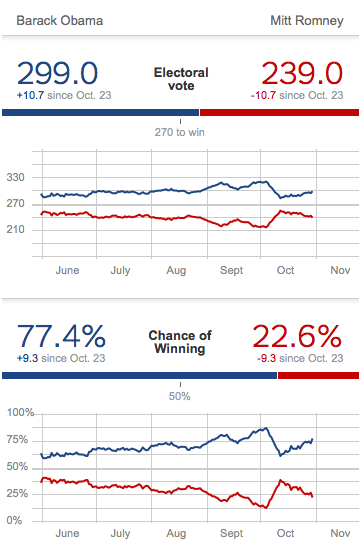
Nate Silver is a pollster with a reputation, having correctly predicted the outcome of the 2008 American election in 49 of the 50 States. In 2012 he is giving the edge to President Obama over Governor Romney by a good margin.
There is a science to polling, and Mr. Silver knows it well enough to realize that it is not exact: all predictions come with a level of uncertainty.
But he figures that Mr. Obama has at least a 77% chance of winning the required 270 electoral college votes, even if at the same time he is predicting the President will only capture 52% of the popular vote.
The last time an incumbent sought re-election during the aftermath of a great recession was in 1936, when Franklin D. Roosevelt was challenged by the Republican Governor of Kansas, Alfred Landon.
At that time TheLiterary Digest magazine was the pollster to be reckoned with, having correctly predicted the winner in each presidential election since 1920, including Roosevelt’s 1932 victory.
The labour market has fared better in Canada than in many other rich countries, it has fared better than it has in past recessions, but it has not fared as well as it could.
This is the major message from a recently released report by the Parliamentary Budget Office, which offers a valuable description of the Canadian jobs market because it puts developments in context: comparing them to underlying trends, comparing them to previous recessions, and comparing them to developments in other countries.
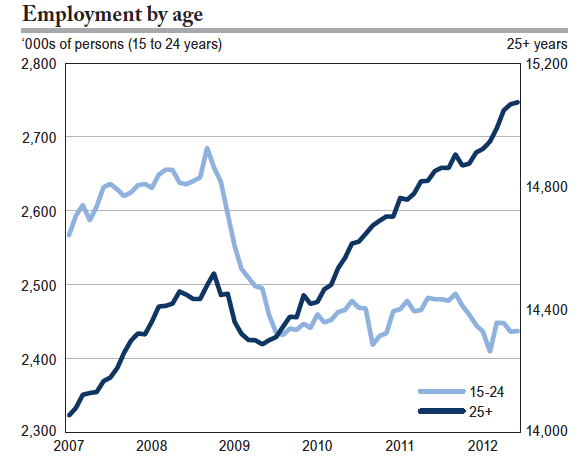
There has been virtually no growth in employment among young Canadians over the course of the last three years. Employment plummeted in late 2008 for those younger than 25, and has gone nowhere but sideways since . This is in sharp contrast for older groups: their employment levels recapturing all the recessionary losses by 2010.
Read the employment levels for 15 to 24 year olds in thousands off of the left scale, and that for those 25 and older off of the right scale. Between September 2008 and August 2009 employment among the young fell by a quarter of a million, and has been virtually stagnant since.
The state of the jobs market is best assessed by a number that is not given enough attention by Statistics Canada, and the many media reports based upon its monthly press release.
The headline attention is all soaked up by the unemployment rate and the level of employment, when it really should be something Paul Krugman—the Princeton University economist and New York Times columnist—calls his “favorite gauge” of the employment situation.
In a recent column in the Globe and Mail, Tom Flanagan bemoans the fact that the premium structure of Employment Insurance is not lined up with expected benefits. As a result, provinces to the west of the Ottawa River have long paid a good deal more into the program than they receive in benefits.
The solution: a constitutional amendment allowing Quebec to run its own EI program.
Quebec and Alberta interests certainly line up on this issue: one wrestles more control over federal powers, the other sees smaller government and lower taxes.
But let’s be clear, devolution of EI responsibilities—which constitutionally rests with the Federal Government—is about this sort of politics, not at all about the underlying economics of social insurance.
There are a host of legislative changes that the Federal government can introduce to make EI more efficient without even whispering the C-word.

 Economics for public policy