Inequality and Economic Opportunity … what do we care about? what do we measure? what should we do?

Inequality erodes opportunity, and limited opportunity exacerbates inequality.

This vicious inter-generational cycle has brought inclusive growth into question, contributed to the rise of populist sentiment, and strained the social contract in many rich countries. The way forward for researchers and policy makers requires not only a clear understanding of the facts about what kind of inequality matters and how it matters, but also an ethical grounding that speaks to the outcomes and opportunities that are important to citizens not only in the here and now, but also in the next generation.

This is the major message of a presentation I will be giving to the faculty and students of the PhD program in Economics at The Graduate Center of The City University of New York, where I am lucky to work and teach. My presentation—which also has the great benefit of being discussed by my soon-to-graduate PhD student, Aman Desai—makes this case by addressing three related questions

  1. What do we care about?
    • We care about self-realization that contributes to an expanding and inclusive community that in turn enhances the capacities of its members to become all that they can be. And this involves caring about a sense of progress, a sense of movement toward security and inclusion, and a sense of fairness.
  2. What do we measure?
    • Empirical researchers studying intergenerational mobility need to align what they measure with what we care about, which asks for an eclectic use of statistics and a sometimes subtle appreciation of how they relate to what we care about.
  3. What should we do?
    • Certainly public policy should be evidence-based, but it needs increasingly to be ethically-grounded, with researchers bringing their numbers to public policy by explicitly making their own values clear. In my view, three values should guide public policy toward what we care about: all humans are equal, and should be treated with dignity; labour has preference over capital; and wealth is created to be shared.

But what gives this presentation an extra spice, at least for me, is that April 10th, 2025 marks the 100th anniversary of the publication of F. Scott Fitzgerald’s novel, The Great Gatsby. So it is fitting for me to begin the presentation with a bit of biography on how the Great Gatsby Curve got its name!

Feel free to download the presentation slides, and certainly if you are at the Graduate Center, to attend the presentation!
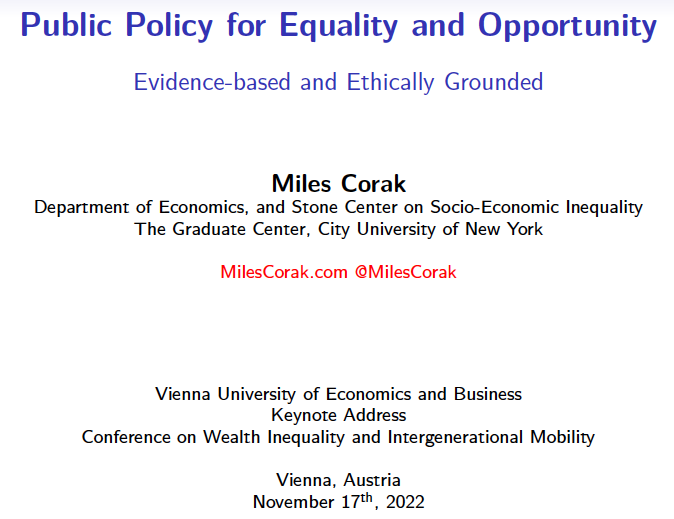
Public Policy for Equality and Opportunity: Evidence-based and Ethically Grounded

Inequality erodes opportunity, and limited opportunity exacerbates inequality. This vicious intergenerational cycle has brought inclusive growth into question, contributed to the rise of populist sentiment, and strained the social contract in many rich countries. The way forward for researchers and policy makers requires not only a clear understanding of the facts about what kind of inequality matters and how it matters, but also an ethical grounding that speaks to the outcomes and opportunities that are important to citizens not only in the here and now, but also in the next generation.

This is the argument I make in a keynote lecture that I have had the privilege to give, first on October 20th 2022 to the 8th Annual Congress de Economía y de Políticas Públicas, SobreMéxico in Mexico City, and second on November 17th 2022 to the Conference on Wealth Inequality and Intergenerational Mobility at the Vienna University of Economics and Business in Vienna.

Download the latest version of my presentation.

Watch the presentation .

The Great Gatsby Curve poses three questions for economic theory, statistical measurement, and public policy

When comparing many countries, not just the rich but also across the entire globe, researchers have consistently found that the higher the level of income inequality about a generation ago, the more strongly children’s adult prospects are tied to their family backgrounds. This relationship between higher inequality and lower social mobility has become known as The Great Gatsby Curve.

Economic theory, statistical measurement, and public policy have all been most constructively informed by this picture when they explore

  1. What kind of inequality matters?
  2. What kind of social mobility do we care about?
  3. Which cross-country comparisons are most judicious, from which policy learning is best informed?

Watch this interview produced by the Institute for New Economic Thinking ,who gave me the opportunity to explain what the Great Gatsby is, and highlight how it offers a constructive framework for deeper conversations about the relationship between inequality and social mobility.

Inequality, life chances, and public policy

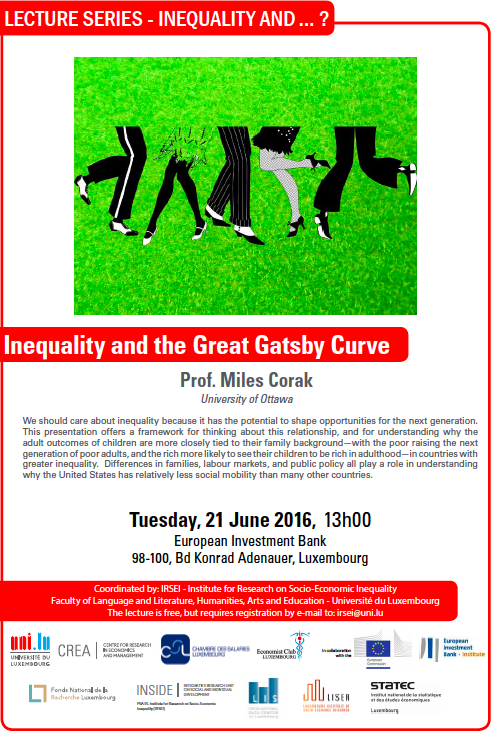
Lecture series Inequality and Miles Corak European Investment Bank Luxembourg

We should care about inequality because it has the potential to shape opportunities for the next generation. My presentation at the European Investment Bank offers a framework for thinking about this relationship, and for understanding why the adult outcomes of children are more closely tied to their family background—with the poor raising the next generation of poor adults, and the rich more likely to see their children to be rich in adulthood—in countries with greater inequality.

Differences in families, labour markets, and public policy all play a role in understanding why the United States and the United Kingdom have relatively less social mobility than many other countries.

Feel free to download the presentation, which will also soon be posted online by the University of Luxembourg.

An inclusive society seeks to eliminate child poverty

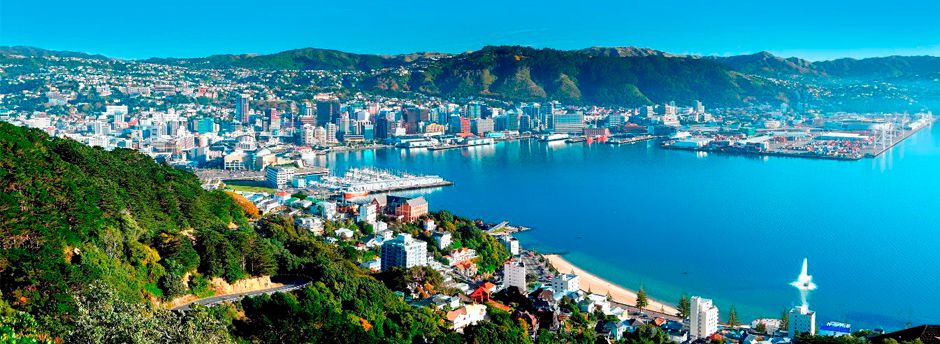
Wellington New Zealand

My meeting with senior Treasury officials began with the nonchalantly stated advice “In the event of an earthquake we like to get under the tables and hold on to the legs so that they don’t get away from us.”

As a Canadian, albeit one who has visited New Zealand three times in the past decade, I naively took this as a metaphor for the earth-shattering ideas the public service expects from its consultations with outside experts.

I assure you that the dozen or more participants gathered to discuss how the government might contribute to building “a more inclusive New Zealand” offered advice that was far from ground breaking.

How possibly could they?

Continue reading “An inclusive society seeks to eliminate child poverty”

Building a more inclusive society requires a conversation about inequality

[ This post is based on the opening address I gave on the invitation of the New Zealand Treasury to the “A More Inclusive New Zealand Forum” held in Wellington, New Zealand on July 27th, 2015. ]

I would like to open this gathering with a statement of admiration for both its content, and its process. The organizers have asked us to deliberate on “inclusion”, and to do so through conversation.

As a part of my contribution to this conversation I would ask you to consider four major messages, all four of which revolve around the question: What does inclusion mean?

I use “mean” in the sense of how we define inclusion, and “mean” in the sense of its implications for policy.

What does “inclusion” mean, and how can we give it enough precision to inform public policy?

My four messages are:

  1. an inclusive society means that all children can become all that they can be;
  2. an inclusive society seeks to eliminate child poverty;
  3. income inequality has the potential to erode inclusion;
  4. public policy must address many dimensions of inequality.


A More Inclusive New Zealand Forum

Continue reading “Building a more inclusive society requires a conversation about inequality”