The Great Gatsby: as Hollywood never imagined it

After much anticipation Hollywood finally releases its version of F. Scott Fitzgerald’s classic novel, The Great Gatsby.

Was Gatsby a crook? Or was he a victim of a crooked game, the American Dream as a broken promise?

In this program originally aired on CBC radio last August, Sarah Churchwell of the University of East Anglia, a professor of American literature and author of Careless People, interprets Fitzgerald as saying the American Dream is a lie.

But listen also for my reading of a few passages to appreciate, tongue-in-cheek, why the underlying economics suggest that The Great Gatsby is indeed a novel for our times.

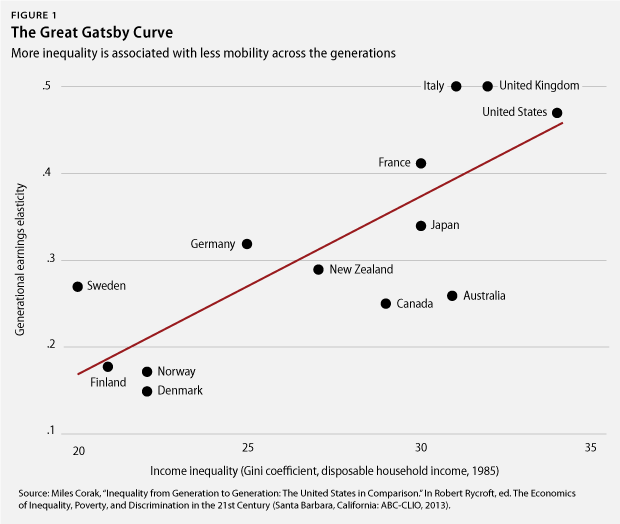
If you want the movie version, and a detailed discussion of The Great Gatsby Curve, here is a lecture I had the honour to give earlier this year at the University of Lethbridge on the invitation of the Prentice Institute and its Director Susan McDaniel.

I have to admit, however, the Hollywood version looks somewhat more exciting!
Inequality and social mobility, an interesting discussion

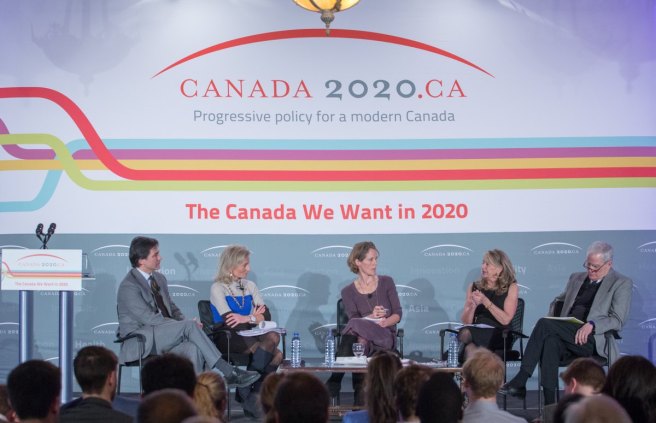
Canada2020 event February 26 2013

“The idea that all citizens should have an equal chance to succeed in life, regardless of where they start, is fundamental to liberal societies and emblematic of the American—and Canadian—dream” is the way a Canadian think tank, Canada2020, introduces a panel discussion it hosted that explored the idea of economic mobility, why it is important, and how it is related to inequality of outcomes.

I was a member of the panel and had a very interesting—and at times humorous and entertaining—discussion with Zanny Minton Beddoes the economics editor of The Economist, Carolyn Acker the founder of Pathways to Education, and Ron Haskins a senior fellow at the Brookings Institution. You can view the entire discussion, which was moderated by Diana Carney, by clicking on the following screen shot (and waiting a bit for it to load):

The short presentation I made at the beginning of the talk is, if you are interested, available here: Equality_of_Opportunity_A_Canadian_Dream_for_Canada2020

I plan on revising the background document I wrote for the event—which you can download from the Canada2020 website—and would therefore be very pleased to hear your views on the discussion, and any specific feedback you might have.

How to Slide Down the Great Gatsby Curve: Inequality, Life Chances, and Public Policy in the United States

CorakMiddleClass_fig1

The Center for American Progress has released a study I wrote called “How to Slide Down the Great Gatsby Curve: Inequality, Life Chances, and Public Policy in the United States”. Here is an excerpt:

Continue reading “How to Slide Down the Great Gatsby Curve: Inequality, Life Chances, and Public Policy in the United States”

The US Senate wonders about tax policy for the American Dream: Senator Hatch asks about the validity of the statistics

Senator Orrin Hatch has a sharp eye.

In response to my July 10th testimony to the Senate Committee on Finance hearing on “Helping Young People Achieve the American Dream” I received some homework, a series of questions asking me for a good deal more detail.

Senator Hatch, who is a US Senator for Utah, asks a thoughtful question about measurement issues. I will offer my answers to all the questions in a series of blog posts over the coming days. You can review the questions at my November 11th post. But I would like to begin with the first question Senator Hatch asks because it gives us the opportunity to clarify what the statistics mean. This is a good place to start.

Continue reading “The US Senate wonders about tax policy for the American Dream: Senator Hatch asks about the validity of the statistics”

Inequality and top income shares in Canada: Recent trends and policy implications

Inequality has increased in the majority of rich countries, but the share of income and earnings going to the top has increased most in the anglophone countries.  McMaster University economist Mike Veall says Canada has not escaped this trend, and argues that a public policy response is needed.

The underlying causes of, in his words, “the surge” in the shares of the top 1%, one-tenth of 1% and even the top one-hundredth of 1% in Canada remain elusive. Even so these changes should motivate at least three policy responses that could be supported across the political spectrum.

Professor Veall was the 2012 president of the Canadian Economics Association, the professional association of economists based in Canada, and presented his presidential address at the annual meetings of the Association held last June at the University of Calgary.

Continue reading “Inequality and top income shares in Canada: Recent trends and policy implications”

My summer reading list was about inequality and opportunity; you might like some of these books

If there is a thread running through the books I read this summer I suppose it is inequality: its causes and consequences; the real life and not so real life—but no less true—experiences of living these causes and experiencing the consequences; and what can—or for that matter can’t—be done about it.

The original ad in the Princeton University newspaper announcing the publication of F. Scott Fitzgerald’s novel. Fitzgerald had been a student at the university. Source: The Daily Princetonian, April 18 1925 .

Inequality in earnings and incomes has been a very hot topic in labour economics for the last two decades, but the relevance of this research and its use in public policy discussion has now become strikingly clear.

My last academic year was dominated by the rise of inequality on the public and public policy radar screen, and I have been so tied up in these discussions that I was carried, as if on a train leaving the station, right along throughout the entire summer.

I re-read a speech President Obama made on the topic. Last December he spoke about a type of inequality that “hurts us all”, and made a link between equality of outcomes and equality of opportunities.

Continue reading “My summer reading list was about inequality and opportunity; you might like some of these books”