Inequality and top income shares in Canada: Recent trends and policy implications

Inequality has increased in the majority of rich countries, but the share of income and earnings going to the top has increased most in the anglophone countries.  McMaster University economist Mike Veall says Canada has not escaped this trend, and argues that a public policy response is needed.

The underlying causes of, in his words, “the surge” in the shares of the top 1%, one-tenth of 1% and even the top one-hundredth of 1% in Canada remain elusive. Even so these changes should motivate at least three policy responses that could be supported across the political spectrum.

Professor Veall was the 2012 president of the Canadian Economics Association, the professional association of economists based in Canada, and presented his presidential address at the annual meetings of the Association held last June at the University of Calgary.

Continue reading “Inequality and top income shares in Canada: Recent trends and policy implications”

My summer reading list was about inequality and opportunity; you might like some of these books

If there is a thread running through the books I read this summer I suppose it is inequality: its causes and consequences; the real life and not so real life—but no less true—experiences of living these causes and experiencing the consequences; and what can—or for that matter can’t—be done about it.

The original ad in the Princeton University newspaper announcing the publication of F. Scott Fitzgerald’s novel. Fitzgerald had been a student at the university. Source: The Daily Princetonian, April 18 1925 .

Inequality in earnings and incomes has been a very hot topic in labour economics for the last two decades, but the relevance of this research and its use in public policy discussion has now become strikingly clear.

My last academic year was dominated by the rise of inequality on the public and public policy radar screen, and I have been so tied up in these discussions that I was carried, as if on a train leaving the station, right along throughout the entire summer.

I re-read a speech President Obama made on the topic. Last December he spoke about a type of inequality that “hurts us all”, and made a link between equality of outcomes and equality of opportunities.

Continue reading “My summer reading list was about inequality and opportunity; you might like some of these books”

Social mobility and inequality in the UK and the US: How to slide down the Great Gatsby Curve

In a speech given this morning to announce an update on the government’s Strategy for Social Mobility, Nick Clegg, the Deputy Prime Minster of the United Kingdom, said that “We need an open society where people choose their place”; he said that “The effect of social class and class attitudes on Social Mobility are the ghost in the machine.”; and, in summary, he said that “We are a long distance from being a classless society”.

Yet in the same breath, he also said that it is a myth to suggest that reducing inequality will promote social mobility.

This is surely an inappropriate representation of the role of inequality in determining opportunity.

Continue reading “Social mobility and inequality in the UK and the US: How to slide down the Great Gatsby Curve”

Social mobility is about twice as great in Australia and Canada than in the United Kingdom and the United States

Social mobility is about twice as great in Australia and Canada than in the United Kingdom and the United States.

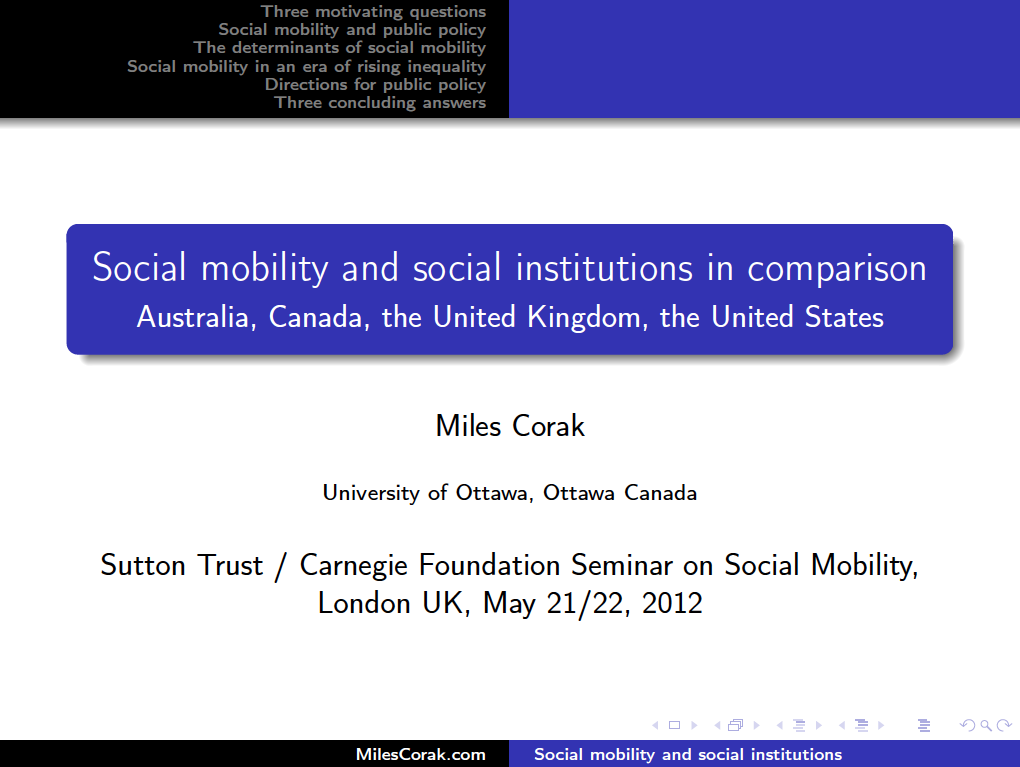
This is the first of three facts upon which my presentation to The Sutton Trust and The Carnegie Corporation workshop on social mobility called: “Social Mobility and Education in the Four Major Anglophone Countries” on May 21st. This summit of academics, politicians, and public policy advocates coincided with the one year anniversary since the Deputy Prime Minister of the United Kingdom, Nick Clegg, released the government’s social mobility strategy.

Continue reading “Social mobility is about twice as great in Australia and Canada than in the United Kingdom and the United States”

A little secret Denmark shares with Canada about social mobility that Americans and Brits should know

In an article that appeared earlier this year, The New York Times described the extent to which rich parents can expect to see their children grow up to be rich adults, as well as the likelihood that the poor raise children destined for poverty.

Surprisingly enough, the article came close to concluding that if Americans are interested in living the American Dream—where family background has little influence on adult outcomes—they should move to, of all places, Denmark, or if crossing the Atlantic seems daunting, then, as a second best, to Canada.

Indeed, Denmark has been a darling of sorts ever since Richard Wilkinson and Kate Pickett highlighted in their book, The Spirit Level, that Danish life is so much better along a whole host of dimensions because income inequality is so much lower.

But Denmark has a little secret, one it shares with Canada, about how kids get jobs, and about how this determines life chances even in places with low inequality.

Continue reading “A little secret Denmark shares with Canada about social mobility that Americans and Brits should know”

Inequality and social mobility

[These are the opening remarks I made to the Senate Standing Committee on Social Affairs, Science and Technology of the Parliament of Canada. I appeared as a witness at the May 2nd meeting of the Committee dealing with Social inclusion and cohesion in Canada to address the topic of inequality. These remarks do not substitute for the official transcripts that will be produced by the Standing Committee.]

Continue reading “Inequality and social mobility”