Why Canada should foster a ‘second-chance’ society

[This is the unabridged version of an article published in the Globe and Mail on February 22nd, 2016.]

Canadians should be thumping their chests, after all many others are patting us on the back. When it comes to social mobility we are among the world leaders. Even U.S. President Obama acknowledged that a poor child is more likely to move up in life in Canada than in the United States.

This kind of mobility, the capacity for children to become all that they can be without regard to their starting point in life, is the bedrock of fairness.

For sure this distinct Canadian accomplishment of making the American Dream more of a reality north of the border was never without its imperfections, ringing rather hollow for many native communities, some immigrant groups, and certain visible minorities. Great accomplishments on average never reveal the full diversity of experience.

But just as importantly winning the social mobility sweepstakes is something for the record books, not a guarantee for the future. The foundations of fairness are shifting; luck will matter more, meritocracy will be perverted by growing inequality, and our public policies haven’t really changed to prepare for the new reality that is already pressing on young people.

Continue reading “Why Canada should foster a ‘second-chance’ society”
Economic theory and practical lessons for measuring equal opportunities

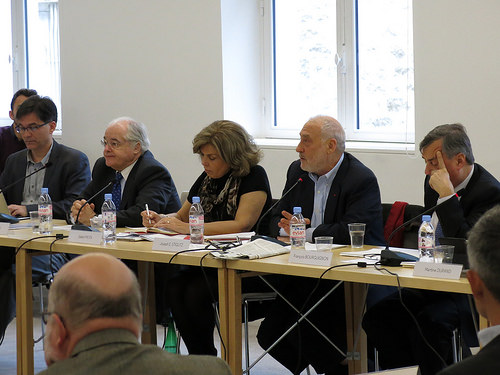
High Level Expert Group Workshop on Inequality of Opportunity January 2015 Paris OECD
High-Level Expert Group, January 2015, Paris

I’ve written a working paper based upon a presentation I made in January 2015 to a workshop on “Inequality of Opportunity” held by the High-Level Expert Group on the Measurement of Economic Performance and Social Progress. The OECD, which was one of the organizations co-hosting the workshop, is currently reviewing the paper for publication.

You can download the current draft here, and I’d invite any comments before it is finalized and officially released.

You can view the workshop agenda and all the presentations here. The broader program of the Expert Group, which includes the development of “distributional National Accounts”—national accounting that recognizes inequality and the distribution of income—can be found at this link.

What follows for quick reference is the introduction of my paper. If you have a chance to read the whole thing and have some thoughts to make it better, feel free to include your suggestions in the comment section at the end of this post, or email them to me.

~~~~~ ~~ o ~~ ~~~~~

Continue reading “Economic theory and practical lessons for measuring equal opportunities”

The main messages of “Too Many Children Left Behind,” a book published by the Russell Sage Foundation

Here are the slides for the presentation “Too many children left behind: The U.S. Achievement Gap in Comparative Perspective”, which I gave to the conference “Causes and Consequences of Inequality and Social Mobility: What Can Be Done?”

Click to access corak_too_many_children_left_behind_sapienza_rome_2015.pdf

The conference was held at the Faculty of Economics, Sapienza University of Rome on September 25th and 26th, 2015, and you can see the full program here: http://www.eticaeconomia.it/ee/wp-content/uploads/2015/09/Evento-n28_pdf.pdf

Building a more inclusive society requires a conversation about inequality

[ This post is based on the opening address I gave on the invitation of the New Zealand Treasury to the “A More Inclusive New Zealand Forum” held in Wellington, New Zealand on July 27th, 2015. ]

I would like to open this gathering with a statement of admiration for both its content, and its process. The organizers have asked us to deliberate on “inclusion”, and to do so through conversation.

As a part of my contribution to this conversation I would ask you to consider four major messages, all four of which revolve around the question: What does inclusion mean?

I use “mean” in the sense of how we define inclusion, and “mean” in the sense of its implications for policy.

What does “inclusion” mean, and how can we give it enough precision to inform public policy?

My four messages are:

  1. an inclusive society means that all children can become all that they can be;
  2. an inclusive society seeks to eliminate child poverty;
  3. income inequality has the potential to erode inclusion;
  4. public policy must address many dimensions of inequality.


A More Inclusive New Zealand Forum

Continue reading “Building a more inclusive society requires a conversation about inequality”

“Inequality, Life Chances, and Public Policy,” watch the presentation I made at Millersville university

I was very pleased to speak at the 2014 International Policy Conference on the theme “Inequality: Defining our Time?” held at Millersville University on November 6th and 7th, 2014. I spoke on the very kind invitation of Professor Ken Smith and the Department of Economics at Millersville University.

My talk was called “Inequality, Life Chances, and Public Policy: How to Slide Down the Great Gatsby Curve,” and you can watch it here if you have an interest.

These are the associated slides: Inequality Life Chances and Public Policy how to Slide Down the Great Gatsby Curve for Millersville University International Policy Conference

The source for this presentation is an article I published in the Journal of Economic Perspectives called “Income Inequality, Equality of Opportunity, and Intergenerational Mobility

The discussant, who begins speaking at about 47 minutes into the talk, is Professor Antonio Callari of Franklin and Marshall College. He offered some interesting remarks about how the theme of the talk relates to developments in Lancaster PA, where the conference was held.

[ One silly grammatical error that I wish I could take back occurs when I say “the more statistically significant among you,” when my intention was “the more statistically savvy among you.” ]

Social mobility, fixed forever? Gregory Clark’s The Son Also Rises is a book of scholarship, and of scholastic overreach

[ This post is a book review of: Gregory Clark (with Neil Cummins, Yu Hao, and Daniel Diaz Vidal and others), 2014. The Son Also Rises: Surnames and the History of Social Mobility. Princeton and Oxford: Princeton University Press. ]

The Son Also Rises forcefully advances the idea that social position is determined by innate inherited abilities, an idea that is potentially pregnant with policy implications. “Once you have selected your mate,” Gregory Clark counsels, “your work is largely done. You can safely neglect your offspring, confident that the innate talents you secured for them will shine through regardless.”

With this book Professor Clark (an economic historian with the University of California at Davis) dons the mantle of Francis Galton, who more than 100 years ago examined the transmission of status across the generations of 19th century England, and who is equally known for the statistical methods he developed to study the issue.

Continue reading “Social mobility, fixed forever? Gregory Clark’s The Son Also Rises is a book of scholarship, and of scholastic overreach”