
Here is the presentation called “Inequality and Opportunity” that I am pleased to make to a luncheon meeting of the Ottawa Economics Association. The paper upon which it is based is called “How to Slide Down the Great Gatsby Curve.”
Tag: social mobility
The Great Gatsby: as Hollywood never imagined it
After much anticipation Hollywood finally releases its version of F. Scott Fitzgerald’s classic novel, The Great Gatsby.
Was Gatsby a crook? Or was he a victim of a crooked game, the American Dream as a broken promise?
In this program originally aired on CBC radio last August, Sarah Churchwell of the University of East Anglia, a professor of American literature and author of Careless People, interprets Fitzgerald as saying the American Dream is a lie.
But listen also for my reading of a few passages to appreciate, tongue-in-cheek, why the underlying economics suggest that The Great Gatsby is indeed a novel for our times.
If you want the movie version, and a detailed discussion of The Great Gatsby Curve, here is a lecture I had the honour to give earlier this year at the University of Lethbridge on the invitation of the Prentice Institute and its Director Susan McDaniel.
I have to admit, however, the Hollywood version looks somewhat more exciting!
Tax policy for equality and social mobility
The Canadian House of Commons has charged its subcommittee on Finance to examine income inequality in Canada.
More specifically the Committee’s mandate is to produce a report that will:
- review Canada’s federal and provincial systems of personal income taxation and income supports;
- examine best practices that reduce income inequality and improve per capita gross domestic product;
- identify any significant gaps in the federal system of taxation and income support that contribute to income inequality;
- identify any significant disincentives to paid work in the formal economy that may exist as part of a “welfare trap;” and
- provide recommendations on how best to improve equality of opportunity and prosperity for all Canadians.
Its website contains the written submissions received by the April 5th deadline.
I will appear as a witness in a televised hearing beginning at 8:45 EDT on Thursday April 25th, 2013. The other witnesses slated to appear at the same meeting are listed here.
You can view it all here as Meeting 116 if you have an interest.
A copy of my written submission is available as a pdf: Corak_Submission_to_Finance_Committee.
Inequality and social mobility, an interesting discussion
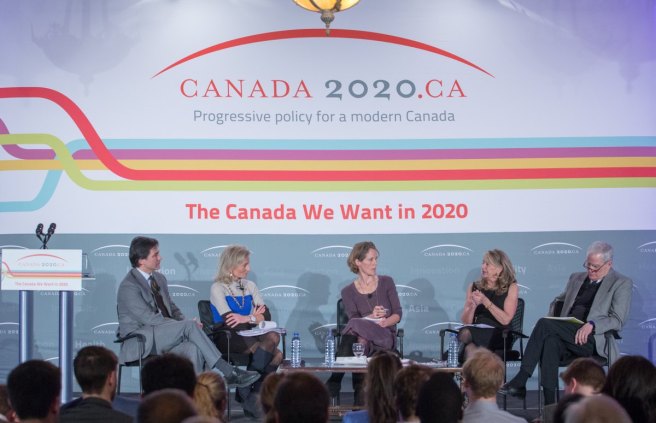
“The idea that all citizens should have an equal chance to succeed in life, regardless of where they start, is fundamental to liberal societies and emblematic of the American—and Canadian—dream” is the way a Canadian think tank, Canada2020, introduces a panel discussion it hosted that explored the idea of economic mobility, why it is important, and how it is related to inequality of outcomes.
I was a member of the panel and had a very interesting—and at times humorous and entertaining—discussion with Zanny Minton Beddoes the economics editor of The Economist, Carolyn Acker the founder of Pathways to Education, and Ron Haskins a senior fellow at the Brookings Institution. You can view the entire discussion, which was moderated by Diana Carney, by clicking on the following screen shot (and waiting a bit for it to load):
The short presentation I made at the beginning of the talk is, if you are interested, available here: Equality_of_Opportunity_A_Canadian_Dream_for_Canada2020
I plan on revising the background document I wrote for the event—which you can download from the Canada2020 website—and would therefore be very pleased to hear your views on the discussion, and any specific feedback you might have.
Public policies for equality and social mobility

“Inequality matters. It matters because it has the potential to shape opportunity.”
This is how I begin the conclusion to a just finished paper that will serve as a background document for an event called “Equality of Opportunity—a Canadian Dream?” that will take place Tuesday evening, February 26th.
The event is organized by Canada2020, an Ottawa based think tank, and will take the form of a panel discussion moderated by Diana Carney and include as panelists Carolyn Acker (founder of Pathways to Education), Zanny Minton Beddoes (the economics editor at The Economist), Ron Haskins (senior fellow at The Brookings Institution), and me.
The conclusion to my paper, “Public policies for equality and social mobility”, continues:
Continue reading “Public policies for equality and social mobility”
Social mobility and generational differences in income status in my family history
The February 9th, 2013 issue of the The Economist magazine featured an article on social mobility called “Nomencracy“, which discussed research on the lack of social mobility over very long periods of time in some countries. This engendered a good deal of discussion including an exchange of views I had with other academics on The Economist’s Free Exchange Blog, which is introduced here, and begins here.
But frankly the best correspondence I received on this was from a UK-based reader whose family origins are from Leicestershire, and who was kind enough to share his family history with me. His experiences vividly illustrate the challenges of upward mobility. I am pleased to reproduce his letter to me with his kind permission.
His great-great-great-great-grandfather was a framework knitter.

 Economics for public policy