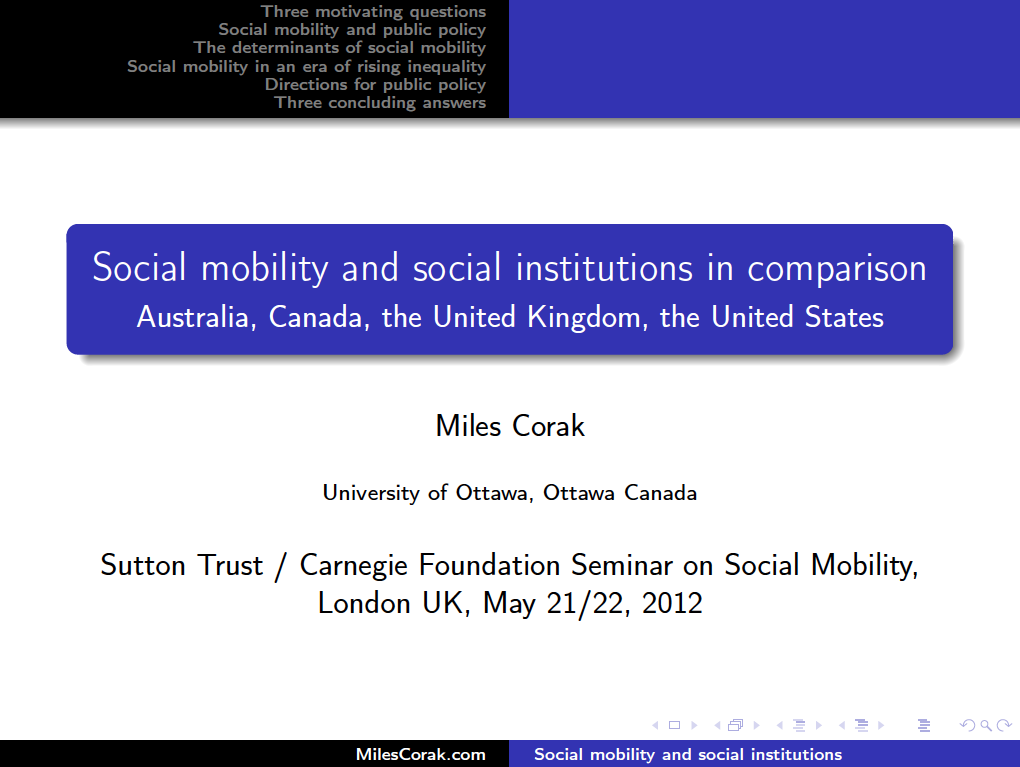
Social mobility is about twice as great in Australia and Canada than in the United Kingdom and the United States

Social mobility is about twice as great in Australia and Canada than in the United Kingdom and the United States.

This is the first of three facts upon which my presentation to The Sutton Trust and The Carnegie Corporation workshop on social mobility called: “Social Mobility and Education in the Four Major Anglophone Countries” on May 21st. This summit of academics, politicians, and public policy advocates coincided with the one year anniversary since the Deputy Prime Minister of the United Kingdom, Nick Clegg, released the government’s social mobility strategy.
Continue reading “Social mobility is about twice as great in Australia and Canada than in the United Kingdom and the United States”

A little secret Denmark shares with Canada about social mobility that Americans and Brits should know

In an article that appeared earlier this year, The New York Times described the extent to which rich parents can expect to see their children grow up to be rich adults, as well as the likelihood that the poor raise children destined for poverty.

Surprisingly enough, the article came close to concluding that if Americans are interested in living the American Dream—where family background has little influence on adult outcomes—they should move to, of all places, Denmark, or if crossing the Atlantic seems daunting, then, as a second best, to Canada.

Indeed, Denmark has been a darling of sorts ever since Richard Wilkinson and Kate Pickett highlighted in their book, The Spirit Level, that Danish life is so much better along a whole host of dimensions because income inequality is so much lower.

But Denmark has a little secret, one it shares with Canada, about how kids get jobs, and about how this determines life chances even in places with low inequality.

Continue reading “A little secret Denmark shares with Canada about social mobility that Americans and Brits should know”

“What the U.S. can Learn from Britain’s War on Poverty”

In 1999 Tony Blair pledged to end child poverty in the United Kingdom within 20 years.

There were three pillars to this pledge: (1) making work pay; (2) increasing income support to families with children whether or not parents are working; and (3) investing more in children.

Jane Waldfogel of Columbia University examines each of these pillars in a presentation to Cornell University earlier this year. She also discusses the results of these policies and the lessons for the United States.

Waldfogel’s one hour presentation is a summary of  the major messages in her book Britain’s War on Poverty published by the Russell Sage Foundation.

Inequality and social mobility

[These are the opening remarks I made to the Senate Standing Committee on Social Affairs, Science and Technology of the Parliament of Canada. I appeared as a witness at the May 2nd meeting of the Committee dealing with Social inclusion and cohesion in Canada to address the topic of inequality. These remarks do not substitute for the official transcripts that will be produced by the Standing Committee.]

Continue reading “Inequality and social mobility”

How to give children the vote

The right to vote is an inherent right of all citizens, and the first and most important marker of the capacity to participate in the setting of social priorities.

Children should be given that right from birth. But until they reach the age of majority it should be exercised by proxy with the custodial parent or parents given an extra vote for every child under their guardianship.

Continue reading “How to give children the vote”

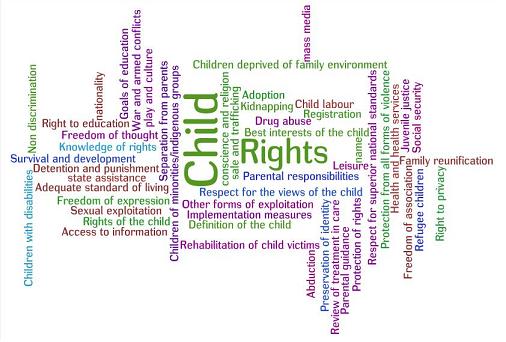
Three policies to promote the dignity and rights of children

On April 19th 2012 I made a presentation called “Promoting the dignity and rights of children” to the Dignity for All campaign summit held in Ottawa Canada. The presentation offered three policy recommendations to the Federal government that if undertaken would improve the well-being of children and respect their rights as citizens.

Continue reading “Three policies to promote the dignity and rights of children”