Welcome to your first course in “Macroeconomic Policy”

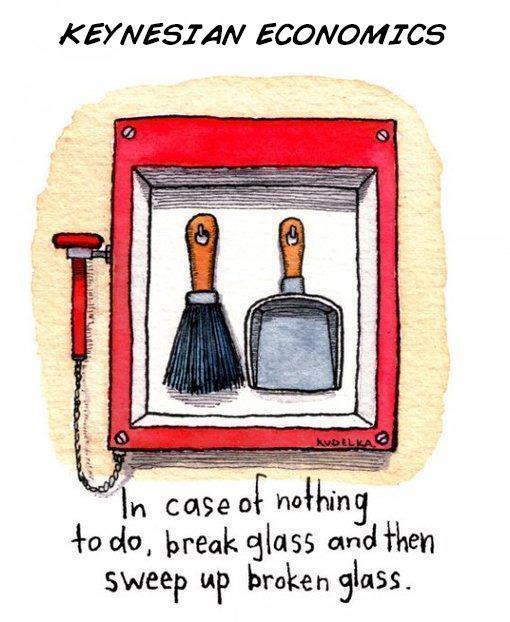
keynesian-economics

This is an exciting time to be studying macroeconomics! The “Great Recession” still, after almost eight years, echoes in high unemployment in European countries, in lower earnings and wage rates in the United States, and is even more strongly imprinted in excessive debt, low employment, and outright despair in other countries like Greece and Spain. Interest rates have never been as low, indeed in some countries banks are charging negative interest rates … it costs money to save money! Inflation is low, unemployment is exceptionally high (particularly among young people), and exchange rates keep bouncing around.

What has caused this instability in the overall level of economic activity, in incomes, and in employment? And what role can, or for that matter should, public policy play in making things better? How can it play these roles?

Every responsible citizen should have an understanding of the basic principles of macroeconomics. Without it how can you possibly understand some of the critical debates in almost every recent election in the rich countries: is a balanced government budget a good thing or a bad? how can governments create more jobs? why are interest rates so low, and should inflation be a worry? How can you possibly understand why less rich economies sometimes hit a brick wall as prices increase without bound, as unemployment soars, and as investment capital leaves the country? It is not an exaggeration to suggest that poor macroeconomic management is sometimes the prequel to civil unrest.

This is the first class of a course that is designed to meet the needs of students in public policy who may have had only limited exposure to economics. But almost anyone can follow along. Upon completion of the course successful students will be familiar with the basic principles of macroeconomics, and be able to apply them critically to issues dealing with Canadian and international public policy.

Your next steps?

Download the course outline, and get the two required books. Then watch one prominent macro-economist—Joseph Stiglitz—explain his views of what caused the great recession and what government should do about it in this presentation given about one year after the Great Recession was unleashed in the autumn of 2008. Pay attention to the vocabulary he uses: list words that are not familiar to you, try to discern when he is speaking about “microeconomics” and when he is talking about “macroeconomics”, think about the logic he uses and what this says about the way economists think. Here is a list to help guide you.

Our studies start next week with a discussion of what we mean by “macroeconomics,” and how we measure the things central to gauging macroeconomic performance. To be prepared for our discussions read the readings listed in the course outline for September 15th.
Earnings inequality at the top has slowed progress in pay equity between men and women

Nicole Fortin, a professor of economics with the University of British Columbia, addressed the 50th anniversary meeting of the Canadian Economics Association with a “state of the art” presentation on earnings inequality in top incomes and the gender pay gap, examining three questions:

  1. What are the consequences of under representation of women in top incomes to the overall pay gap?
  2. How is it contributing to the slowdown in the convergence of male and female wages?
  3. What could be done to change things?

Continue reading “Earnings inequality at the top has slowed progress in pay equity between men and women”

Applying Behavioural Economics to Canadian public policy

Some decisions invite undesirable behaviour, even if unintentional. Others can encourage desirable behaviour, but they have to be thought through. Think about taking the escalator, or taking the stairs.

These actions are challenging because they have an immediate cost, but generate long-term benefits, and because human decision-making can be skewed to a present bias. Behavioural economics studies these challenges, and was the subject of a State of the Art Lecture given by Philip Oreopoulos of the University of Toronto at the 50th meeting of the Canadian Economics Association. Here is a summary of his talk.

Continue reading “Applying Behavioural Economics to Canadian public policy”

Is there a Canadian economics, or just economics done by Canadians?

This is the 50th anniversary of the Canadian Economics Association, and it is natural to wonder how Canadian economics has changed, even if there is such a distinct thing as “Canadian Economics.” The annual meetings kicked off with a session on “Fifty Years of Canadian Economics.”

Continue reading “Is there a Canadian economics, or just economics done by Canadians?”

Two dead philosophers buried 10 metres apart, still living: John Rawls and Robert Nozick

My year as a visiting professor with the Department of Economics at Harvard is coming to an end, and I am on a pilgrimage of sorts. Today was spent in Mount Auburn Cemetery, visiting the notable and still living dead.

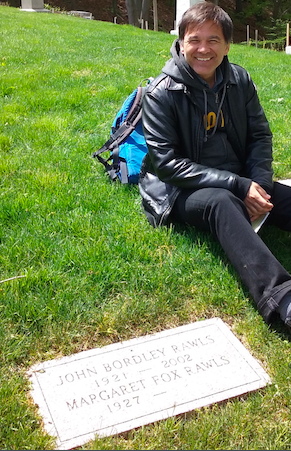
Visiting John Rawls in Mount Auburn Cemetary Cambridge Massachsetts

John Rawls died on November 24th, 2002. He is buried in a part of the cemetery called Harvard Hill, where you can see over the tree tops, just barely, the spire of Sanders Theatre in Memorial Hall. Professor Rawls is the author of A Theory of Justice, published in 1971. I read it for the first time in the early 1980s as a graduate student when working on my Master’s degree at McGill University. Rawls asks what kind of social contract would we enter into to govern the workings of our society if we had to negotiate it behind a veil of ignorance, not knowing where we stood in society, knowing nothing at all about ourselves, not our social rank, not even who are parents were. His answer? A good society is one in which the interests of the least advantaged have priority: social welfare is improved only when the least advantaged advance.

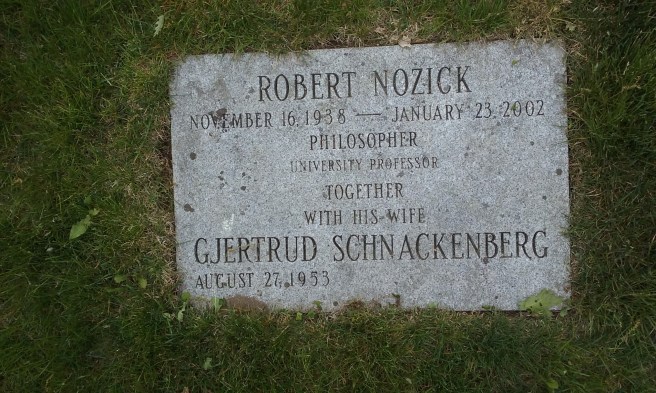
Also buried on Harvard Hill, barely 10 meters away, is Robert Nozick, who died on January 23rd, 2002. Nozick’s great work is Anarchy, State, and Utopia, a forceful response to Rawls, published in 1974. Nozick argued for a minimal state, focusing on the importance of individual property rights. Social welfare is based upon process, the freedom to engage in voluntary exchange in the exercise of property rights is what makes a society good, and the state should play a minimal role providing only those most basic services that uphold property rights. Let the outcomes be what they will be, as long as this process respected.

Robert Nozick in Mount Auburn Cemetery Cambridge Massachusetts

Two books, still alive, and very much for our times.

Long live the mandatory census! or maybe not?

[This post is based on my comments at “Celebrating the Census,”  a panel discussion organized by the McGill University Centre on Population Dynamics held in Montreal on April 29th, 2016. Other members of the panel were Jean-Yves Duclos, Sebastien Breau, Ian Culbert, Ariane Krol, Mary Jo Hoeksema, and the moderator Celine LeBourdais.]

The Census is built block-face by block-face. It is built sub-division by sub-division. Village, township, city, municipality, it is built until the entire country is perfectly and completely tiled.

The Census is a machine, complicated and intricate. And the public servants working at Statistics Canada should be rightly proud of the hard work and dedication devoted to the development, maintenance, and management of this machine. Even the most jaundiced among us, regardless of political persuasion, should recognize and acknowledge this accomplishment.

RH Coast looking north over Jean Talon S0001
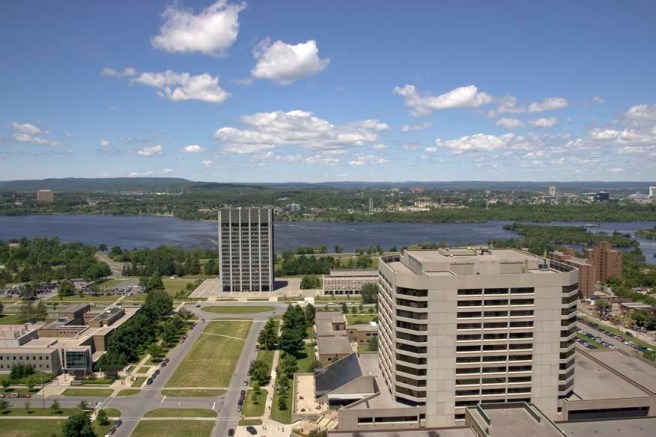
The Jean Talon building, in the bottom right, was originally called the “Census Building.” Photograph by Philip Smith.

The value of this machine is that it lets us see ourselves in detail more precise than any other mirror, and the return of a mandatory long form, in which Canadians are required to offer up a description of some of the most private aspects of their lives, is hailed by many as a major turn in public policy that will allow this picture to stay clearly focused.

But the Census is more than a machine. Jean Talon knew that. The very first Census he conducted, beginning in the later part of 1666, was clearly an act of nation building. He used it to help him, and France, develop and build a viable colony extending from the shores of the Saint Lawrence River, transforming the countryside into a prosperous agricultural region that would prepare the way for waves and waves of more immigrants. The Census is an act of political imagination.

And the public servants who work at Statistics Canada are not well placed to exercise that imagination, even if at times what they do in managing the machine casts them in that role.

There is still much to be done for Canadians to accept and appreciate the benefits of the Census, and for the federal government to give them ownership of the results. The Census is mandatory—by law it must be filled out—but we should strive to think of it as voluntary, our participation to be both exercised and celebrated as an act of citizenship in a way that fosters each Canadian’s political imagination.

Continue reading “Long live the mandatory census! or maybe not?”