If there is such a thing as the “Canadian Dream,” it would look very much like what Americans say is the “American Dream”

Public opinion polls suggest that Canadians and Americans share basic attitudes toward inequality and opportunity, and toward the underlying drivers of upward mobility. If there is such a thing as the “Canadian Dream,” it would look very much like what Americans say is the “American Dream.”

The Pew Charitable Trusts conducted a number of public opinion polls asking Americans what meaning they attach to the phrase “The American Dream,” and these have been adapted and conducted in Canada with remarkably similar responses.

In these polls respondents were asked to indicate the degree to which they agreed with a series of possible definitions of the American Dream. Sixty percent of American respondents ranked “being able to succeed regardless of family background” eight or higher on a ten point scale, while 59 percent of Canadians did so. The percentage indicating that the statement “Your children being financially better off financially than you” represents the American Dream was 64 percent in the United States, and 57 percent in Canada.

These two options relate most directly to social mobility as measured by social scientists, and the country differences in responses to them are not statistically significant. In fact, this was the case for the ratings given to all but one of the other ten options presented to these representative samples, Americans ranking “Owning your own business” more highly.
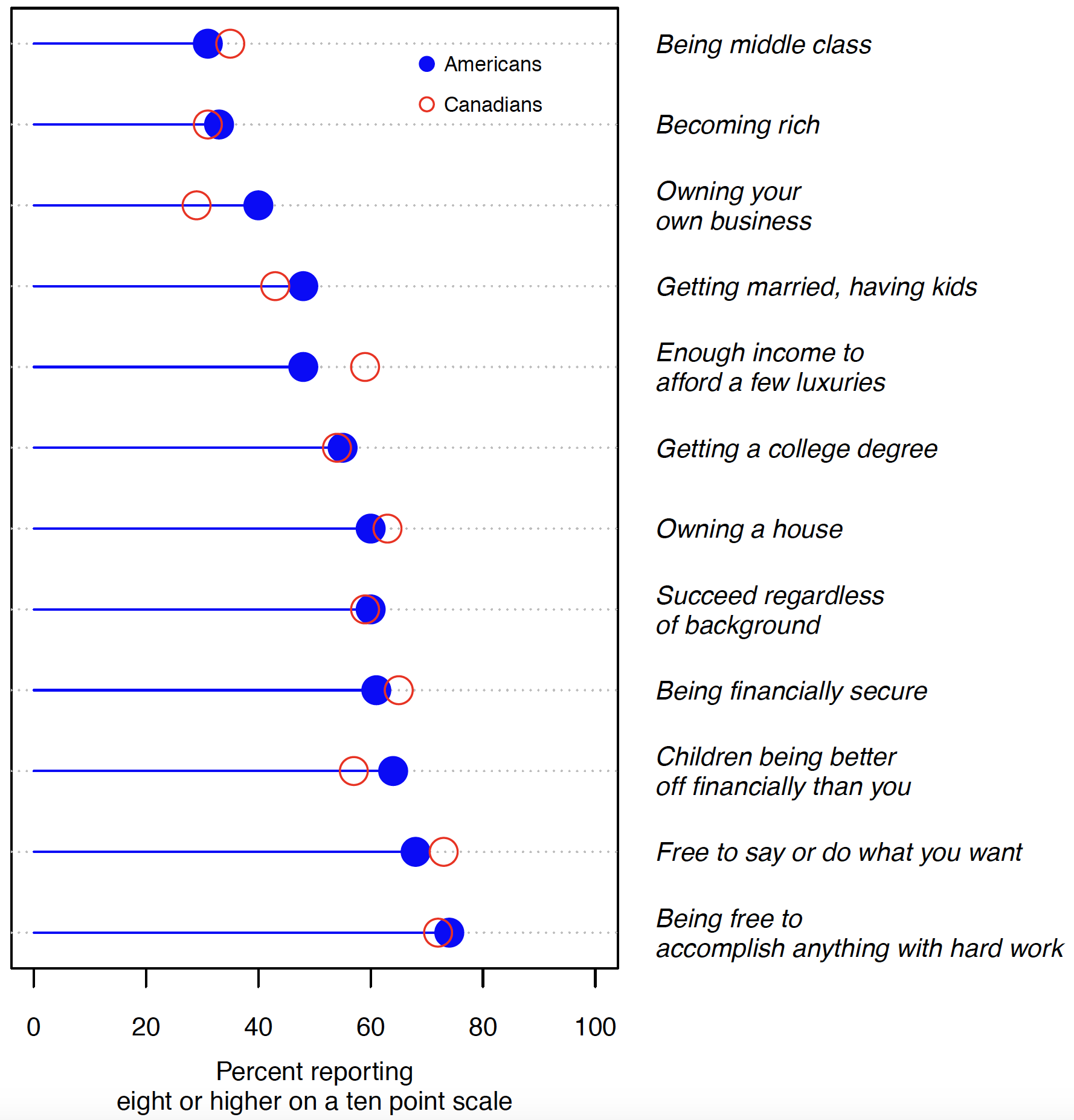
Source: Connolly, Corak, Haeck (2019) using data from Corak (2010).

Continue reading “If there is such a thing as the “Canadian Dream,” it would look very much like what Americans say is the “American Dream””

Equality of opportunity is a choice

Tony Atkinson, the great British economist, encourages us to think of inequality as a choice, something that can be influenced by public policy.

If this is the case for equality of outcomes, then it is surely also so for equality of opportunity; the significant differences in social mobility between the rich countries hinting at the role governments play in determining the degree to which family background is destiny, the rich raising the next generation of rich adults, the poor seeing their children face low chances of upward mobility.

Some of these differences may simply reflect different social priorities, but others may teach us about the power of different policies. Continue reading “Equality of opportunity is a choice”

Rest in peace Alan Krueger

Alan Krueger did everything an economist should aspire to achieve: strong research grounded in a solid understanding of theory and statistical method; framed to uncover facts important to the way people lead their lives, to the challenges they face; and communicated to resonate among policy makers, compelling them to do better for their citizens.

Writing in 1924, upon the death of his teacher and mentor Alfred Marshall, the great British economist John Maynard Keynes said that the “study of economics does not seem to require any specialised gifts of an unusually high order. Is it not, intellectually regarded, a very easy subject compared with … philosophy and pure science? Yet good, or even competent economists are the rarest of birds. An easy subject at which very few excel !”

And just as Keynes said of Marshall, that this paradox is explained by the fact that the “master-economist” needs to embody “a rare combination of gifts,” so to it can be said of Alan Krueger, the Princeton University labour economist who died on March 16th, 2019 at the age of 58. Continue reading “Rest in peace Alan Krueger”

Canada’s Poverty Reduction Strategy adopts the United Nations Sustainable Development Goal to end poverty

The targets to reduce income poverty in Canada’s Poverty Reduction Strategy take an important step toward the first UN Sustainable Development Goal addressed to ending poverty, but progress will fall short without all Canadian governments—not just the federal, but also provincial, and municipal governments—adopting coordinated policies to eliminate deep poverty.

The first UN Sustainable Development Goal is to “End poverty in all its forms everywhere,” and has explicit targets associated with it.

Two of these targets are particularly relevant for Canadians. They speak to ending income poverty, and are:

By 2030, eradicate extreme poverty for all people everywhere, measured as people living on less than $1.90 a day

By 2030, reduce at least by half the proportion of men, women and children of all ages living in poverty in all its dimensions according to national definitions

Canada’s Poverty Reduction Strategy is informed by both of these targets, setting a nationally appropriate poverty line, and using it to explicitly adopt the second target. However, it addresses the first UN target only partially: offering an appropriate definition of extreme poverty, but not adopting an explicit target.

Eradicating extreme poverty will require all governments in the Canadian federation—not just the federal—to pursue consistent and coordinated policies. Significant progress will only happen with the partnership and commitment of the provinces and municipalities.

Continue reading “Canada’s Poverty Reduction Strategy adopts the United Nations Sustainable Development Goal to end poverty”

Canada’s official poverty line: what is it? how could it be better?

Source: extracted from “Opportunity for All: Canada’s First Poverty Reduction Strategy”, Employment and Social Development Canada. Click on image to enlarge

Canada’s Poverty Reduction Strategy released by Jean-Yves Duclos, the Federal Minister of Minister of Families, Children and Social Development, proposes to introduce legislation to establish an official poverty line for the country. This is an act of political courage, but the poverty line continually needs to be updated and improved.

Continue reading “Canada’s official poverty line: what is it? how could it be better?”

Ask yourself two questions while reading Canada’s Poverty Reduction Strategy

Canada’s first “Poverty Reduction Strategy” will only prove useful if citizens take ownership, and use it to hold governments to account for reaching meaningful goals.

What is a “poverty reduction strategy”? How is it useful?

In one sense, it is surely actions taken, programs designed, monies spent. And that is how Opportunity for All — Canada’s First Poverty Reduction Strategy begins: a list of policies, programs, and budgets that the government has undertaken, and for which politicians want to be given credit. The federal government can rightly claim that it has been pursuing a “poverty reduction strategy” from the day it was elected in October 2015.

But for citizens, whether poor, rich, or middle class, this is not good enough. A poverty reduction strategy must also be a clearly stated set of priorities that reflect our concerns; priorities that are paired with measurable targets allowing us to plot a path to somewhere better. Continue reading “Ask yourself two questions while reading Canada’s Poverty Reduction Strategy”