Mr. Keynes and the Austrians: a battle over a suggested interpretation of unemployment

Arthur Cecil Pigou made lasting contributions to the science of economics, but for macro-economists of a certain generation he will always be considered a laughingstock.
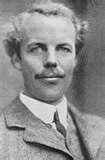
Arthur C Pigou

Professor Pigou taught at Cambridge University during the first decades of the 1900s, and had the misfortune of making a cameo appearance in the opening chapters of what is arguably the most influential economics book of the 20th century, The General Theory of Employment, Interest, and Money, written with eloquence, and at times a very caustic pen, by his colleague at the same university, John Maynard Keynes (whose last name, by the way, sounds like “Canes”).

Pigou’s big mistake was to suggest that the unemployed themselves were to be blamed for their predicament. To Mr. Keynes, the notion that the persistently high unemployment rates of the Great Depression were in some sense voluntary was worthy of scorn and ridicule.

Continue reading “Mr. Keynes and the Austrians: a battle over a suggested interpretation of unemployment”

How much confidence should we have in the job numbers?

normal_curve

Statistics Canada reported that employment rose by 51,000 in February.

These numbers seem to gyrate tremendously from month to month in a way that has little to do with economic fundamentals: jumping by 40,000 in December, falling by 22,000 in January, and now rising significantly.

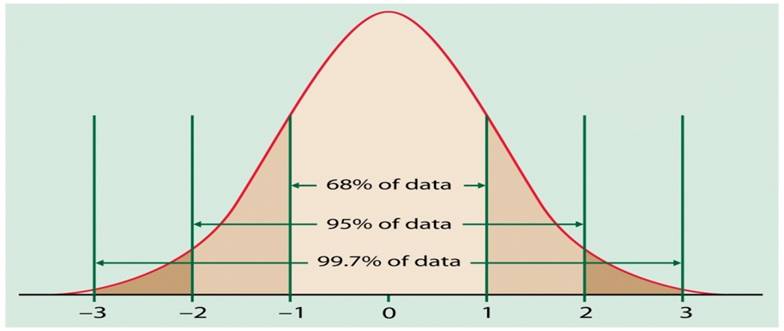
How much confidence should we have in them?

Continue reading “How much confidence should we have in the job numbers?”

Three predictions for the January job numbers

corak-jobs

On Friday Statistics Canada will release its estimates of the January job numbers, and after about 20 minutes of statistical modelling, using fuzzy data, over a small glass of red wine, I am prepared to make three predictions, albeit with different degrees of confidence.

First, I am most confident suggesting that January’s job growth will be less than the 40,000 recorded in December; second, I am confident that it will be less than 21,000, which is the average monthly change during the recent past; and third, if I had to offer a single number, I’d say the economy added only about 1,700 jobs in January.

All three ingredients—the statistics, the fuzzy data, and the red wine—were important in making my forecast, but realizing the data are fuzzy was crucial.

Continue reading “Three predictions for the January job numbers”

Secure jobs on the rise in Canada, but the young are still shut out of the jobs market

Mr. Carney can’t push on a string. And he knows it.

His now famous comment labelling the stockpiles of retained earnings held by Canadian firms  as “dead money”, while perhaps being the most memorable quote of 2012, must also have been made out of a certain frustration that even this superstar central banker faces limits in his powers to push, encourage, and otherwise jumpstart business investment.

The Governor of the Bank of Canada knows that the flip side of dead money is insecurity in the jobs market.

Continue reading “Secure jobs on the rise in Canada, but the young are still shut out of the jobs market”

Polling the pollsters suggests the odds favour Obama

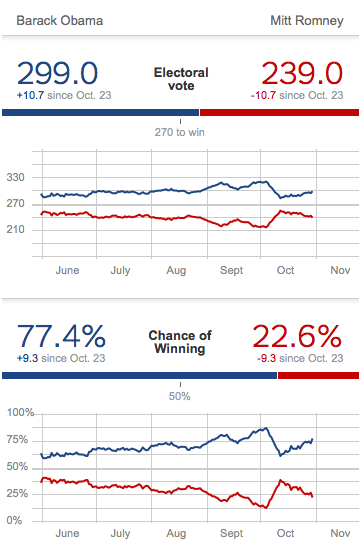
Nate Silver is a pollster with a reputation, having correctly predicted the outcome of the 2008 American election in 49 of the 50 States. In 2012 he is giving the edge to President Obama over Governor Romney by a good margin.

Source: Nate Silver, http://fivethirtyeight.blogs.nytimes.com/, Accessed October 31st, 2012.

There is a science to polling, and Mr. Silver knows it well enough to realize that it is not exact: all predictions come with a level of uncertainty.

But he figures that Mr. Obama has at least a 77% chance of winning the required 270 electoral college votes, even if at the same time he is predicting the President will only capture 52% of the popular vote.

The last time an incumbent sought re-election during the aftermath of a great recession was in 1936, when Franklin D. Roosevelt was challenged by the Republican Governor of Kansas, Alfred Landon.

At that time The Literary Digest magazine was the pollster to be reckoned with, having correctly predicted the winner in each presidential election since 1920, including Roosevelt’s 1932 victory.

Continue reading “Polling the pollsters suggests the odds favour Obama”

The Canadian labour market: better than most, better than it has been, but not better than it could be

The labour market has fared better in Canada than in many other rich countries, it has fared better than it has in past recessions, but it has not fared as well as it could.

This is the major message from a recently released report by the Parliamentary Budget Office, which offers a valuable description of the Canadian jobs market because it puts developments in context: comparing them to underlying trends, comparing them to previous recessions, and comparing them to developments in other countries.

Continue reading “The Canadian labour market: better than most, better than it has been, but not better than it could be”