Building a more inclusive society requires a conversation about inequality

[ This post is based on the opening address I gave on the invitation of the New Zealand Treasury to the “A More Inclusive New Zealand Forum” held in Wellington, New Zealand on July 27th, 2015. ]

I would like to open this gathering with a statement of admiration for both its content, and its process. The organizers have asked us to deliberate on “inclusion”, and to do so through conversation.

As a part of my contribution to this conversation I would ask you to consider four major messages, all four of which revolve around the question: What does inclusion mean?

I use “mean” in the sense of how we define inclusion, and “mean” in the sense of its implications for policy.

What does “inclusion” mean, and how can we give it enough precision to inform public policy?

My four messages are:

  1. an inclusive society means that all children can become all that they can be;
  2. an inclusive society seeks to eliminate child poverty;
  3. income inequality has the potential to erode inclusion;
  4. public policy must address many dimensions of inequality.
 

A More Inclusive New Zealand Forum

Continue reading “Building a more inclusive society requires a conversation about inequality”
The US unemployment is lower than the Canadian, but not by as much as the official statistics suggest

The unemployment rate in the United States fell to 5.3% in June, while the Canadian rate as of May stands at 6.8%. When Statistics Canada releases the June numbers on July 10th they are unlikely to show much improvement.

But when comparing the two countries it is important to remember that there are subtle differences in statistical methods that tend to push the  Canadian statistic higher than the American. The unemployment rate in Canada would be 6.1% if it were calculated using US methods, rather than 6.8%

The gap between the two may be significant and it may grow even larger, but it is not as big as the official statistics suggest. See this 2012 post for an explanation.

Middle incomes, oil prices, and the fickle promise of prosperity

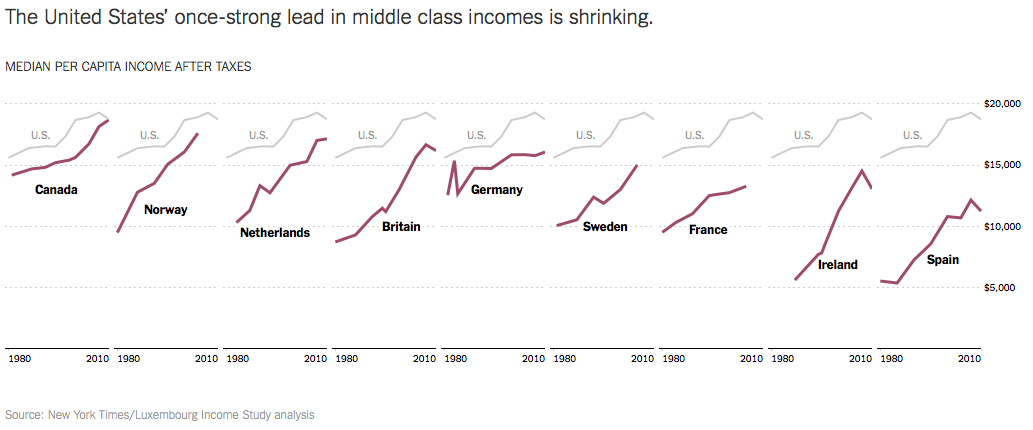
You could almost hear the air rushing out of a political agenda tailored around middle class malaise immediately after The New York Times published a story last April called “The American Middle Class Is No Longer the World’s Richest.” Here, with hard data, was that bastion of liberal thinking showing that the Canadian middle class was about to overtake the American on its way to becoming the richest in the world.

click on image to enlarge
Source: David Leonhardt and Kevin Quealy (2014). The New York Times. April 22nd.

The story made the talking points of the federal opposition parties—that the Canadian middle class was under threat, not well served by current government policy, and in need of something better—look more like limp balloons on the floor of a party that’s gone on too long, than a front line of battle ready troops about to seize power.

Trouble is, the claim that the Canadian middle class was doing better than the American lost sight of deeper trends. All bets are off now that oil prices have plunged, but the revised talking points of politicians are still no better at focusing on the underlying drivers of prosperity.

Continue reading “Middle incomes, oil prices, and the fickle promise of prosperity”

Two stories about inequality

In many rich countries the “hard” facts describing the income distribution are easily available. Yet, discussions about inequality are animated by two different stories with very different public policy implications.

You can listen to a caricature of these points of view in this pair of interviews on CBC radio: http://www.cbc.ca/radiowest/2015/01/21/two-different-takes-on-the-worlds-wealthiest-one-per-cent/

I offer more detail on the way Canadians have framed these stories as a part of a presentation to the School of Policy Studies at Queen’s university.

Here is Story 1 in pictures

(click on an image to start the slideshow and press Escape to return to this page).

Here is Story 2 in pictures

(click on an image to start the slideshow and press Escape to return to this page).

My presentation argued that context—rooted in economic theory and the appropriate use of statistics—is needed to understand the truth behind these stories, and to turn them into a conversation useful for public policy.

Here is the full set of slides I used.

Corak_Two_Stories_about_Inequality_and_Public_Policy_presentation_to_Queens_University_February_5_2015

“After Piketty”, 12 policy proposes to reduce inequality of outcomes

“The media storm surrounding the publication of Thomas Piketty’s remarkable Capital in the Twenty-First Century (2014) has ensured that inequality is now in the forefront of public debate. But what next?”

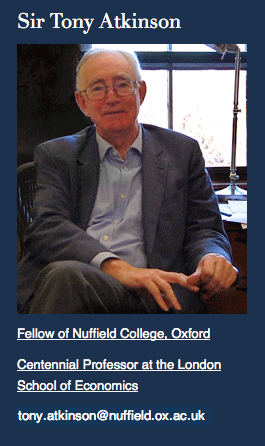
Sir Tony Atkinson

Thus begins an essay in The British Journal of Sociology by the dean of inequality studies, A. B. Atkinson of Oxford University. This is a must read for anyone interested in public policy addressed to the growing inequality in the rich countries.

Professor Atkinson’s focus is on the United Kingdom, but his far-reaching set of policy prescriptions address many aspects of public policy (not just tax and transfer policy), and have relevance well beyond the European context.

Tony Atkinson is an economist of the highest order who has been studying and contributing to the economics of inequality since the 1960s. In this paper he offers 12 proposals that, he says, “could bring about a genuine shift in the distribution of income towards less inequality.”

Continue reading ““After Piketty”, 12 policy proposes to reduce inequality of outcomes”

Should children vote? I argue that there are reasonable ways to give children the vote in an interview with CBC radio

Sound booth at the CBC Studio in Ottawa
This is the view inside the sound booth at CBC Ottawa where I did a radio interview for the program “The 180”. (The cup of water is mine!)

I make the case for giving children the vote in a radio interview broadcast on the CBC program “The 180”. The show is hosted by Jim Brown, whose subtle style and empathy with both me and his listeners is really quite impressive. Here is a link to the eight minute interview.

Matthew Lazin-Ryder, a producer on the show, nicely summarizes the main points on the program web page, but if you want more background on the voting scheme I describe—which involves giving custodial parents an extra vote for every child under their guardianship, and which is called Demeny Voting—check out the following posts.

  1. How to give children the vote
  2. Citizenship as a privilege or as a right? Should children be given the vote
  3. Should children be given the vote? Watch this TEDx talk

In fact, Demeny voting has a Wikipedia page, and you can get references to some of the underlying sources there as well as from the first of the above posts, which also points out that Paul Demeny (after whom the scheme is named) did an interview with CBC Radio in 2011.