Three rules for good pundit behaviour, or if you like: how to obstruct the debate on inequality in three easy steps

Inequality is increasing in Canada. Or is it?

A short report on the topic released by a major Canadian bank includes the bold heading “Income inequality has been unchanged in Canada — say what?”. This apparently contrarian finding has been seized upon by at least one influential pundit in a way that only serves to obstruct constructive public policy discussion.

A debate is in order, not over whether inequality has increased—because it has—but why this is important, and what could, or for that matter should, be done about it.

But this sort of discussion requires the best of our public commentators, and in this post I offer three rules for good pundit behaviour. Economic statistics can be confusing and they can be used in confusing ways, purposely or not, and so these rules might also be a set of general guideposts for the average reader to help separate fact from fiction, since after all we can’t expect pundits to always follow them.

Continue reading “Three rules for good pundit behaviour, or if you like: how to obstruct the debate on inequality in three easy steps”

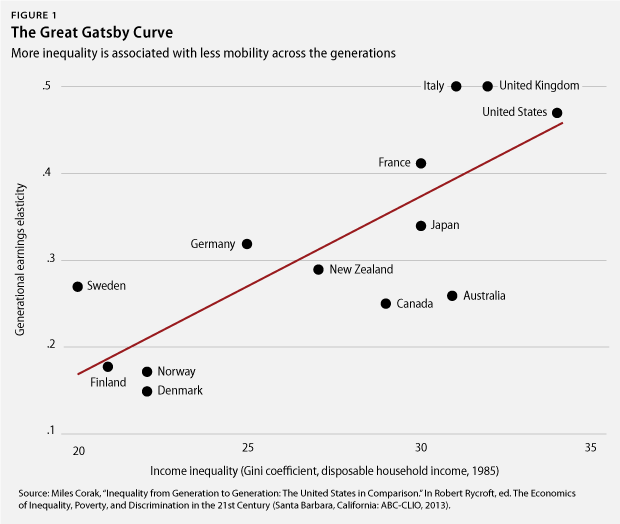
How to Slide Down the Great Gatsby Curve: Inequality, Life Chances, and Public Policy in the United States

CorakMiddleClass_fig1

The Center for American Progress has released a study I wrote called “How to Slide Down the Great Gatsby Curve: Inequality, Life Chances, and Public Policy in the United States”. Here is an excerpt:

Continue reading “How to Slide Down the Great Gatsby Curve: Inequality, Life Chances, and Public Policy in the United States”

The US Senate wonders about tax policy for the American Dream: Do parents act in the best interests of their children?

How should programs intended to support children in low-income families be designed if parents don’t always act in the best interests of their children?

This question, among others, was posed to me in response to my July 10th testimony to the Senate Committee on Finance hearing on “Helping Young People Achieve the American Dream.”  You can review all of the questions on my November 11th post.

In one way or another they address the fundamental drivers of the extent to which children grow up to be adults having the same socio-economic status as their parents. Family background matters for life chances because of three related forces: inequalities originating in the labour market, the capacity of families to invest in the skills and aptitudes of their children, and the degree to which public policy levels the playing field.

What parents do matters a good deal, and a question posed by the Committee Chairperson, Senator Max Baucus, recognizes this, and wonders about the implications for the design of public policy.

Continue reading “The US Senate wonders about tax policy for the American Dream: Do parents act in the best interests of their children?”

The US Senate wonders about tax policy for the American Dream: Senator Baucus asks if things are getting worse

Is the American Dream harder to achieve now than a generation ago?

In response to my July 10th testimony to the Senate Committee on Finance hearing on “Helping Young People Achieve the American Dream” I received some homework, a series of questions asking me for a good deal more detail. You can review all of the questions on my November 11th post, but this one posed by the Committee Chairman, Senator Max Baucus of Montana, is particularly relevant.

Compared to many other countries the United States is both more unequal, and more of this inequality is passed on to the next generation.

Knowing where Americans stand compared to other countries is interesting because it helps us to begin to understand the underlying causes, and hence how public policy might influence outcomes.

But for the same reasons it is just as interesting, if not more so, to compare the United States not just to other countries, but to itself in a previous time.

Continue reading “The US Senate wonders about tax policy for the American Dream: Senator Baucus asks if things are getting worse”

Inequality and top income shares in Canada: Recent trends and policy implications

Inequality has increased in the majority of rich countries, but the share of income and earnings going to the top has increased most in the anglophone countries.  McMaster University economist Mike Veall says Canada has not escaped this trend, and argues that a public policy response is needed.

The underlying causes of, in his words, “the surge” in the shares of the top 1%, one-tenth of 1% and even the top one-hundredth of 1% in Canada remain elusive. Even so these changes should motivate at least three policy responses that could be supported across the political spectrum.

Professor Veall was the 2012 president of the Canadian Economics Association, the professional association of economists based in Canada, and presented his presidential address at the annual meetings of the Association held last June at the University of Calgary.

Continue reading “Inequality and top income shares in Canada: Recent trends and policy implications”

#S17 is today, and reminds us of the price of inequality

The twitter hash tag is #S17, and using it will connect you to all those preparing for the first anniversary of the Occupy Wall Street movement, which of course is today, September 17th.

You will find tweets encouraging your participation: “If you feel that the world is on the right track, stay home. If you know things are bad, Join your local #OWS.”

Others will guide you on how to prepare, be it “Escaping from Zip Ties” or “How to pick your way out of handcuffs” (actually just the Smith and Weston model 100s).

But whatever your level of engagement, there is a message that this anniversary has for us all, a reminder of the real price of inequality.

Continue reading “#S17 is today, and reminds us of the price of inequality”