The changing nature of work calls for enhancing the human and financial capital of children in less wealthy families

The Canadian federal government should enhance the human and financial capital of children in less wealthy families, enhance market incomes of lower paid workers, and enhance the security of working incomes by adapting three existing programs to new realities: widening their scope, making them more flexible, and making them easier to obtain.
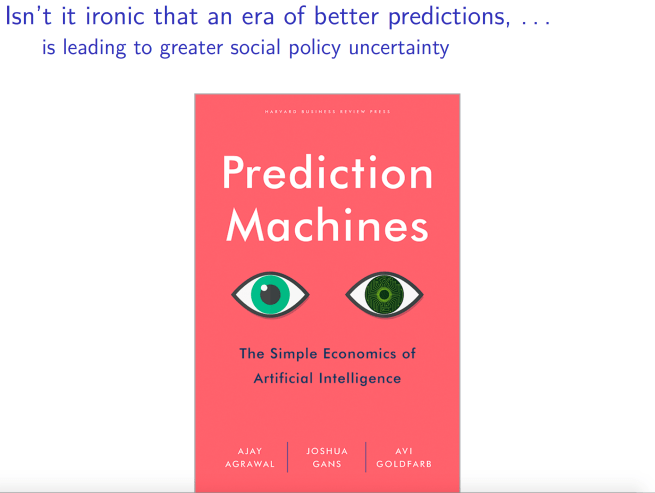
The changing world of work is also a changing world of pay, a world that will likely lean toward greater wage rate inequalities, lower or stagnating incomes for the bottom 40 percent, and greater income insecurity for the broad majority.

I suggest three changes to current public policies that take incremental, but important, steps toward fostering capital accumulation among children from less wealthy families, increasing market incomes earned from that capital for the working poor, and finally enhancing income security for the broad majority.

These policies lean toward encouraging inclusive growth, in which the benefits of the new world of work and pay are broadly shared.

In this post I discuss the first policy proposal, which is:

Enhance human and financial capital by making community colleges tuition-free, and making the Canada Learning Bond more flexible
Continue reading “The changing nature of work calls for enhancing the human and financial capital of children in less wealthy families”

Thinking about minimum wages, and thinking about them like an economist

There is a movement afoot, and there is an election in the offing. Always a great dance to watch, no matter what the issue.

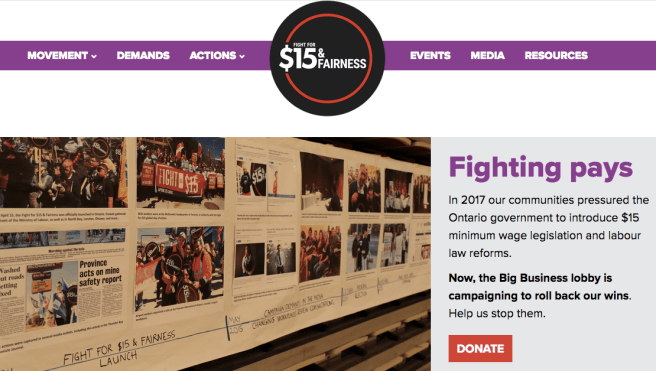
The latest show is taking place in Ontario, where “$15 & Fairness” is the rallying call for raising the minimum wage, and has found a willing partner in the province’s Premier who will go to the polls in the spring, but in the meantime has legislated significant increases in the minimum price for an hour of work. The same dance plays out in the United States, and in many cities and states a minimum wage of $15 per hour is becoming a reality.

The big question in Ontario is exactly that raised by The New York Times during the 2015 primaries when Bernie Sanders was battling Hillary Clinton for the Democratic nomination: “As the campaign for a $15 minimum wage has gained strength this year, even supporters of large minimum-wage increases have wondered how high the wage floor can rise before it reduces employment and hurts the economy.”

Something to think about, but how would you think about it if you were an economist? Here are four rules of the road that might come in handy regardless of which dance you might be watching next time.

Continue reading “Thinking about minimum wages, and thinking about them like an economist”

Poor children are twice as likely to grow up to be poor adults in some Canadian communities than in others

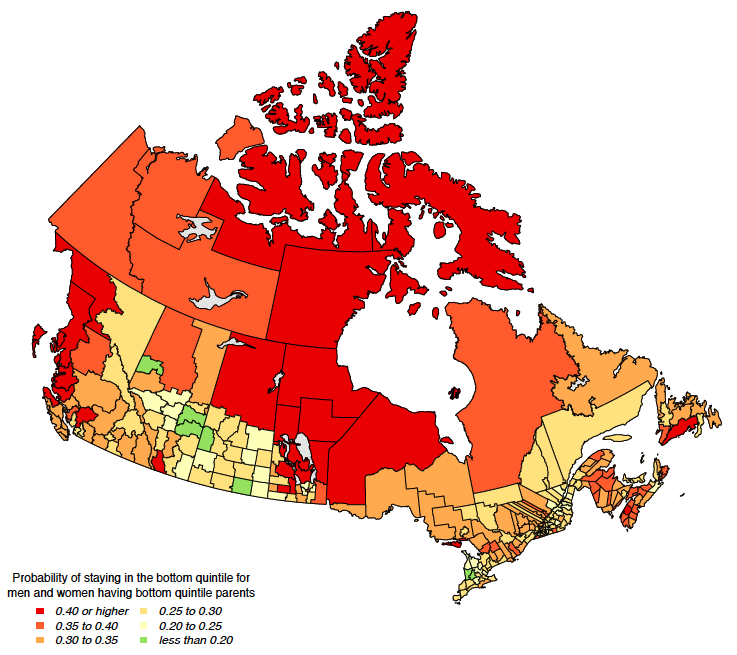
Intergenerational cycles of poverty vary across Canada, with low income children in some places facing a less than one-in-five chance of growing up to be poor adults, but in others the rate is more than double. The strong majority of children raised by lower income parents face a greater than one-in-four chance of growing up to be low income adults, and for many these odds were at least as high as one-in-three.

The chance that poverty will be passed on across the generations is 30 percent for the country as a whole, and the majority of children, 54 percent, live in 97 of a total of 266 municipalities where the chances of falling into an intergenerational cycle of low income are between 25 and 30 percent. A further 24 percent of poor live in a community where these chances are at least 0.30 but under 0.35.

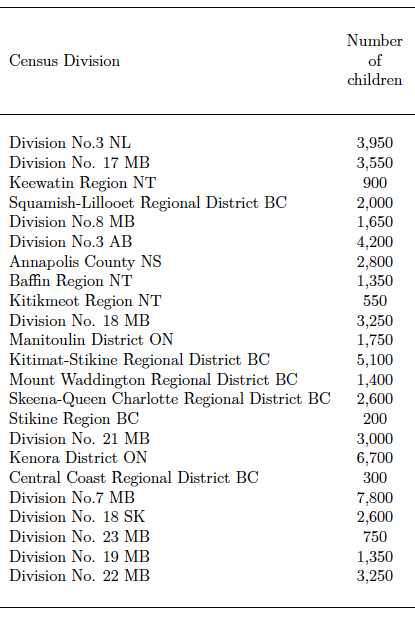
There are 23 municipalities with a 40 percent or greater chance of an intergenerational cycle of low income. These communities are all small in population, and account for two percent of the total number of children.

There is a greater than 40% chance of intergenerational poverty In 23 Census Divisions

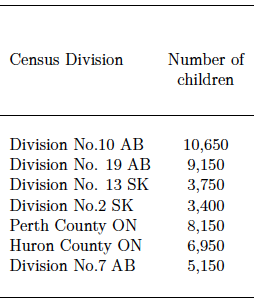
There are only seven of 266 communities in which the probability of a cycle of low income is less than 20 percent, representing only 1.6  percent of all children.

There is less than a 20% chance of intergenerational poverty in seven Census Divisions

The average parent income in these communities is below the national average. This raises the possibility that geographic mobility may be an important aspect of intergenerational mobility. The two Ontario communities listed in the above table are not areas in which there was significant economic growth, but the distances and costs associated with moving to nearby regions that were poles of growth—more specifically Toronto—were likely low.


[ The findings described in this post are drawn from my recently released research paper called “Divided Landscapes of Economic Opportunity: The Canadian Geography of Intergenerational Income Mobility.” You can learn more about this research, and download a copy of the paper and host of other information by reading the page devoted to this project at: MilesCorak.com/Equality-of-Opportunity . ]

Tony Atkinson has died

anthony-atkinson

Tony Atkinson has died.

Tony Atkinson is a great economist because he is a master at all the challenges defining the subject.

He is a theorist of the first order.

And his theory informs measurement.

And better measurement guides the search for, the gathering of, and the presentation of better information.

And theory, measurement, and information are in the service of better public policy, better social decisions for the least advantaged … in his country, and across the globe.

Tony Atkinson is a great economist, and he was a great human being.

Kind.

Generous.

Without ego.

Full of empathy.

And I am grateful to have learned, and to be able to continue to learn, so much from his writings and example.

And I am grateful to have crossed his path.

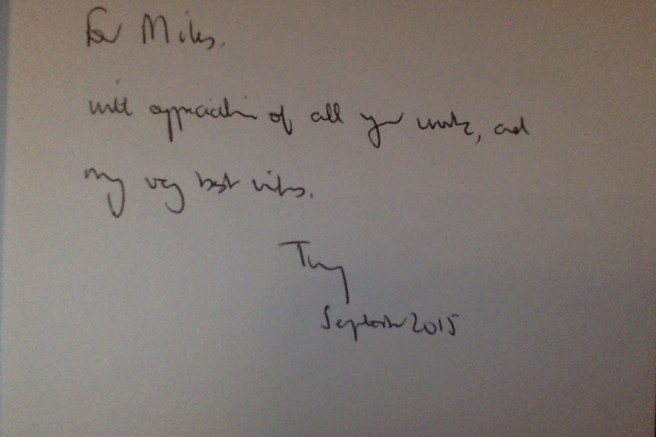
tony-atkinson-inscribes-my-copy-of-his-book-inequality
Tony Atkinson’s inscription in my copy of his last book, Inequality: What can be done?

[ If you want to know more about this great economist, start with this post which will also direct you to his website.

Beatrice Cherrier has written a lovely tribute to Professor Atkinson, paying respect to his fundamental contributions to public economics: “Remembering Tony Atkinson as the architect of modern public economics.”

Thomas Piketty has done the same, paying respect to his empirical work on income inequality: “Passing of Anthony B. Atkinson.”

Andrew Leigh offers both a professional and a touching personal sketch of the man: “Tony Atkinson is the economist who had the measure of inequality.” As does Thomas Piketty: “Passing of Anthony B. Atkinson.”

Tony’s most recent contribution—continuing a long line of work on poverty—-is a World Bank report known as the Atkinson Report. Read Francisco Ferreira’s blog post: “Tony Atkinson (1944-2017) and the measurement of global poverty.”

And read this, from his colleagues at the London School of Economics: Tony Atkinson 1944-2017.

The Financial Times published an obituary on January 2nd, 2017 called “Sir Tony Atkinson, economist and campaigner; 1944-2017;” The New York Times on January 3rd, 2017, “Anthony B. Atkinson, Economist Who Pioneered Study of Inequality, Dies at 72;” and The Economist on January 7th, Anthony Atkinson, a British Economist and expert on inequality, died on January 1st . ]

I’ve been blogging for five years, and here are my 10 favourite posts

With the New Year approaching, permit me the opportunity to wish you and yours peace and prosperity.

The end of 2016 marks the fifth year of my blog, and I’m grateful to my students and readers for making it worthwhile, and particularly to those who have taken the time to reblog, comment on, or otherwise share one of my 148 posts.

Rather than offer you the usual top ten most popular posts, here are links to my favourite posts written at some point since I started blogging in November 2011. They are not necessarily the most viewed, but I like them because they best illustrate the principles motivating my writing:

  1. Write about what you know, and give readers the opportunity and resources to learn more.
  2. Focus on what is relevant—what people want to read, and what contributes to a constructive conversation about public policy.
  3. Do this in a professional way that uses the principles of economics.

Here are links to my ten favourite posts of the last five years.

Continue reading “I’ve been blogging for five years, and here are my 10 favourite posts”

How The Great Gatsby Curve got its name

Great Gatsby Curve

On January 4th, 2012 The New York Times published an article called “Harder for Americans to Rise from Lower Rungs.” I had spent a considerable amount of time during the New Year’s holidays talking with Jason DeParle about the comparative literature on intergenerational income mobility, and was pleased to see his article on the front page.

So pleased that I emailed Alan Krueger, the Princeton University economist who at the time was the Chairman of the Council of Economic Advisors, to draw his attention to it, though I don’t know why I imagined that Krueger and his staff in the White House would not be reading The Times.

That is how “The Great Gatsby Curve” was born.

Continue reading “How The Great Gatsby Curve got its name”