Sons of low-income parents are more likely to grow up to be poor than daughters

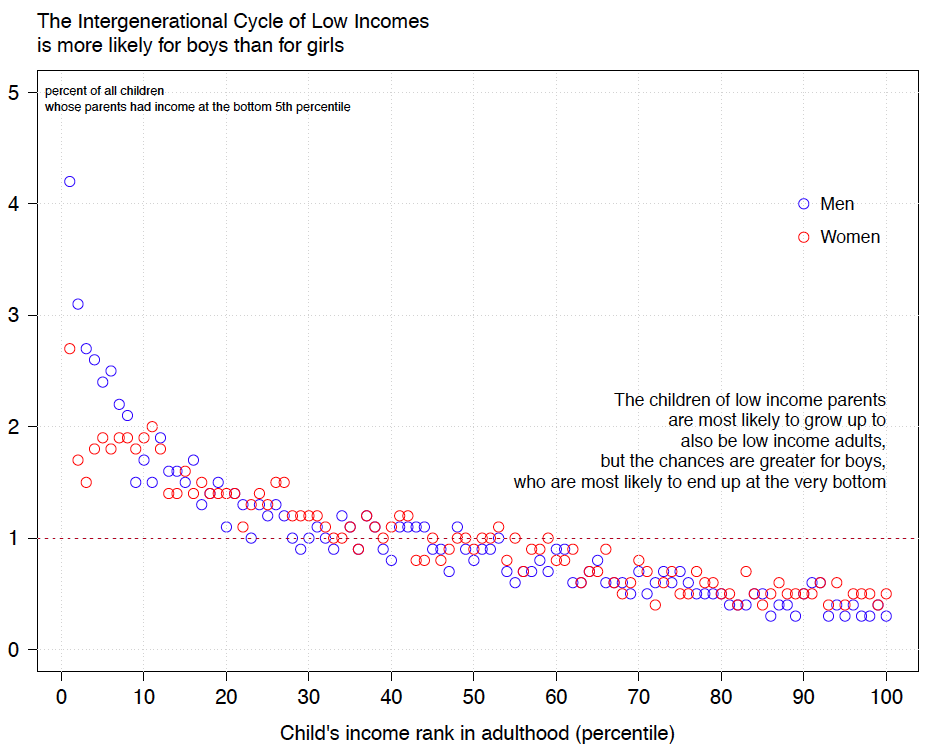
Children of low-income parents are more likely than not to grow up to be low-income adults. This is true for both boys and girls, but more so for boys.
the-intergenerational-cycle-of-low-income-for-boys-and-girls
(Click on the image to enlarge.)

This figure shows the rankings of children from low-income Canadian families, what fraction stand on each of the 100 rungs defined to equally divide the population across their adult income distribution. Their parents stood on exactly the bottom 5th rung of their income ladder, and the likelihood of them not advancing very much or even falling lower is clearly evident.

If adult incomes were completely independent of family income background, then we would expect 1 percent of these children to be on each of the 100 divisions of their income distribution. If this were the case children of low-ranking parents would be as likely to rise to middle incomes, or even to the very top, as they would be to stay on the same rung as their parents, or fall lower.

But in fact, this cohort of Canadians (those born in the 1960s) are much more likely to be the low-ranking adults of the next generation and are more likely to repeat the experiences of their parents.

This inter-generational cycle of low-income is more likely for boys. Although there is considerable upward rank mobility among these children, men raised by parents who were outranked by 95 percent of their counterparts are most likely to fall even lower, to be outranked by 99 percent of their cohort. Their chances of falling to the bottom 1 percent are more than 4 percent.

They are most likely to remain in the bottom 10 percent of the income distribution. Although an intergenerational cycle of low-income is also the most likely outcome for women, the chances are significantly lower, hovering in the neighbourhood of 2 percent for each of the rungs up to about the 10th.

[ This post is an edited excerpt from a forthcoming paper I have written called “‘Inequality is the root of social evil,’ or maybe not? Two stories about inequality and public policy”, which is published in the December 2016 issue of Canadian Public Policy. If you have any feedback please feel free to let me know in the comments section. ]

Should we worry about the top 1%, or praise them?

Every Statistics Canada data release on the share of the economic pie going to the top 1% elicits strong opinions, the most recent being no exception. Do top earners elicit rather dishonourable sentiments such as envy that should be given little weight? Or do they challenge our need for community and inclusion, influencing the way we live our lives in more fundamental ways? Should we praise the top 1% or worry about them?

It depends. We would be in a better position to answer this question if we put aside questions of merit and just deserts and focused more on the sources of social mobility and the capacity to conduct policy to support it in an era of higher inequality.

Earnings mobility for children from the very broad middle—parents whose income ranges from the bottom 10 percent all the way to the cusp of the top 10 percent—is not tied strongly to family income. These children tend to move up or down the income distribution without regard to their starting point in life. This may be one element of insecurity among the middle class: in spite of their best efforts, their children may be as likely to lose ground and fall in the income distribution as they are to rise.

the-intergenerational-transmission-of-priviledge
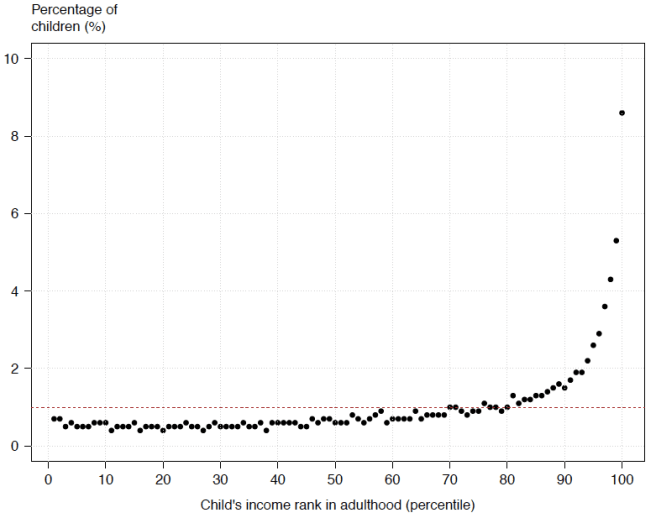
Children raised by parents in the top 1% are most likely to grow up to be the next generation of top earners

The situation is very different for children raised by top-earning parents, as the above figure illustrates. It shows the intergenerational cycle of privilege, the percentile rank in adulthood of children raised by top-1-percent parents. This playing field is clearly not level. If it were, all the points in the figure would be the same, all lining up along the dashed horizontal line drawn for reference at 1 percent.

Continue reading “Should we worry about the top 1%, or praise them?”

How much social mobility for America? More, but it won’t happen without inclusive growth

shania-twain
Shania Twain, the legendary country-pop music star, personifies the “rags to riches” mobility at the core of the American Dream, and what’s so amazing she’s not even American. (Click image to read her bio.)

A common way to think about social mobility is in terms of “rags to riches” movement, a type of mobility that is central to the great defining metaphor of the United States, “The American Dream.” Indeed, policy makers often frame their discussion of social mobility in these terms, as for example in a May 2016 speech by the Chairman of the Council of Economic Advisers.

Upward movement is a natural way to think about social mobility, and Americans should have more of it. But this won’t happen without lowering the chances of intergenerational cycles of poverty, and promoting inclusive economic growth.

Continue reading “How much social mobility for America? More, but it won’t happen without inclusive growth”

Here’s a policy-relevant way to set the poverty line

Angus Deaton, the Princeton University economist, wrote in the opening paragraph of his acceptance speech for the 2015 Nobel Prize in economics that:

Measurement, even without understanding of mechanisms, can be of great importance in and of itself—policy change is frequently based on it—and is necessary if not sufficient for any reasoned assessment of policies, including the many that are advocated for the reduction of national or global poverty. We are wise to remember the importance of good data, and not to neglect the challenges that measurement continuously poses (Deaton 2016, page 1221).

This nicely sums up the tone of a previous post, that a conversation about Canadian public policy directed to poverty has not been well served by the confusing and conflicting information provided by official statistics.

Just how should we measure poverty in a way that is most helpful for public policy?

This is a particularly important issue given the mandate the Prime Minister has given his Minister of Families, Children and Social Development, directing him to “Lead the development of a Canadian Poverty Reduction Strategy that would set targets to reduce poverty and measure and publicly report on our progress.

Continue reading “Here’s a policy-relevant way to set the poverty line”

Understanding what poverty means and how it is measured are the first steps toward a poverty reduction strategy

Poverty rates in Canada LICO and LIM
Two most commonly used Statistics Canada poverty rates show radically different patterns.

The two most commonly used poverty rates produced by Statistics Canada tell very different stories. The patterns are curious, and confusing. The two statistics—the poverty rate according to the Low Income Cut-off and that according to the Low Income Measure—track each other rather closely up to the early 1990s, then diverge quite markedly as the Low Income Cut-off falls steadily to an unprecedented low, while the Low Income Measure drifts upward. Which statistic should we believe?

The cyclical patterns also differ, with the Low Income Measure registering higher poverty during recessions only before the 1990s, and in a way that is more muted and lagging the movement in the Low Income Cut-off. It also signals a rise in poverty only well after the onset of the 1990/92 recession, and both measures show no upturn in poverty during the Great Recession, which began in 2008 and led to a significant fall in employment.

For something that is central to so many policy debates, the Canadian “poverty” rate is notoriously confusing, and it is easy to imagine that public policy may be misled. The first step in devising a poverty reduction strategy is understanding what these numbers mean, and whether they are useful. Is poverty at unprecedented lows, or has it been stuck at high levels for decades? Both views can’t be right, but they can both be wrong.

Continue reading “Understanding what poverty means and how it is measured are the first steps toward a poverty reduction strategy”

Three enhancements to Employment Insurance to reduce income inequality, promote income security, and support families

Social policy in Canada faces three challenges having to do with income inequality, income insecurity, and the imbalance between work and family life. My presentation at the Queen’s University conference, “Social Canada Revisited,” begins by outlining three facts that illustrate these challenges:

  1. The share of total market income going to bottom-income Canadians has fallen
  2. Workers with steady employment suffer significant and long-lasting income losses after a layoff
  3. Families have changed to help cushion and support middle incomes, but the family-work balance is titled

I suggest that there are precedents in the existing Employment Insurance program that can be enhanced and built upon to more fully offer Canadians the social insurance they need and want, and put forward three enhancements that will move social policy in this direction.

  1. Enhance Working While on Claim and integrate it seamlessly with the Working Income Tax Benefit to offer steady and increased income support to lower-income Canadians in a way that mimics some versions of a Basic Income
  2. Introduce wage insurance that would top up weekly earnings for workers with a steady employment history who have suffered a permanent layoff
  3. Expand so-called “Special Benefits” by creating individual accounts over which individuals have complete sovereignty

Download a copy of my presentation for the details.